Dr Water LabWhatsAppBook a test

Home / Water Treatment 101

What each method takes out, and what it leaves in.

No single filter does everything. These explainers describe each system and filter type in plain language, with no brands and no sales pitch.

The order of stages in a typical home system
  1. At the inletSedimentRemoves: sand, rust, silt
  2. At the inletActivated carbonRemoves: free chlorine, taste and odour
  3. At the inletSoftenerIf neededRemoves: hardness minerals
  4. At the kitchen tapReverse osmosisRemoves: dissolved salts, hardness minerals, many metals
  5. At the kitchen tapRemineralisationAdds: calcium and magnesium, for taste

Systems

Where the equipment sits decides which taps it treats.

Whole-house

Fitted at the water inlet, so every tap, shower and appliance gets treated water.

Treats: sediment for the whole home, free chlorine where a building doses it, and hardness when a softener is included.

Does not treat: dissolved salts. It is untested for the chlorine dioxide DEWA reports, and it does not make purifier-grade drinking water.

Whole-house filtration for villas →

Under-sink

A purifier in the kitchen cabinet feeding its own drinking-water tap.

Treats: drinking and cooking water at one tap, usually with RO or UF.

Does not treat: showers, bathrooms or appliances elsewhere in the home.

Under-sink drinking water systems →

Countertop

A unit that stands beside the sink and needs little or no plumbing work.

Treats: drinking water in small volumes, typically with carbon or a compact RO stage.

Does not treat: more than one tap, and it holds less than an under-sink system.

Drinking water filters →

Shower filter

A cartridge fitted between the pipe and the shower head.

Treats: sediment at that one shower, and free chlorine where a building doses it.

Does not treat: hardness or scale. It is untested for the chlorine dioxide DEWA reports for supplied water.

Shower filters in Dubai →

Filter types

Most systems combine several of these stages in a row.

Sediment

A fine mesh or wound cartridge that strains particles out of the water.

Removes: sand, rust, silt and other visible particles.

Does not remove: anything dissolved: disinfectant, hardness or salts.

Sediment filters explained →

Activated carbon

Porous carbon that holds on to certain chemicals as water passes through.

Removes: free chlorine, which it is certified for, and many of the compounds behind taste and odour.

Does not remove: hardness or dissolved salts. We found no household-scale test for the chlorine dioxide DEWA reports.

Activated carbon filters explained →

Ultrafiltration (UF)

A hollow-fibre membrane with pores small enough to hold back very fine matter.

Removes: fine particles, cloudiness and bacteria-sized organisms.

Does not remove: dissolved minerals or salts, so hardness and TDS are unchanged.

How filter stages work together →

Reverse osmosis (RO)

Pressure pushes water through a very tight membrane; the rest goes to drain.

Removes: most dissolved salts, hardness minerals and many metals. TDS drops sharply.

Does not remove: free chlorine on its own (a carbon pre-filter does that). No certified claim covers chlorine dioxide. Some water goes to drain.

What is reverse osmosis? →

Ultraviolet (UV)

A lamp that exposes flowing water to UV light. Nothing is added or filtered.

Removes: nothing physically. It inactivates bacteria and viruses that pass the lamp.

Does not remove: particles, chemicals, hardness or taste. It needs clear water to work properly.

UV water filters explained →

Ion-exchange softener

Resin beads swap calcium and magnesium for sodium, then recharge with salt.

Removes: the hardness minerals that form scale.

Does not remove: disinfectant, particles or TDS. It adds a little sodium and needs salt top-ups.

Water softeners in Dubai →

Salt-free conditioner

Changes how hardness minerals behave so less of them stick as scale.

Removes: nothing from the water. It aims to reduce scale build-up, and results vary with conditions.

Does not remove: hardness itself. A hardness test reads the same before and after.

Is Dubai water hard? →

Remineralisation

A final cartridge after RO that puts a small amount of minerals back.

Removes: nothing. It adds calcium and magnesium, mainly for taste.

Does not remove: anything. It is a finishing stage, not a filter.

Adding minerals back to RO water →

Comparisons

The pairs people most often ask us to compare.

RO vs UV

They do different jobs and are often used together rather than chosen between.

The first: RO removes dissolved substances and lowers TDS.

The second: UV disinfects and removes nothing, so taste and TDS do not change.

UV water filters explained →

RO vs UF

Both are membranes. The difference is how tight the membrane is.

The first: RO lowers dissolved salts and minerals, needs pressure and a drain line.

The second: UF keeps minerals in, sends no water to drain and leaves TDS unchanged.

Purified, distilled, mineral and RO water →

Softener vs filter

A softener is not a filter, and a filter is not a softener. A softener is fitted only when the test calls for it.

The first: a softener deals with hardness and scale only.

The second: a filter deals with particles, and free chlorine if it is carbon. It leaves hardness alone.

Do shower filters remove hard water? →

More explainers

The full guide

Water purification systems: types and methods for the home

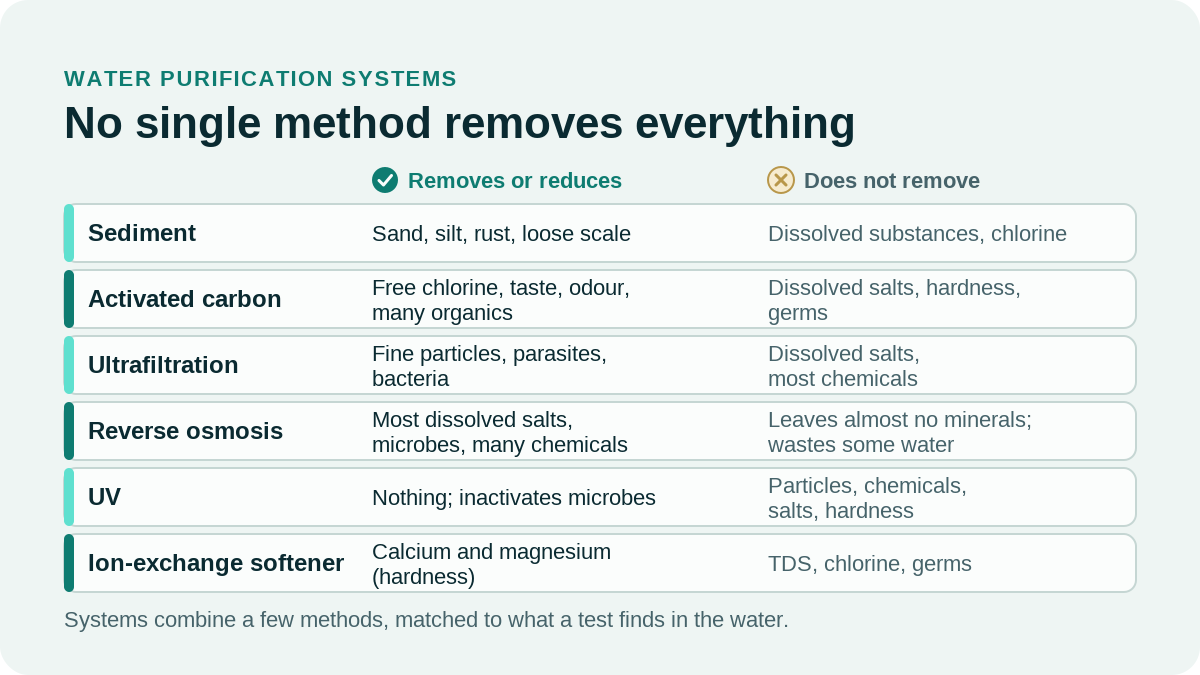
Table of six home water treatment methods (sediment, activated carbon, ultrafiltration, reverse osmosis, UV and ion-exchange softener) listing what each removes or reduces and what it does not remove.
What each of six common treatment methods removes or reduces, and what it does not remove.

Home water purification systems differ in two ways: where they sit (the whole-house inlet, under the sink, on the counter or at the shower) and which methods they use (sediment, carbon, membranes, UV, softening). No single method removes everything. The right system combines a few methods matched to what a test finds in your water.

Where water purification systems are fitted

Whole-house (point of entry). Fitted where the mains enters a villa. Treats every tap, shower and appliance. Usually sediment and carbon, plus a softener if hardness justifies it. Removes particles and free chlorine. Does not produce low-TDS drinking water. Details: whole-house water filtration for villas.

Under-sink (point of use). Fitted in the kitchen cabinet with its own tap. Treats drinking and cooking water only, so it can use fine stages such as reverse osmosis. Does nothing for showers or appliances. Details: under-sink drinking water systems.

Countertop. A jug, gravity unit or plug-in purifier that needs no plumbing. Capacity and flow are limited, and jug filters are mainly carbon, which the CDC notes are designed to improve taste and smell, not to remove germs.

Shower filter. Screws in at one shower. Certified for free chlorine at that outlet; untested for chlorine dioxide, the disinfectant DEWA reports. Does not soften water or remove limescale. Details: shower filters in Dubai.

Apartments normally use point-of-use options only, because shared plumbing cannot be altered. See water filters for apartments and renters.

Types of water filters and what each one does

Sediment filter. A physical barrier for sand, silt and rust. Removes particles. Does not remove anything dissolved. Sediment filters explained.

Activated carbon. Adsorbs free chlorine, many organic chemicals, taste and odour. Does not remove dissolved salts, hardness or germs. Activated carbon filters explained.

Ultrafiltration (UF). A membrane with pores of about 0.01 micron. The CDC lists it as removing parasites and bacteria and as somewhat effective against viruses. Does not remove dissolved salts or chemicals, so TDS is unchanged.

Reverse osmosis (RO). A much tighter membrane, about 0.0001 micron. Removes most dissolved salts along with microbes and many chemicals. Does not keep the natural minerals, and it sends part of the water to drain. What is reverse osmosis?

Ultraviolet (UV). A lamp that inactivates bacteria, viruses and parasites. Removes nothing: no particles, chemicals, salts or hardness. UV water filters explained.

Ion-exchange softener. Resin that swaps calcium and magnesium for sodium. Removes hardness, so scale stops forming. Does not lower TDS, remove chlorine or disinfect. Water softeners in Dubai.

Salt-free conditioner. Changes how hardness minerals behave so they are less likely to stick as scale. Does not remove them. A University of Nebraska–Lincoln review notes these devices leave most hardness minerals in the water and that results vary between homes.

Remineralisation cartridge. Adds a small amount of calcium and magnesium back to RO water, mainly for taste. Removes nothing. How to add minerals back to RO water.

Summary table

MethodRemoves or reducesDoes not removeUsual position
SedimentSand, silt, rust, loose scaleDissolved substances, chlorineFirst stage
Activated carbonFree chlorine, taste, odour, many organicsDissolved salts, hardness, germsAfter sediment
UltrafiltrationFine particles, parasites, bacteriaDissolved salts, most chemicalsUnder-sink, after carbon
Reverse osmosisMost dissolved salts, microbes, many chemicalsLeaves almost no minerals; wastes some waterUnder-sink, after carbon
UVNothing; inactivates microbesParticles, chemicals, salts, hardnessLast stage
Ion-exchange softenerCalcium and magnesium (hardness)TDS, chlorine, germsWhole-house, after carbon
Salt-free conditionerNothing; reduces scale adhesionHardness mineralsWhole-house
RemineralisationNothing; adds mineralsAny contaminantAfter RO

Removal claims for any real product depend on its certification. The main standards are NSF/ANSI 42 (taste and odour), 53 (health-related contaminants), 58 (reverse osmosis), 55 (ultraviolet systems) and 44 (cation exchange softeners). A certificate covers only the substances listed on it.

Three comparisons people ask about

RO vs UV

RO removes dissolved salts, microbes and many chemicals. UV only inactivates microbes and leaves everything else in the water. If your concern is taste or TDS, UV will not help. If your water is already low in TDS and the only concern is microbes, UV after good pre-filtration is the lighter option.

RO vs UF

Both are membranes. UF holds back particles and bacteria but lets dissolved salts through, so minerals and TDS stay the same and no water is wasted. RO rejects the dissolved salts too, which changes the taste and lowers TDS, at the cost of a drain line and reject water. Choose by TDS: what TDS means.

Softener vs filter

A softener removes hardness and nothing else. A filter (sediment and carbon) removes particles and free chlorine and leaves hardness alone. Limescale needs a softener. Free chlorine smell needs carbon. See is Dubai water hard?

How the methods fit together

Stages run from coarse to fine so each protects the next. How a water filter system works covers the order, and 3-stage, 5-stage and 7-stage filters covers how many stages are worth having.

Which combination suits you depends on measured hardness, TDS and disinfectant residual. DEWA's typical figures for the water it supplies to the network (2023 averages; no units printed, conventionally mg/L) are TDS 216, total hardness 61.3 and chlorine dioxide 0.44; it lists no free chlorine figure, and no filter is certified for chlorine dioxide. That hardness is at the soft / moderately hard boundary on the US Geological Survey scale, so supplied water is not hard by that scale.

Next step

Dr Water Lab offers a free water test at your home: hardness, TDS, disinfectant residual and pH, with written results. Book a water test and choose a system on evidence.
Frequently asked questions

What are the different types of water filters?

The main types are sediment filters, activated carbon filters, ultrafiltration and reverse osmosis membranes, UV lamps and ion-exchange softeners.

Which water purification system is best for home use?

It depends on your water and your goal. For better-tasting drinking water with lower TDS, an under-sink reverse osmosis purifier is the usual choice. For sediment and scale across a villa, whole-house filtration with a softener is. A water test settles it.

Is a water filter the same as a water purifier?

The terms overlap. "Filter" usually means sediment and carbon stages that improve clarity and taste. "Purifier" usually means a system with a membrane or UV stage that also deals with microbes or dissolved salts.

Does any system remove everything?

No. The CDC notes that filters that remove germs often do not remove chemicals, and the reverse. Systems combine methods for that reason.

Sources

Which of these fits your home depends on your water.

Answer five questions for a starting point, or book the free test and get a recommendation based on readings.

WhatsAppBook a free test