What the published figure says
DEWA's Sustainability Report 2024 includes a quality table for supplied water. The values are averages of station averages for 2023.
| Parameter | DEWA specification | DEWA typical figure (2023 average) |
|---|---|---|
| Total hardness | 40 – 120 | 61.3 |
| Calcium hardness | 25 – 65 | 41 |
| Calcium | 10 – 26 | 16.4 |
| Magnesium | 2 – 20 | 4.9 |
| Bicarbonate | 30 – 80 | 61.0 |
| TDS | 100 – 450 | 216 |
| pH | 7.90 – 8.50 | 8.34 |
| Saturation index | Positive | Positive |
Two cautions come with the table. It prints no units. Hardness is conventionally reported in mg/L as calcium carbonate, and we read it that way, but the document does not state it. And the figures describe water at the network, up to your meter. They are not measurements of your tap.
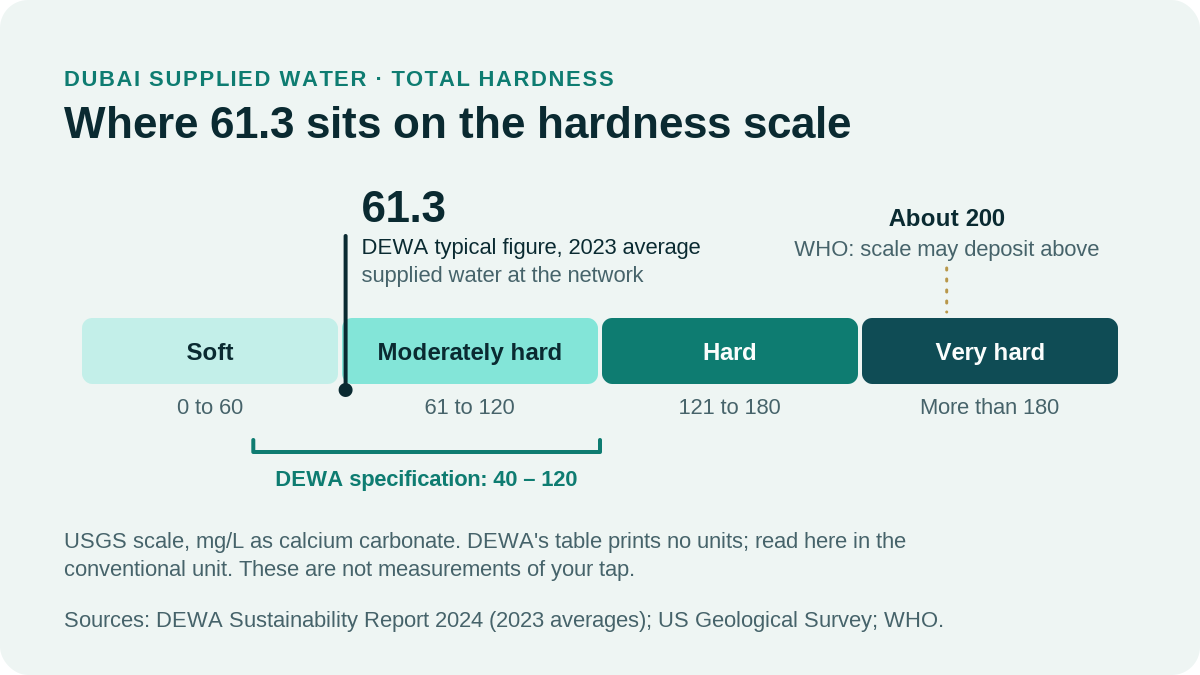
Where 61.3 sits on the hardness scale
We found no official UAE or Dubai hardness classification. The scale most people use is the US Geological Survey's, in mg/L as calcium carbonate:
| Classification | USGS scale (mg/L as calcium carbonate) |
|---|---|
| Soft | 0 to 60 |
| Moderately hard | 61 to 120 |
| Hard | 121 to 180 |
| Very hard | More than 180 |
A WHO background document cites the same scale with the boundaries written as 60, 120 and 180.
If DEWA's figure is in the conventional unit, 61.3 is at the very bottom of "moderately hard", one step from "soft". DEWA's own specification allows 40 to 120, so supplied water could sit anywhere from soft to the top of moderately hard and still be within specification. Nothing in that range is "hard" on this scale.
For comparison, WHO's drinking-water guidelines say that "a hardness above approximately 200 mg/l may cause scale deposition" in pipework and tanks within buildings. DEWA's typical figure is less than a third of that. WHO proposes no health-based guideline value for hardness. DEWA's table prints 500 in a column headed "WHO Guideline Value (Max)"; in WHO's own text that number is a remark about what consumers tolerate, not a limit.
So does Dubai have hard water? Not according to the utility's published average. Dubai water, hard or soft, is best described from the data as soft to moderately hard at the network.
Why people still report scale and "hard water" symptoms
White marks on shower glass, a crusted kettle, hair that feels different after a move: these reports are real and common. The published data does not explain them by itself, and we will not pretend it does. These are the plausible contributors. None of them is proven for your home until someone measures.
Evaporation concentrates whatever is dissolved. When a drop dries on glass or a tap, the water leaves and the dissolved solids stay. At a published TDS of 216, there is something to leave behind even in water that is not hard. Many white spots are dried mineral residue in general, not a sign of high hardness.
Heating drives minerals out of solution. Kettles and water heaters deposit scale faster than cold surfaces. DEWA lists the saturation index of its supplied water as "Positive". In water chemistry a positive index conventionally means water leans towards depositing calcium carbonate, not dissolving it. That is a deliberate property of treated water, and it is consistent with some scale forming where water is heated or left to dry.
Building tanks and pipework. Water at your tap has been stored in your building's tank and has run through its pipes, which are the owner's responsibility. Dubai Municipality's guideline requires tanks to be emptied, cleaned and disinfected at least twice a year. We have no published data on how tank condition changes hardness, so we do not claim that it does. It is simply the part of the route nobody has measured for you.
Variation between homes. The published figure is an average of station averages across a year, and the specification is a range. Your building may sit at a different point in that range.
Supplies that are not the network. DEWA reports that groundwater in its emergency wells averages 1,500 mg/L TDS, a very different water from the desalinated supply. Wells made up a fraction of one percent of DEWA's water in 2025. Dubai Municipality's guideline also covers water delivered by tanker. If your property is not on the DEWA network, the published figures do not describe your water.
Things that are not water. Climate, air conditioning, sun, pool chlorine and new products all change how hair and skin feel. The studies that link hard water with hair or skin effects concern water of about 200 mg/L and above. We found no study of Dubai water and hair or skin. For that discussion see signs of hard water on hair and skin. Water treatment is not medical treatment; persistent hair loss or a skin condition is a question for a doctor.
Do you need a hard water filter in Dubai?
First, a point about names. Most products sold as a "hard water filter" do not remove hardness.
| Method | What it does about hardness | What it does not do |
|---|---|---|
| Ion-exchange water softener | Removes calcium and magnesium by swapping them for sodium | Does not lower TDS; WHO notes it increases the sodium content of the water |
| Shower filter | Nothing. It is certified for free chlorine at one shower | Does not soften water |
| Activated carbon or sediment filter | Nothing | Does not remove dissolved minerals |
| Reverse osmosis (kitchen tap only) | Removes most dissolved minerals, including hardness | Not a whole-house solution |
That is how to make hard water soft: an ion-exchange softener for the whole house, and nothing else does the same job. Boiling removes only part of the hardness, as scale in the kettle.
Whether you need one depends on a number. We fit a softener at the villa inlet only when the test shows hardness worth treating. If your tap reads close to DEWA's published figure, a softener will change little, and your money is better spent elsewhere, or not spent. If scale is your main complaint, start with how to remove limescale. If you are considering a shower filter for this reason, read do shower filters remove hard water first. Details of the softener option are on water softeners in Dubai.
Only a test at the tap settles it
The utility's figure tells you what leaves the network. A hardness test at your kitchen and bathroom taps tells you what arrives. If the two match, hardness is not your problem and you can look at other causes. If your reading is well above the published range, that is worth knowing and worth tracing.
Next step
Get the number for your own home. Book a free water test. We measure hardness, TDS, disinfectant residual and pH at your taps, check the tank and inlet, and give you the results in writing with no obligation. Appointments are taken at least 10 days ahead.
Find out what is in your water
The free test measures hardness, TDS, disinfectant residual and pH at your own taps. We supply, install and maintain water treatment systems in every area of Dubai; message us for prices and service details.