Why the tank matters
DEWA's quality figures describe water up to your meter. After the meter, the water sits in your building's tank and runs through its pipes before it reaches a tap. A Dubai government laboratory, Trakhees, states the consequence in a 2022 factsheet: "The quality of the water coming out of the tap depends on how well the water storage tanks are maintained." The same factsheet notes: "Water stored for a long time can also encourage growth of mold and bacteria."
This is why the question can you drink tap water in Dubai has two parts: the supply, and your building.
Who is responsible
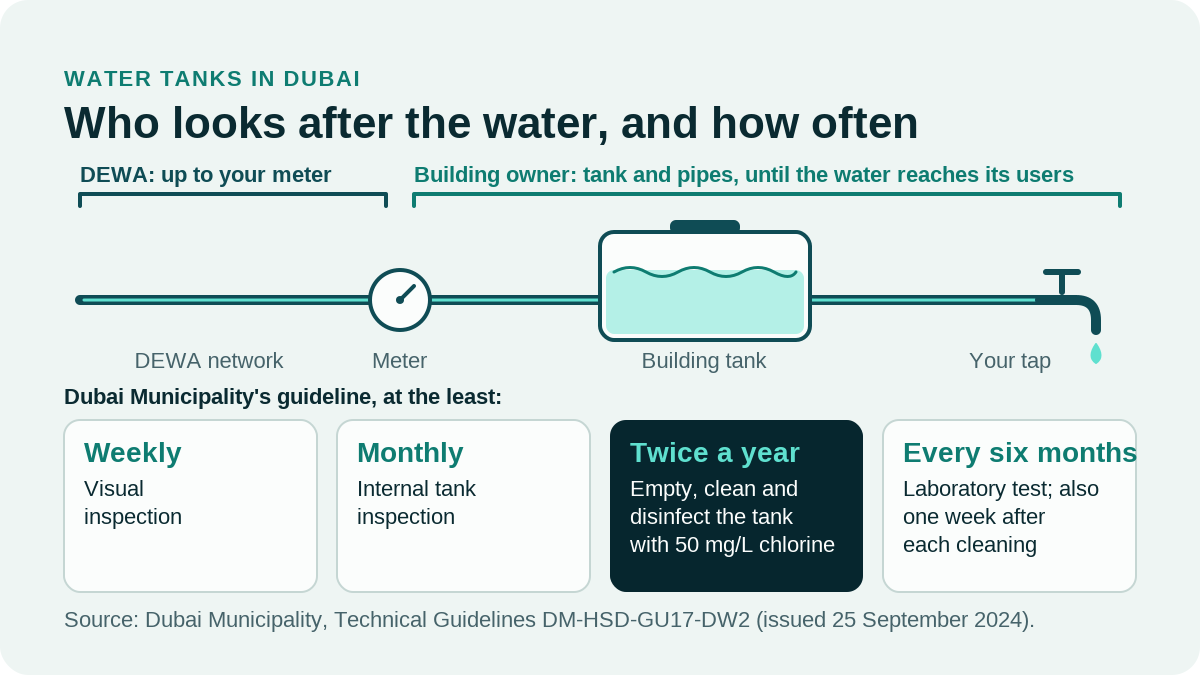
Dubai Municipality's Technical Guidelines for Quality of Unbottled Drinking Water (DM-HSD-GU17-DW2, issued 25 September 2024) place the duty on the building owner or the owner's representative: "Commitment to applying the requirements and standards mentioned in this guide to ensure the quality and safety of water in the building until it reaches its users." The guideline defines the owner as the building owner, manager, representative or legally authorised management.
In practice:
- Villa you own: you.
- Rented villa or apartment: the landlord or the building's management. A Gulf News report from 2022 puts it as "landlords are accountable for the cleanliness of water storage tanks". That is a news report, not an official text. Your tenancy contract may say more.
- Apartment tower: the owners' association or facilities manager.
What Dubai Municipality's guideline requires
| Requirement | What the guideline says |
|---|---|
| Cleaning and disinfection | "All water tanks should be emptied, cleaned, and disinfected with 50 mg/L of chlorine at least twice a year." |
| System disinfection | Hot and cold water systems disinfected to a free residual chlorine of 1–2 mg/L for 1 hour "at least twice a year and if bacteria are detected" |
| Inspection | Tank covers intact and fixed; tanks "internally inspected at least monthly"; visual inspections at least weekly |
| Laboratory testing | Drinking water sampled once every six months for tests against UAE.S GSO 149:2021, by a laboratory accredited by the Emirates International Accreditation Centre, and one week after each regular cleaning |
| Tank size | Storage "sufficient to supply water for at least 24 hours". The guideline lists "Installing oversized storage tanks that cause stagnation and stratification" among the factors for microbial growth |
Dubai Municipality gave the same message to households when it launched its Safe Water for a Healthy Community initiative on 5 March 2025: "residents are advised to disinfect and clean water tanks and plumbing systems at least every six months using companies approved by Dubai Municipality". "At least twice a year" and "at least every six months" are the same frequency in different words.
If your property is in a free zone under Trakhees (PCFC), its factsheet says landlords, building or facility management and owners "must clean and disinfect their water storage tanks every 6 months", using a certified tank cleaning company, and test the water afterwards.
Approved companies and fines
The guideline says: "The water tank cleaning company must be approved by Dubai Municipality – Food Safety Department, Registration and Permit Section". A 2022 Gulf News report points instead to an approved list under Health and Safety on the municipality's website. We could not open a current approved list, so we do not link to one or name a department with confidence. Ask the company for its Dubai Municipality approval and confirm it with the municipality.
The guideline lists these fines:
| Violation | Fine |
|---|---|
| Violating health conditions for cleaning drinking water tanks | AED 1,000 |
| Violations by tank-cleaning companies | AED 1,000 |
| Operating without an approved permit | AED 20,000 |
Water tank cleaning procedure, step by step
Dubai Municipality's guideline sets the result: every tank "emptied, cleaned, and disinfected with 50 mg/L of chlorine". It says cleaning companies "must adhere to the cleaning and disinfection methods and requirements approved by Dubai Municipality". It does not print a step-by-step method.
The sequence below combines what the guideline does state with the general steps in a World Health Organization technical note on cleaning and disinfecting water storage tanks. That note was written for emergency water supplies, so read it as the logic of the job, not as the approved Dubai method. This is work for an approved company. It is not a do-it-yourself job.
- Notice and shut-off. Residents are told when the water will be off, and the supply to the tank is closed. A notice template is further down this page.
- Emptying. The tank is drained completely. WHO's note says to use the washout valve at the base where one is fitted, not the normal outlet.
- Cleaning. The internal surfaces are scrubbed with a stiff brush or a high-pressure jet, with special care at corners and joints. The tank is then flushed until no trace of detergent is left.
- Disinfection. The guideline's figure is 50 mg/L of chlorine. It gives no contact time for the tank. WHO's note leaves a chlorinated tank to stand for 24 hours, or 8 hours at double the dose. Ask the company what contact time it uses and on what basis.
- Draining and rinsing. WHO's note says to empty the tank completely and dispose of the disinfecting water with care, because it contains a high concentration of chlorine. The tank is then refilled with drinking water, left for about 30 minutes and emptied again.
- Pipework. The guideline separately requires the hot and cold water system to be disinfected to a free residual chlorine of 1–2 mg/L for 1 hour, with each outlet allowed to flow for at least 5 minutes, at least twice a year.
- Report and sample. The company must prepare and keep cleaning and disinfection reports that include the chemicals used and the methods. A water sample goes to an accredited laboratory one week after the cleaning.
On safety, the guideline requires companies to ensure the safety of their workers, "including training certificates for working in confined spaces". WHO's note describes working inside a tank as difficult and dangerous, and says someone must stay outside by the access hatch the whole time. That is the main reason this is not a job for a resident or a building caretaker.
Underground tanks
The guideline's rule covers "All water tanks", so a tank below ground is cleaned and disinfected at least twice a year like any other. We found no separate procedure for underground tanks in the guideline. What follows is practical reasoning from its general requirements, not an official method.
- You cannot see it from outside. A roof tank shows a cracked lid or a leak. An underground tank shows nothing, so the weekly visual check and the monthly internal inspection the guideline asks for are the only way to know its condition.
- The cover sits at ground level. The guideline requires tank covers to be "intact and fixed in place". For a cover that sits in a driveway or garden, that requirement does more work than it does on a roof.
- Emptying usually means pumping. There is nowhere lower for the water to drain to.
- Entry is confined-space work. This is where the guideline's requirement for confined-space training applies most directly. WHO's note adds that fresh air should be blown into a tank before anyone enters.
Ask the same questions as for any tank, and add one: how the company's workers enter and leave the tank safely.
Water tank cleaning notice to residents (template)
Building managers and owners' associations can copy the text below. For routine cleaning it is good practice. For disinfection after a contamination incident, the guideline goes further: residents must be notified of the procedures applied in the building, and users must be alerted to the presence of disinfectants that may cause eye or skin irritation or unpleasant odours.
Notice: water tank cleaning and disinfection
Building: ____________ Date of notice: ____________
Dear residents,
The water storage tanks of this building will be emptied, cleaned and disinfected on ____________ (date), from ________ to ________ (time). The work will be carried out by ____________ (company name), a company approved by Dubai Municipality.
The water supply will be off during this time. Please:
- store enough water beforehand for drinking, cooking and flushing toilets
- keep all taps closed, and do not run washing machines or dishwashers
- tell the management office in advance if anyone in your home has a medical need for running water
When the supply returns, run each tap and shower until the water is clear before you use it. The water may smell of chlorine for a short time.
A water sample will be sent to an accredited laboratory after the cleaning. The cleaning report and the laboratory result will be available from ____________ (office or contact).
Questions: ____________ (name, phone, email)
Building management
Fill in the blanks from what your cleaning company will actually do. The timings, and any instruction about when the water can be used again, should come from the company.
What to ask a tank cleaning company
We do not clean tanks and we do not recommend or rank companies. These questions follow directly from the guideline:
- Are you approved by Dubai Municipality for tank cleaning? Can I see the approval?
- Will the tank be emptied, cleaned and disinfected, and at what chlorine concentration?
- Will the pipework be disinfected as well as the tank?
- Will I get a dated certificate or report I can keep?
- Who takes the water sample a week after cleaning, and which accredited laboratory tests it?
We do not publish tank cleaning prices, because it is not our service and we have no sourced figures.
Water filter with tank: where filtration fits
People search for a "water tank filter" or a "water tank filtration system" hoping a filter will make tank cleaning unnecessary. It will not. Here is what each part does.
| Step | What it does | What it does not do |
|---|---|---|
| Tank cleaning and disinfection | Removes sediment and growth from the tank itself | Does not change the taste, hardness or TDS of incoming water |
| Sediment filter | Catches particles such as sand and rust | Does not disinfect; does not remove dissolved minerals |
| Activated carbon filter | Certified for free chlorine taste and smell | Does not remove dissolved salts; does not disinfect |
| Under-sink reverse osmosis purifier | Lowers dissolved solids for drinking water at one tap | Does not treat the rest of the house |
| UV lamp | Disinfects water passing through it | Removes nothing from the water |
A filter treats the water that passes through it. It does not clean what sits upstream. If a tank is neglected, a filter downstream has more work to do and its cartridges clog sooner.
There is a second point that sellers rarely mention. Utilities leave a small disinfectant residual in the water to protect it on its way to you. Where that residual is free chlorine, a carbon filter removes it, and after it nothing protects the water from regrowth. Dubai Municipality requires that residual disinfectant remain sufficient to prevent re-contamination, so where a filter sits relative to the tank is decided at the survey. Dubai Municipality's guideline warns that old carbon filters past their use-by date "can support the growth of microbes", and requires "Regular maintenance and cleaning as recommended by the filter manufacturer". Cartridges changed on time are part of the system, not an extra.
For villas, our whole-house water filtration combines sediment and activated carbon stages at the water inlet. In apartments we work only at the point of use, with nothing on shared plumbing; see water filters for apartments and renters.
Signs worth checking
None of these proves a tank problem, but each is a reason to ask when the tank was last cleaned:
- sediment or particles in a glass of water
- a musty or stale smell from the cold tap
- water that has changed colour
- a tank cover that is loose, cracked or missing
- no cleaning certificate, or one more than six months old
As part of our home water test we make a visual check of the tank and the water inlet and note what we see. It is a visual check, not an inspection certificate and not a laboratory test.
Next step
If you want to know what the tank and pipes are doing to your water, measure it at the tap. Book a free water test. We measure hardness, TDS, disinfectant residual and pH, make a visual check of the tank and inlet, and give you the results in writing with no obligation. Appointments are taken at least 10 days ahead.
Find out what is in your water
The free test measures hardness, TDS, disinfectant residual and pH at your own taps. We supply, install and maintain water treatment systems in every area of Dubai; message us for prices and service details.