How a sediment water filter works
A sediment filter works like a very fine sieve. Water is pushed through a material full of small openings. Particles larger than the openings are held back, and the water carries on.
In a home this is usually a replaceable cartridge inside a plastic housing. University of Nebraska–Lincoln Extension lists the common cartridge materials as polypropylene, polyester, cellulose, ceramic, glass fibre and wound or pleated fabrics. Two designs cover most cartridges:
- Depth cartridges (spun or string-wound). A thick wall of fibres traps particles throughout its depth. They hold a lot of dirt and are thrown away when full.
- Pleated cartridges. A thin sheet folded to give a large surface area. Particles collect on the surface. They give higher flow, and some can be rinsed and reused.
Whole-house systems with heavy sediment sometimes use a tank of granular media that is cleaned by backwashing, in place of a cartridge.
Micron ratings in plain terms
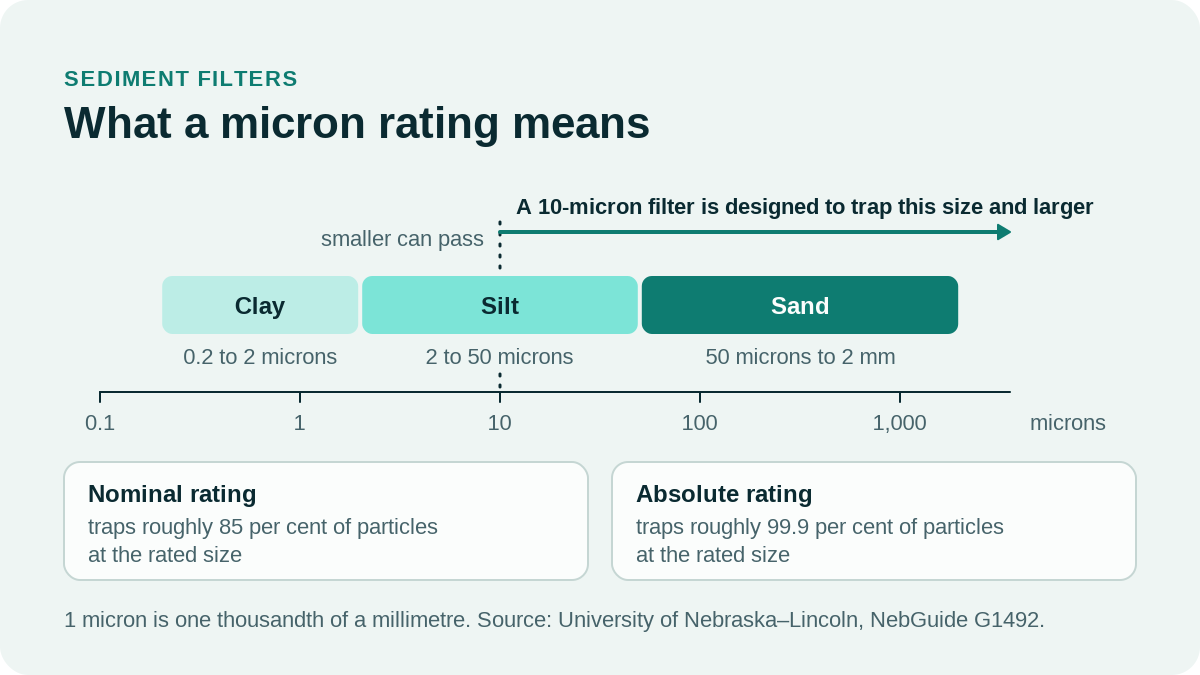
A micron is one thousandth of a millimetre. A cartridge's micron rating describes the smallest particle it is designed to trap: a 10-micron filter is meant to catch particles of 10 microns and larger.
The Nebraska guide gives useful reference sizes:
| Particle | Approximate size |
|---|---|
| Sand | 50 microns to 2 mm |
| Silt | 2 to 50 microns |
| Clay | 0.2 to 2 microns |
Two words on the label change what the rating means:
- Nominal means the filter should trap roughly 85 per cent of particles at the rated size.
- Absolute means roughly 99.9 per cent.
Most household sediment cartridges carry a nominal rating. That is fine for protecting plumbing and later filter stages. It is not a basis for claims about microbes. The CDC makes the distinction clearly: a filter with an absolute pore size of 1 micron will catch a 1-micron germ, while a filter with a nominal or mean pore size of 1 micron may not.
Finer is not automatically better. The Nebraska guide notes that if the pore size is too small for the amount of solids in the water, the filter clogs quickly, and that the largest rating which still removes the target particles generally needs the least maintenance. Where there is a lot of sediment, two cartridges in series, coarse then fine, last longer than one fine cartridge alone.
What a sediment filter removes
- Sand, grit and silt
- Rust flakes from old pipes, tanks and fittings
- Loose scale that has broken off inside pipes or heaters
- Other suspended matter that makes water cloudy
- Iron and manganese that are present as solid particles
What a sediment filter does not remove
- Anything dissolved. Salts, hardness minerals, nitrate and dissolved metals pass through. The TDS reading does not change. See what TDS means.
- Chlorine, taste and odour. That is the job of activated carbon.
- Hardness and limescale. A sediment filter catches flakes of scale that have already formed. It does not stop new scale forming, because the calcium is dissolved when it passes the filter.
- Microbes, reliably. The Nebraska guide states that cartridge sediment filters are generally not recommended for microbial contaminants.
- Very fine clay. Particles at the small end of the clay range can pass ordinary cartridges.
Where it sits in a home system
First, always.
- At the villa inlet, ahead of carbon and any softener. It keeps grit out of the carbon media, the softener resin and its control valve, and out of water heaters, washing machines and tap aerators. See whole-house water filtration for villas.
- Under the sink, as stage one of a drinking water purifier, ahead of the carbon cartridges and the membrane.
The Nebraska guide describes sediment filters as pretreatment that improves the performance of activated carbon and reverse osmosis units. The reason is practical: particles coat carbon and foul membranes, and both are more costly to replace than a sediment cartridge. The full sequence is set out in how a water filter system works.
Where the filter sits relative to a storage tank also matters. A filter before the tank keeps incoming grit out of it. A filter after the tank catches whatever the tank itself adds, such as settled sediment stirred up when the level drops. Homes with older tanks sometimes need both. See water tanks: cleaning and filtration.
Maintenance and lifespan
A sediment cartridge has a simple life. Flow is highest when it is new. As it fills, flow falls. When the drop is noticeable at the taps, the cartridge is due.
A few practical points:
- Clear housings help. You can see the cartridge darken.
- Pressure gauges help more. A gauge before and after the filter shows the pressure difference growing as the cartridge loads.
- Gallon or litre ratings are a rough guide only. The Nebraska guide points out that life depends on the type and amount of sediment, which varies from home to home.
- Do not leave a cartridge in for too long, even if flow seems fine. Regular replacement limits bacterial growth on the trapped material. The CDC gives the same advice for filters generally.
- After plumbing work or tank cleaning, expect a shorter cartridge life. Disturbed pipes and tanks release a burst of debris.
To be confirmed
When you need a sediment filter, and when you do not
You need one if:
- You are fitting any other treatment. Carbon, softeners, membranes and UV all depend on it.
- You see grit in tap aerators, shower heads or the washing machine inlet screen
- Water runs cloudy or rusty after a supply interruption or tank cleaning
- Your building has older pipework or a storage tank
A sediment filter alone will not meet your goal if:
- The complaint is chlorine smell, taste, limescale or dry skin and hair. None of these is caused by particles.
- You want safer or lower-TDS drinking water. That needs carbon and usually a membrane.
Common misconceptions
"A sediment filter makes water safe to drink." It makes water clearer. Clarity and safety are different things.
"The lowest micron rating is the best." Too fine a cartridge on gritty water blocks quickly and starves the house of flow.
"White flakes in the kettle mean I need a sediment filter." Those flakes formed inside the kettle from dissolved hardness. A filter upstream cannot prevent them. See is Dubai water hard?
"It lasts until the water stops." By then pressure has been poor for weeks and the trapped material has been sitting in your water line.
Next step
During a free water test, Dr Water Lab checks your inlet and tank for sediment as well as measuring hardness, TDS, disinfectant residual and pH. You get the results in writing. Book a water test.
Find out what is in your water
The free test measures hardness, TDS, disinfectant residual and pH at your own taps. We supply, install and maintain water treatment systems in every area of Dubai; message us for prices and service details.