TDS meaning and full form
The full form of TDS is total dissolved solids. "Dissolved" is the important word. Sand, rust flakes and other particles you can see are suspended solids, and a sediment filter deals with those. TDS covers what has dissolved completely: mainly calcium, magnesium, sodium and potassium, with bicarbonate, chloride and sulphate.
For household water, 1 mg/L and 1 ppm are treated as the same thing, so a reading of 216 ppm and a reading of 216 mg/L mean the same.
How TDS is measured
There are two ways.
- In a laboratory. A measured volume of filtered water is evaporated and the residue left behind is weighed. This is the direct method.
- With a TDS meter. A handheld meter measures electrical conductivity, because dissolved salts carry current, and converts that reading into an estimated TDS using a built-in factor. It is an estimate. Two waters with the same conductivity but different minerals can have slightly different true TDS.
A meter gives a single number in seconds, which is why it is popular. That speed is also its limit, as the next section explains.
What the number does and does not tell you
What a TDS reading tells you:
- roughly how mineralised the water is
- how it is likely to taste: very low readings taste flat, high readings taste salty or heavy
- whether a reverse osmosis purifier is still working, when you compare water before and after it
What a TDS reading does not tell you:
- whether bacteria are present
- whether lead, other metals or nitrate are present at levels that matter (these are measured in thousandths of a milligram or a few milligrams, far too small to move a TDS reading)
- how much disinfectant is in the water
- how hard the water is. Hardness is the calcium and magnesium part only. Water can be high in TDS because of sodium and still be soft.
So low TDS does not mean clean, and higher TDS does not mean dirty.
What is a good TDS level for drinking water?
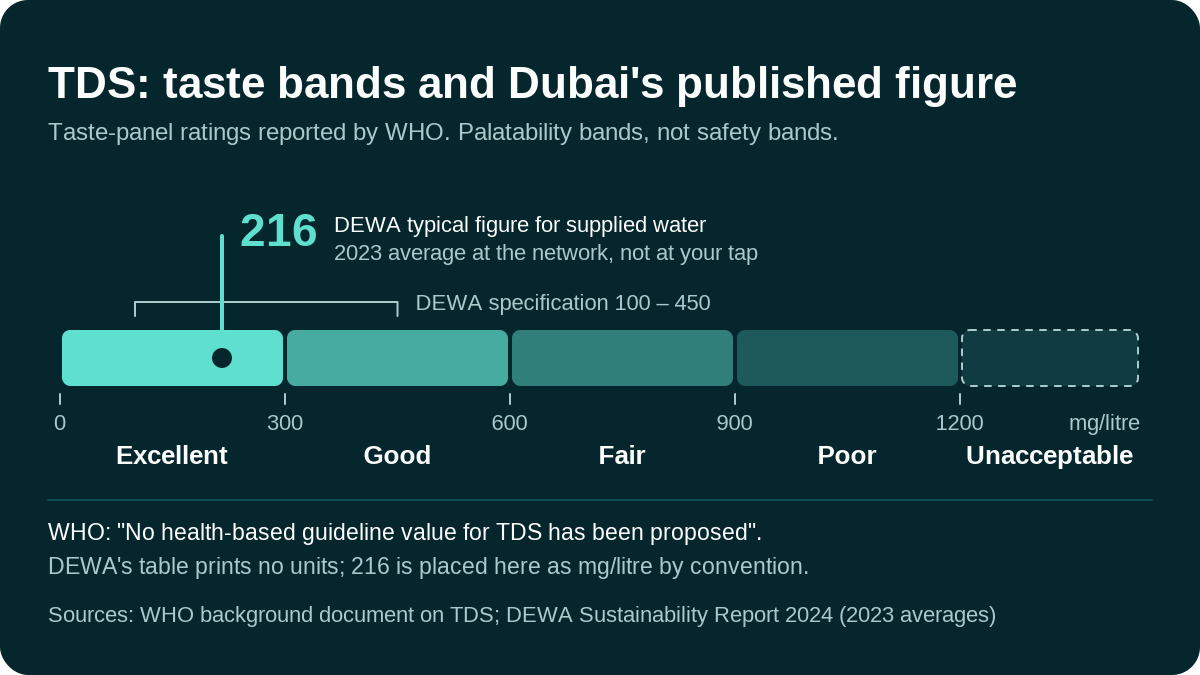
There is no official health limit to quote. The World Health Organization's drinking-water guidelines say: "No health-based guideline value for TDS has been proposed". What WHO offers is guidance on taste. Its guidelines say water under about 600 mg/L is "generally considered to be good" and that water becomes "increasingly unpalatable at TDS levels greater than about 1000 mg/l".
A WHO background document on TDS reports how taste panels rated water:
| TDS (mg/litre) | Taste-panel rating reported by WHO |
|---|---|
| Less than 300 | Excellent |
| 300 to 600 | Good |
| 600 to 900 | Fair |
| 900 to 1200 | Poor |
| Greater than 1200 | Unacceptable |
These are palatability bands, not safety bands. The same document adds that "Water with extremely low concentrations of TDS may also be unacceptable because of its flat, insipid taste", and notes that such water is often corrosive to water-supply systems.
Different authorities write different numbers into their own rules. They are separate documents, not a contradiction:
| Document | TDS figure |
|---|---|
| DEWA's own specification for supplied water (Sustainability Report 2024) | 100 – 450 |
| Abu Dhabi Department of Energy, Water Quality Regulations 2021 | 100 (minimum) – 600 (maximum) mg/l |
| US EPA secondary standard (non-enforceable, aesthetic) | 500 mg/L |
One caution. DEWA's quality table prints 1000 in a column headed "WHO Guideline Value (Max)" for TDS. WHO itself sets no health-based guideline value for TDS; 1000 mg/L comes from its remarks on taste. We do not describe it as a WHO limit.
TDS of Dubai tap water
DEWA publishes a typical TDS of 216 for the water it supplies, against its own specification of 100 – 450. The figure is in the DEWA Sustainability Report 2024 and is an average of station averages for 2023. The table prints no units; TDS is conventionally reported in mg/L, but we quote the number as published.
Two points about that figure:
- It describes water at the network, up to your meter. It is not a measurement of your tap. The water then passes through your building's tank and pipes.
- If the conventional unit applies, 216 falls in the band WHO's taste panels rated "excellent".
For contrast, DEWA reports that the groundwater in its emergency wells averages "more than 1,000 mg/L (i.e. 1,500 mg/L precisely)". Dubai's supply is overwhelmingly desalinated seawater, not well water; see where Dubai's tap water comes from.
What a home TDS meter is good for
A meter is good for two jobs and no use for two others.
- Good for checking a reverse osmosis purifier. Measure your tap water, then the purified water. A working reverse osmosis membrane lowers TDS sharply. The US EPA's WaterSense specification requires certified point-of-use systems to "reduce the influent challenge level of TDS by at least 75 percent". If the gap between the two readings narrows over the months, the membrane or filters need attention.
- Good for spotting a change. A tap reading far above what the utility publishes, or one that jumps from month to month, is a reason to look at the tank and ask questions.
- Not for judging safety. A meter cannot see bacteria, metals or disinfectant.
- Not for judging other filters. Activated carbon, a water softener, a sediment filter and a UV lamp all leave the TDS reading about the same. An unchanged reading does not mean they are broken.
How to take a reading properly, and how to read the number, is in our guide on how to use a TDS meter.
Do you need to lower your TDS?
Usually the question is taste. Reverse osmosis is the household method that lowers TDS. WHO notes that point-of-use reverse osmosis devices "remove virtually all the minerals from the input water", which is why the under-sink purifiers we fit include a remineralisation stage: very low TDS water tastes flat. If the water at your tap reads close to DEWA's published figure, lowering TDS is a preference, not a necessity. See RO water purifiers for how the systems are set up.
Next step
A TDS number means more next to hardness, disinfectant residual and pH readings from the same tap. Book a free water test. We measure all four at your taps, check the tank and inlet, and give you the results in writing with no obligation. Appointments are taken at least 10 days ahead.
Find out what is in your water
The free test measures hardness, TDS, disinfectant residual and pH at your own taps. We supply, install and maintain water treatment systems in every area of Dubai; message us for prices and service details.