How an RO water purifier works, in brief
Pressure forces water against a membrane with extremely fine pores. Water molecules pass through. Most dissolved salts do not. This produces two streams: treated water, called permeate, and a more concentrated stream, called concentrate or reject water, which carries the held-back salts to the drain.
The membrane never works alone. A sediment filter and an activated carbon filter sit in front of it, because particles clog the membrane and chlorine damages it. After the membrane come a carbon polishing stage and, in the systems we fit, a remineralisation cartridge. The full explanation is in what is reverse osmosis.
RO filter, RO system, RO purifier: the same thing?
In everyday use, yes. The three names are applied to the same equipment: pre-filters, a reverse osmosis membrane and post-filters, delivering low-TDS water at one tap.
Where the words differ, it is in how much of the unit they point at:
- RO filter is sometimes used for the whole unit and sometimes for the membrane cartridge alone, the part that is replaced. If a price is quoted for an "RO filter", check which one is meant.
- RO system usually means the whole assembly: the filter set, the membrane, the storage tank or pump, the tap and the tubing.
- RO purifier, or RO water purifier, is the name for the complete unit sold as a finished product.
None of the three names tells you anything about quality. When you compare quotes, set the name aside and compare what is inside: the stages, tank or tankless design, how much water goes to drain, and whether remineralisation is included.
What RO removes, and what it does not do
The US Centers for Disease Control and Prevention describes RO filters as removing germs and some chemicals, including lead, copper and chromium, and says they may also reduce arsenic, fluoride and nitrate. It advises checking the unit's label for the specific substances claimed. NSF/ANSI 58 is the standard that covers reverse osmosis systems.
What an RO purifier does not do:
- It does not treat the whole home. It serves one tap in the kitchen.
- It does not choose what to remove. Calcium and magnesium go along with sodium and chloride.
- It does not replace tank cleaning. Dirty feed water shortens the life of every stage.
Do you need RO water in Dubai
That depends on the TDS at your tap and what you want from your drinking water. DEWA's published typical TDS for the water it supplies is 216, against its own specification of 100–450. That is a 2023 average at the network, as published (conventionally mg/L), not a reading at your tap. WHO proposes no health-based guideline value for TDS and describes water below about 600 mg/l as generally good in taste. If your reading is already at a level you are comfortable with and your only complaint is taste, a carbon filter costs less and needs less maintenance, though it is certified for free chlorine, not for the chlorine dioxide DEWA reports. If you want lower TDS, or you are replacing bottled water and want a similar taste, RO is the method that gets you there.
The free water test measures TDS at your tap, so the decision rests on your own figure. Our guide to what TDS means explains how to interpret it.
Waste water: the honest figure
Every reverse osmosis water filter sends water to drain. That is how the membrane stays clean. How much depends on the design.
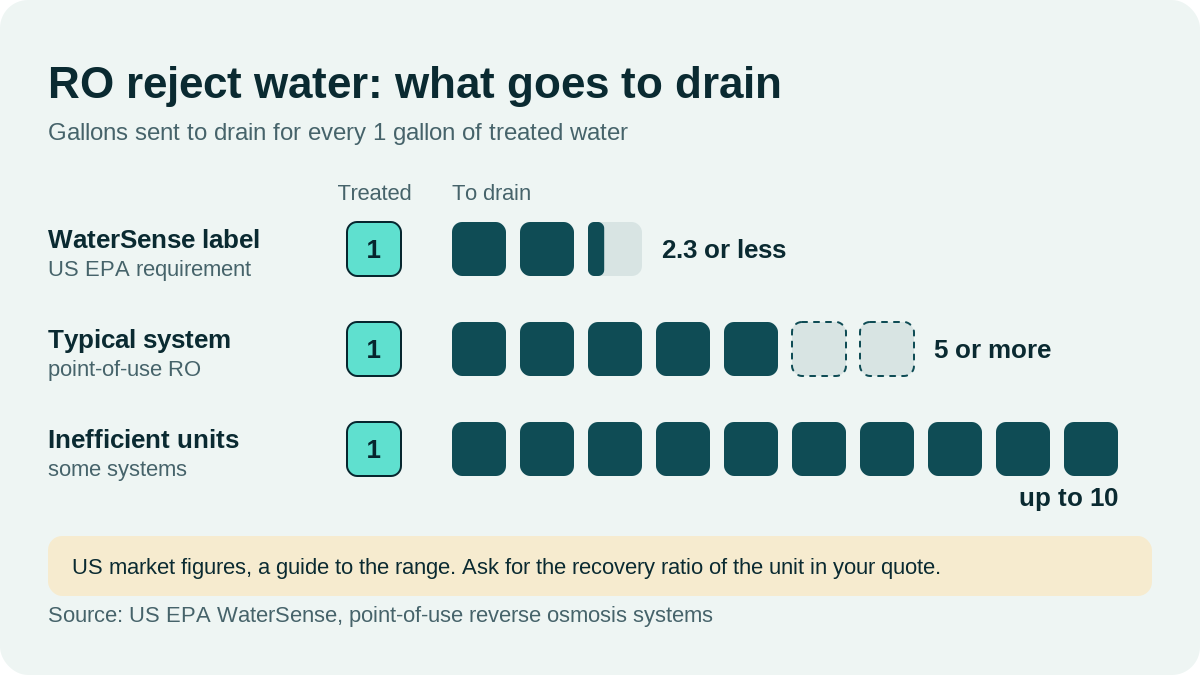
The US Environmental Protection Agency's WaterSense programme says a typical point-of-use RO system sends five gallons or more of reject water to drain for every gallon of treated water, and that some inefficient units send up to ten. To earn the WaterSense label, a system must send 2.3 gallons or less to drain per gallon produced.
These are US market figures and are given here as a guide to the range, not as a claim about any unit sold in the UAE. When you receive a quote, ask for the recovery ratio of the unit in it. To be confirmed.
Remineralisation
RO water contains very little calcium or magnesium, and many people describe the taste as flat. A remineralisation stage passes the water through a mineral cartridge after the membrane, which raises the mineral content slightly and usually nudges the pH up.
This is fitted for taste. Research on whether drinking low-mineral water matters for health is mixed. If you are on a diet that restricts any mineral, ask your doctor. More detail is in how to add minerals back to RO water.
What your home needs
- Space in the kitchen sink cabinet for the filter set and, in many models, a storage tank.
- A drain connection to the sink waste pipe for reject water.
- A tap hole in the sink or worktop for the dedicated tap.
- Enough pressure. A membrane needs pressure to work. Where the feed pressure is low, a booster pump is added.
- A socket if a pump or a tankless unit is fitted.
- Landlord approval in a rented home for the tap hole and drain connection.
Fitting and cabinet requirements are covered in full on the page for under-sink drinking water systems.
How Dr Water Lab sizes an RO system
The test results set the specification. TDS confirms whether RO is worth fitting. The disinfectant residual and the visual check of the tank decide the pre-filtration. Feed pressure decides whether a pump is needed. The number of people in the home sets the membrane capacity and the choice between a tank and a tankless design. The unit is sourced after the test.
Maintenance
- Sediment and carbon pre-filters are changed most often. Late changes are the usual reason membranes fail early.
- The membrane is replaced when its rejection falls. A TDS reading at the purifier tap, taken every few months, shows this.
- Post-carbon and remineralisation cartridges have their own intervals.
Intervals come from the manufacturer and are written into your quote.
Who it suits
Owners of villas and apartments who want lower-TDS drinking water on tap, and tenants whose landlord agrees to the installation.
What it costs
Our systems start from AED 1,000 and go up to AED 20,000, depending on what your home needs. A written quote follows the test and separates the unit, installation and consumables. See water purifier prices in UAE for what drives the cost.
Find out your own TDS before you decide: book a free water test.
Find out what is in your water
The free test measures hardness, TDS, disinfectant residual and pH at your own taps. We supply, install and maintain water treatment systems in every area of Dubai; message us for prices and service details.