What a whole house water filtration system is
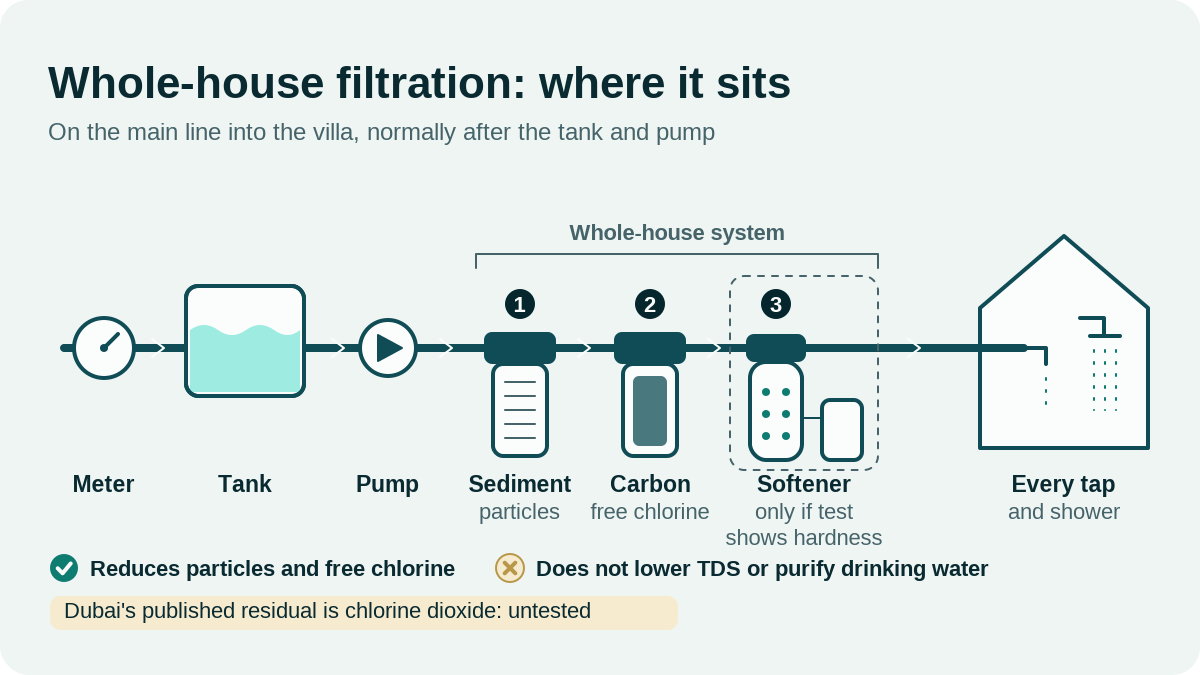
It is point-of-entry treatment: one installation on the main line instead of a filter at each outlet. Water passes through the stages in order.
- Sediment filtration. Traps sand, rust and debris from the mains, the tank and the pipework. More on this in sediment filters.
- Activated carbon. Reduces free chlorine and the compounds behind taste and smell, for the showers as well as the taps. Carbon is certified for free chlorine; for chlorine dioxide, the disinfectant DEWA reports, we have found no tested figure at household scale. See activated carbon filters.
- Softener, where justified. An ion-exchange softener removes hardness and so prevents scale. It is fitted only if the hardness measured at your home supports it. See water softeners in Dubai.
The problems it treats
- Grit in tap aerators and shower heads, and sediment in toilet cisterns.
- Free chlorine taste and smell, where your water carries it. The effect on chlorine dioxide is untested.
- Discoloured water after the supply has been interrupted, where the cause is particles.
- With a softener: scale on taps, shower glass, heating elements and inside appliances.
What it does not do
- It does not lower TDS. Sediment and carbon leave dissolved salts in the water. So does a softener.
- It does not purify drinking water. For the kitchen, an under-sink reverse osmosis purifier is the matching piece. See under-sink drinking water systems.
- It does not disinfect. Carbon removes free chlorine, a residual that protects water in the pipes. The US Centers for Disease Control and Prevention notes that removing disinfectants at the point of entry may allow more germs to grow in a home's plumbing, and Dubai Municipality requires that residual disinfectant remain sufficient to prevent re-contamination. Where the filter sits relative to the tank is therefore decided at the survey, and tank hygiene and timely filter changes matter more once carbon is fitted.
- It does not clean the tank. A filter after a dirty tank simply blocks faster. See water tanks: cleaning and filtration.
- It is not a medical treatment. We make no skin or hair claim for it.
Where it is fitted
On the main line into the house, normally after the tank and pump so the equipment treats the water the house actually receives. The exact position depends on how your villa is plumbed, and is confirmed on the visit.
What the villa needs
Space. A wall or floor area near the inlet, with room to open housings and lift out cartridges or reach the control valve. Outdoor installations need shade or an enclosure.
A drain. Backwashing filters and softeners discharge water during cleaning cycles. A drain point within reach is required for those.
Power. A softener or automatic backwash valve needs a socket, ideally a weatherproof one if outdoors.
Pressure. Every filter adds some resistance. The system is sized so that showers upstairs still run properly when someone opens a tap in the kitchen.
Approval. Owners should check community rules on equipment fixed outside the villa. Tenants need the landlord's written approval.
How Dr Water Lab sizes a whole house water filter
The free water test comes first: hardness, TDS, disinfectant residual and pH at the taps, and a visual check of the tank and inlet. Sizing then uses:
- Bathrooms and occupants, which set the peak flow the system has to pass.
- Pipe size and pump pressure, which set the size of the housings or vessels.
- Sediment load, judged from the tank check and the taps, which decides the grade of sediment filtration and whether a backwashing unit is better than cartridges.
- Disinfectant residual, which guides how much carbon is fitted. It is an indication: a standard chlorine test kit also responds to chlorine dioxide and cannot tell the two apart.
- Hardness, which decides whether a softener is included at all. DEWA's published typical total hardness for the water it supplies is 61.3 (a 2023 average at the network, not at your tap; no unit is printed, conventionally mg/L as calcium carbonate). That is at the boundary between soft and moderately hard on the US Geological Survey scale, so the supplied water is not hard by the standard scale. A softener is quoted only when your tap reading is clearly higher.
Equipment is sourced after the test. If your results show little to treat, the written report will say so.
Maintenance
- Sediment cartridges are changed when they load up.
- Carbon is replaced on the manufacturer's schedule, because spent carbon stops working without any visible sign.
- Softeners need salt and an occasional check of settings.
The tank has its own schedule: Dubai Municipality's guideline says all water tanks should be emptied, cleaned and disinfected at least twice a year.
Who it suits
- Villa owners who want every outlet treated and their appliances protected.
- Villa tenants on longer leases, with the landlord's approval.
It does not suit apartments, where the supply is shared and nothing on common plumbing should be altered. Apartment options are on the page for water filters for apartments and renters.
What it costs
Our systems start from AED 1,000 and go up to AED 20,000, depending on what your home needs. A written quote follows the test.
See what your villa's water needs before choosing equipment: book a free water test.
Find out what is in your water
The free test measures hardness, TDS, disinfectant residual and pH at your own taps. We supply, install and maintain water treatment systems in every area of Dubai; message us for prices and service details.