What a water softener does
A softener is a vessel filled with ion-exchange resin. As water passes through, the resin holds on to calcium and magnesium and releases sodium in their place. The water that comes out is soft: it forms far less scale, and soap lathers more easily.
What a softener does not do
- It does not filter. Sediment, rust and particles pass through or foul the resin. A sediment filter belongs in front of it.
- It does not remove free chlorine. Carbon does that, and carbon ahead of the softener also protects the resin.
- It does not lower TDS. One dissolved mineral is swapped for another, so the meter reads about the same.
- It does not make water safer to drink. Penn State Extension puts it plainly: softeners will not necessarily remove the more serious drinking water contamination problems. Softening is for nuisance problems such as scale and soap film.
- It adds sodium. The same source gives the figure as 7.5 milligrams per quart (a little under a litre) for each grain per gallon of hardness removed, and names this as the main disadvantage for people on low-sodium diets.
- It is not a treatment for skin or hair. Many residents report that soft water feels different in the shower. Research on water hardness and skin is mixed, randomised trials found no objective benefit from softeners for eczema, and a softener is not medical treatment.
Does your home need one
Settle this first, because a softener has running costs for as long as you own it.
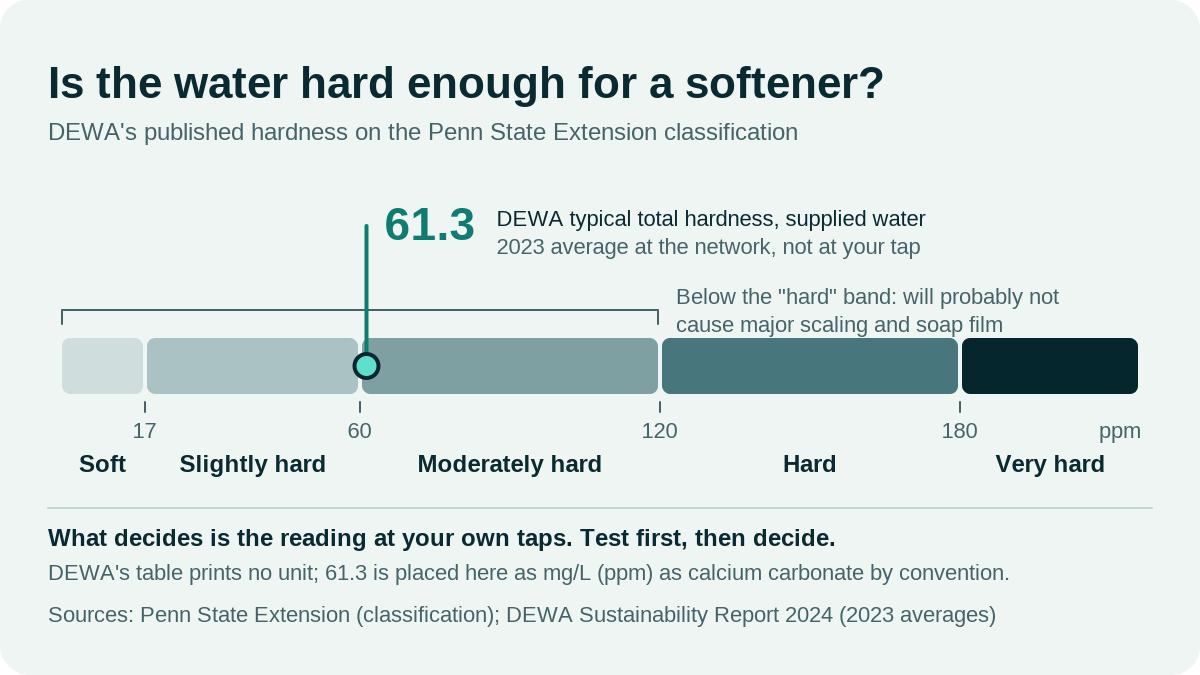
Hardness is measured in milligrams per litre (the same as parts per million) of calcium carbonate. Penn State Extension uses this classification:
| Classification | Hardness (ppm) |
|---|---|
| Soft | under 17 |
| Slightly hard | 17 to 60 |
| Moderately hard | 60 to 120 |
| Hard | 120 to 180 |
| Very hard | over 180 |
The same source notes that water below the "hard" band will probably not cause major scaling and soap film.
Where does Dubai sit? DEWA's published typical total hardness for the water it supplies is 61.3. That is a 2023 average at the network, not at your tap, and the table prints no unit (conventionally mg/L as calcium carbonate). It falls at the very bottom of the moderately hard band above, and at the soft / moderately hard boundary on the US Geological Survey scale. The supplied water is not hard by either scale, and on that figure alone a softener is unlikely to be justified. Readings at the tap can differ, so what decides is the reading at your own taps, which the free test gives you. If it is low, Dr Water Lab will tell you a softener is not worth buying, and the written results will show why. Our guide is Dubai water hard goes through the evidence, and how to remove limescale covers cleaning what is already there.
Water softener salt and regeneration
Once the resin's sodium is used up, it has to be recharged. This is called regeneration.
The softener has a second container, the brine tank, which you keep topped up with softener salt. During regeneration the unit draws salt solution through the resin. The brine pushes the collected calcium and magnesium off the resin and carries them to the drain, and the resin is ready again.
Which salt, and how often
Use salt sold for water softeners, not table or de-icing salt. One appliance maker's guidance is typical: it asks for "clean, 99.5% pure water softening salts", recommends nugget, pellet or coarse solar salt, and says not to use rock, block, granulated table or ice-melting salt. Potassium chloride can be used instead of sodium chloride in many units, which matters to people limiting sodium. Your unit's manual has the final word on which form it takes.
How often you top up depends on three things: the hardness being removed, how much water the household uses, and how often the unit is set to regenerate. That is why there is no general figure worth quoting. Check the brine tank regularly, and expected salt use is estimated in your quote.
Where it is fitted and what the home needs
A softener sits on the main line into the villa, after the sediment and carbon stages. See whole-house water filtration for villas for the full arrangement.
- Space for the resin vessel and the brine tank.
- A drain for regeneration water. This is essential.
- A socket for the control valve.
- A bypass so the garden supply and, if you prefer, a kitchen drinking tap can stay unsoftened.
- Approval from the owner in a rented villa, since the main line is cut.
How Dr Water Lab sizes a softener
Three numbers do the work: the measured hardness, the number of people in the home, and the peak flow the bathrooms demand. Hardness multiplied by daily use gives the load on the resin, which sets the resin volume and how often the unit regenerates. The unit is sourced after the test.
A water softener for the shower only
There is no such thing in the usual sense. A true softener needs resin volume, salt and a drain, which do not fit on a shower arm. Shower filters are certified for free chlorine and do not soften water, whatever the packaging says. See do shower filters remove hard water and shower filters in Dubai.
Salt-free and electronic devices
Salt-free conditioners and electronic or magnetic descalers are sold as softeners. They do not remove calcium or magnesium, so a hardness test reads the same before and after. Dr Water Lab does not describe them as softeners.
Salt-free "anti-scale" units: what the evidence says
The Water Quality Association describes these as antiscaling devices that "aim to reduce or prevent certain scale deposits". Some are physical devices, such as template-assisted crystallisation (TAC) media; others release a chemical such as phosphate or citric acid into the water to discourage scale. The association is clear that they "do not provide a reduction of total calcium or magnesium content", and that they are not proven to achieve soft water. It advises looking for products certified by an accredited third party to a published standard.
Independent evidence on whether they reduce scale is thin. A 2019 University of Waterloo thesis that tested TAC on two source waters found that treated water formed "somewhat less scale" than untreated water, but the drop in free calcium was too small "to be of much practical value", and the author noted how little published research exists. Manufacturer and trade figures claim more. If a salt-free unit is offered, ask which standard it is certified to and where the listing is, and expect the scale to be reduced at best, not removed.
Maintenance
- Keep the brine tank topped up with the right grade of salt, and check that the salt has not formed a hard crust.
- The resin can be fouled by sediment or iron and can harbour bacteria if neglected. Penn State Extension notes that periodic cleaning or disinfection helps, following the manufacturer's instructions.
- Change the sediment and carbon filters in front of the softener on time. They protect the resin.
What it costs
Our systems start from AED 1,000 and go up to AED 20,000, depending on what your home needs. A written quote follows the test and shows purchase, installation and the running cost of salt and regeneration water.
Measure your hardness before anyone sells you a softener: book a free water test.
Find out what is in your water
The free test measures hardness, TDS, disinfectant residual and pH at your own taps. We supply, install and maintain water treatment systems in every area of Dubai; message us for prices and service details.