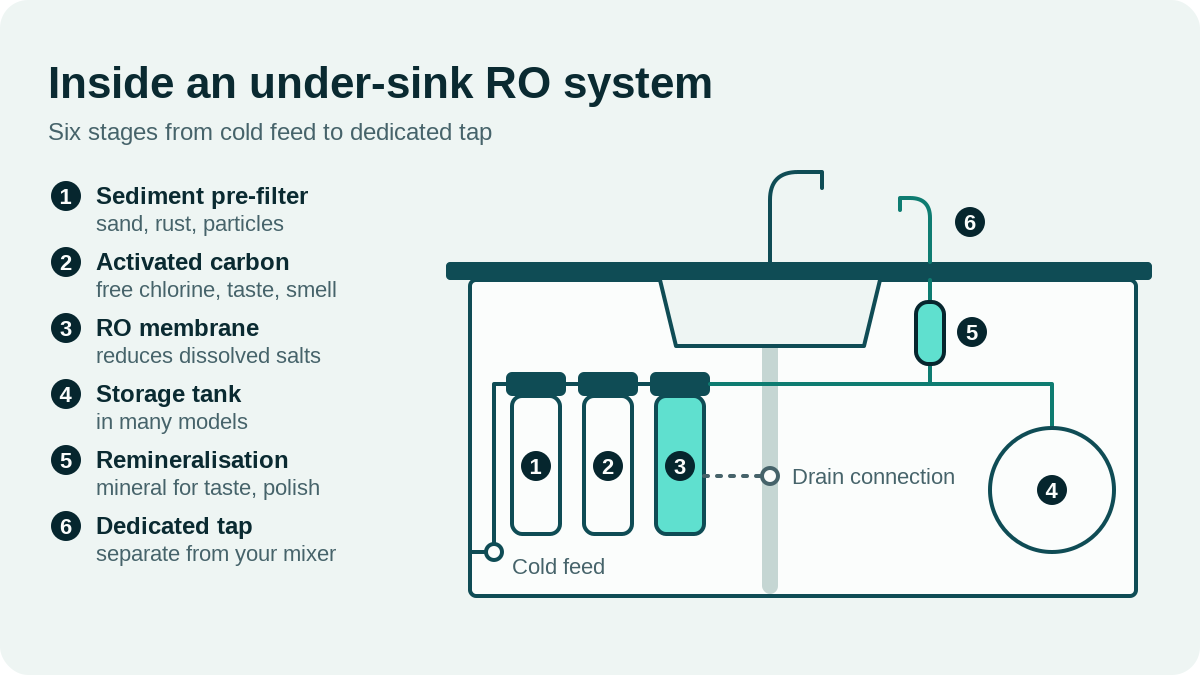
What is inside the cabinet
An under-sink water filtration system is built in stages, and water passes through them in order.
- Sediment pre-filter. Catches sand, rust and particles so they do not clog what follows.
- Activated carbon. Reduces free chlorine and the compounds behind taste and smell. It is certified for free chlorine; we have found no tested figure for chlorine dioxide, the disinfectant DEWA reports. It also protects the RO membrane, which chlorine damages.
- Reverse osmosis membrane. Reduces dissolved salts. Treated water goes forward, and the concentrated reject water goes to the drain.
- Storage tank, in many models. RO produces water slowly, so a small pressurised tank holds a reserve. Tankless models use a pump and a larger membrane instead.
- Remineralisation and polishing. Adds a small amount of mineral back for taste and gives the water a final pass through carbon.
- Dedicated tap. A slim tap at the sink, separate from your mixer.
A simpler under-sink filter stops after stage two. It improves taste and reduces free chlorine but leaves TDS unchanged. For the difference between the two, see drinking water filters.
What an under-sink system treats, and what it does not
It treats the water from one tap: the water you drink, cook with and use for tea, coffee and ice.
It does not treat showers, basins or the washing machine. It does not soften the water in the rest of the home, and it does not clean a tank. If scale in the bathrooms or sediment from the tank is the main complaint, the fix is elsewhere, and the test will show that.
What your kitchen needs
Space. Room in the sink cabinet for the filter set and, if the model has one, the storage tank. Waste bins, pull-out racks and waste disposal units all compete for the same space, so the cabinet is measured on the visit.
A cold water feed. The system takes water from the cold line under the sink through a small adaptor. A working isolation valve is needed so the unit can be shut off for servicing.
A drain connection. The RO reject line is connected to the sink waste pipe.
A tap position. The dedicated tap needs a hole in the sink or worktop. Some sinks have a spare hole behind a cap. Stone and solid-surface worktops can be drilled, but this is a permanent change.
Power, sometimes. If the pressure at your kitchen feed is too low for the membrane, a booster pump is fitted and needs a socket in or near the cabinet. Tankless models always need power.
Landlord approval. In a rented home, ask in writing before a tap hole is drilled or the waste pipe is tapped. The feed adaptor and the unit itself can be removed when you move out. A drilled hole cannot. Renters will find more on this in water filters for apartments and renters.
A kitchen water filter system for the sink: what fits under a Dubai counter
Whether you call it a kitchen water filter system, a water filter for the sink or a water purifier for the sink, the question at the visit is the same: which layout fits your cabinet. There are three.
| Layout | What goes in the cabinet | Needs |
|---|---|---|
| Carbon-only filter | A short row of cartridges | Cold feed and a tap position. No drain, no power |
| Tankless RO purifier | One unit with a built-in pump | Cold feed, drain, tap position and a socket |
| RO purifier with storage tank | The filter set plus a separate tank | Cold feed, drain, tap position, and space for both the filter set and the tank |
Three things most often decide it: what already lives under the sink (bin, pull-out rack, waste disposal unit), whether there is a socket in or near the cabinet, and whether a tap hole can be made or an existing one reused. We measure the cabinet at the visit. Where nothing fits, a countertop unit is the fallback.
How Dr Water Lab sizes an under-sink water filter
Sizing starts with the free water test: hardness, TDS, disinfectant residual and pH at the taps, and a visual check of the tank and inlet. For the kitchen, four things follow from it.
- TDS shows whether reverse osmosis is justified or a carbon filter would do.
- Disinfectant residual and sediment decide how much pre-filtration the membrane needs.
- Pressure at the feed decides whether a booster pump is required.
- Household size sets the capacity, and whether a tank or tankless design suits you.
The equipment is sourced after the test, for your kitchen.
Installation: what happens on the day
The water to the kitchen is shut off at the isolation valve. The feed adaptor is fitted, the unit is fixed in the cabinet, the drain connection is made and the tap is mounted. The system is then flushed, because new carbon and new membranes need rinsing before the water is used. Every joint is checked for leaks under pressure, and the TDS is measured at the new tap so you can see the before and after figures. You are shown the shut-off valve and what to do if you ever see water in the cabinet.
Maintenance
- Pre-filters and carbon are changed most often, because they take the load.
- The RO membrane lasts longer, provided the pre-filters are changed on time.
- The remineralisation cartridge has its own interval.
- The storage tank and lines are sanitised when cartridges are changed.
Intervals are set by the manufacturer and depend on how much water you use and what is in it. They are listed in your quote.
Who it suits
- Villa owners who want purified drinking water in the kitchen, with or without whole-house filtration.
- Apartment owners, since nothing on shared plumbing is touched.
- Tenants, with the landlord's approval for the tap hole and drain connection.
Where there is no free cabinet space, or the landlord will not allow a tap hole, a countertop unit is the better answer.
What it costs
Our systems start from AED 1,000 and go up to AED 20,000, depending on what your home needs. You receive a written quote after the test, covering the unit, installation and the consumables you can expect to replace.
For more on the membrane itself, read RO water purifiers, what is reverse osmosis and how to add minerals back to RO water.
See what your kitchen tap needs first: book a free water test.
Find out what is in your water
The free test measures hardness, TDS, disinfectant residual and pH at your own taps. We supply, install and maintain water treatment systems in every area of Dubai; message us for prices and service details.