What DEWA and Dubai Municipality say
Three official statements bear on the question.
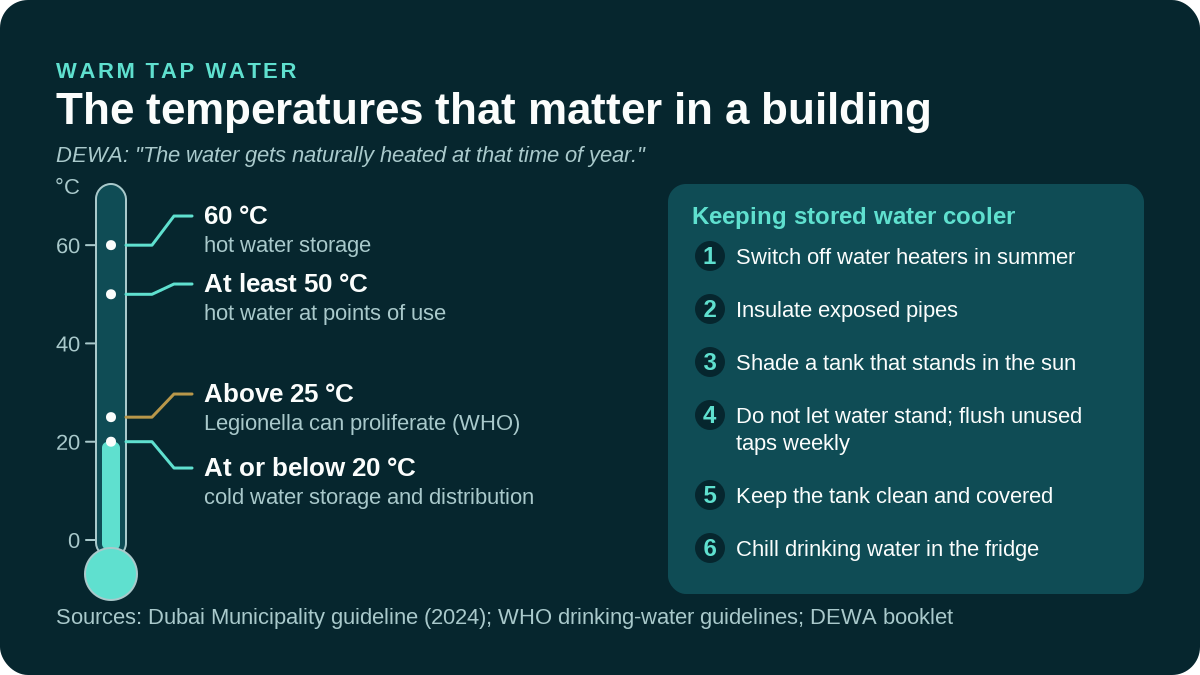
DEWA acknowledges it. In its booklet of general tips for managing water and electricity, DEWA advises: "Close your water heaters in the summer. The water gets naturally heated at that time of year." The same booklet says: "Insulate your water-heater and water pipes".
Dubai Municipality sets a target for buildings. Its Technical Guidelines for Quality of Unbottled Drinking Water (issued 25 September 2024) say: "Cold water storage and distribution should be at or below 20 °C", and "The premises must keep cold water cold at all times." For hot water it sets storage at 60 °C and at least 50 °C at points of use.
The guideline treats temperature as a hygiene matter. It lists poor temperature control among the conditions that support microbial growth, giving the example that "cold and hot water pipes are not insulated".
What is not officially explained
We looked for an official explanation that names the cause in Dubai, such as rooftop tanks or exposed pipes, and did not find one. We also found no DEWA or Dubai Municipality advice aimed at households on what to do about hot water from the cold tap, beyond the heater tip and pipe insulation quoted above.
So the following is reasoning, not an official account. Water gains heat wherever it sits or travels in a hot place. In a home that can mean a storage tank standing in the sun, pipes that run across a roof or along an outside wall, and pipework inside warm ceiling voids. Water that has sat in such a pipe for hours comes out hotter than water that has just arrived. Which of these matters most in your home depends on how it was built. We have no measurements to rank them and will not guess at temperatures.
The World Health Organization makes a related general remark, in the context of temporary water supplies: avoid "storage tanks in direct sunlight where rising temperatures support microbial growth". That is not a statement about Dubai homes, but the physics is the same.
Does warm water affect quality?
Here is what the official sources say, without adding to it.
- Taste. WHO's guidelines note: "Cool water is generally more palatable than warm water".
- Microbial growth. The same guidelines say: "High water temperature enhances the growth of microorganisms". In the section on desalinated supplies, WHO adds that "High temperatures of distributed water in warm climate areas and difficulty in maintaining disinfectant residuals during transport over long distances may lead to microbial aftergrowth".
- Legionella. WHO's fact sheets say Legionella bacteria can proliferate "at temperatures above 25 °C". This is why building guidelines want cold water kept cold and hot water kept hot, with as little as possible sitting in between.
What this means for a household is not a diagnosis. Warm water from the cold tap does not show that your water is contaminated. It does mean the measures that keep stored water in good condition matter more in summer: a clean, covered tank, water that turns over instead of standing, and filter cartridges changed on time. Dubai Municipality requires tanks to be emptied, cleaned and disinfected at least twice a year; the details are on water tanks: cleaning and filtration.
We do not give medical advice. If someone in your home has a health condition that makes them vulnerable to infection, ask their doctor about water use, and ask your landlord or building management for the tank cleaning and laboratory records.
Practical ways to keep stored water cooler
None of the seven steps below will give you chilled water from the cold tap in August. They reduce the heat gained and keep the stored water in better condition. A tank chiller, covered after the list, is the exception.
- Switch off water heaters in summer. This is DEWA's own tip. It saves electricity and stops the heater adding warmth you do not need.
- Insulate exposed pipes. Also DEWA's advice, and Dubai Municipality's guideline names uninsulated pipes as poor temperature control. Start with pipes on the roof and outside walls.
- Shade the tank if it stands in the sun. A cover or shade structure limits direct sun. Ask the landlord or a qualified contractor; anything fitted must leave the tank cover intact and fixed, as the guideline requires.
- Do not let water stand. The guideline lists "Installing oversized storage tanks that cause stagnation and stratification" among the factors for microbial growth, and says taps and showers in unoccupied rooms should be flushed "for several minutes ... at least once a week". After a holiday, run the taps and showers for several minutes before using them.
- Keep the tank clean and covered. Twice-yearly cleaning by a company approved by Dubai Municipality is the baseline. Summer is a sensible time to check when it was last done.
- Chill drinking water in the fridge. Fill a clean, covered jug or bottle and refrigerate it. This is the simplest fix for taste.
- Check the shower before you step in. In the hottest weeks the first water out of a pipe that has sat in the sun can be very hot. Run it briefly and test it with your hand, especially before bathing children.
If you rent, points 2, 3 and 5 are for your landlord or building management. Dubai Municipality's guideline makes the building owner responsible for the water in the building.
Tank chillers
A tank chiller is the one measure that removes heat instead of slowing it down. It is a refrigeration unit connected to the storage tank: it cools the stored water and holds it at the temperature set on its controller. You will see it sold as a water tank chiller, a water tank cooler or a water chiller for a water tank. The names describe the same kind of equipment.
It is also the only measure on this page with a running cost. A chiller uses electricity for as long as the tank needs cooling, and it works against the same sun and heat that warmed the water in the first place. Shading the tank and insulating the pipes first leaves it less to do. It needs space near the tank and a power supply, and in a rented or managed home it is a decision for the owner. We have no sourced figures for chiller sizes or electricity use, so we give none here.
A chiller cools water. It does not clean it. The tank still needs cleaning and disinfection twice a year, and the choice of filters still follows from a water test. Our guide to water tank chillers in Dubai covers when one is worth having and what to try before buying one.
What filters do and do not do about warm water
A water filter does not cool water. No stage we fit, whether sediment, activated carbon, a softener or reverse osmosis, lowers temperature.
Two things are worth knowing if you have filters, or are considering them:
- Carbon removes free chlorine. Where that is the residual, nothing protects the water from regrowth after the filter, and Dubai Municipality's guideline warns that old carbon filters past their use-by date "can support the growth of microbes". In a warm climate, changing cartridges on schedule is not optional. See activated carbon filters.
- Filters and membranes have temperature limits. Check the manufacturer's stated maximum inlet temperature for any system before it is fitted on a line that runs very hot in summer. To be confirmed
For drinking water, an under-sink drinking water system with its own tap plus a jug in the fridge covers both taste and temperature. For the wider picture of what reaches your tap, see can you drink tap water in Dubai and where Dubai's tap water comes from.
Next step
If warm water has made you wonder about the tank, find out what is at the tap. Book a free water test. We measure hardness, TDS, disinfectant residual and pH, make a visual check of the tank and inlet, and give you the results in writing with no obligation. Appointments are taken at least 10 days ahead.
Find out what is in your water
The free test measures hardness, TDS, disinfectant residual and pH at your own taps. We supply, install and maintain water treatment systems in every area of Dubai; message us for prices and service details.