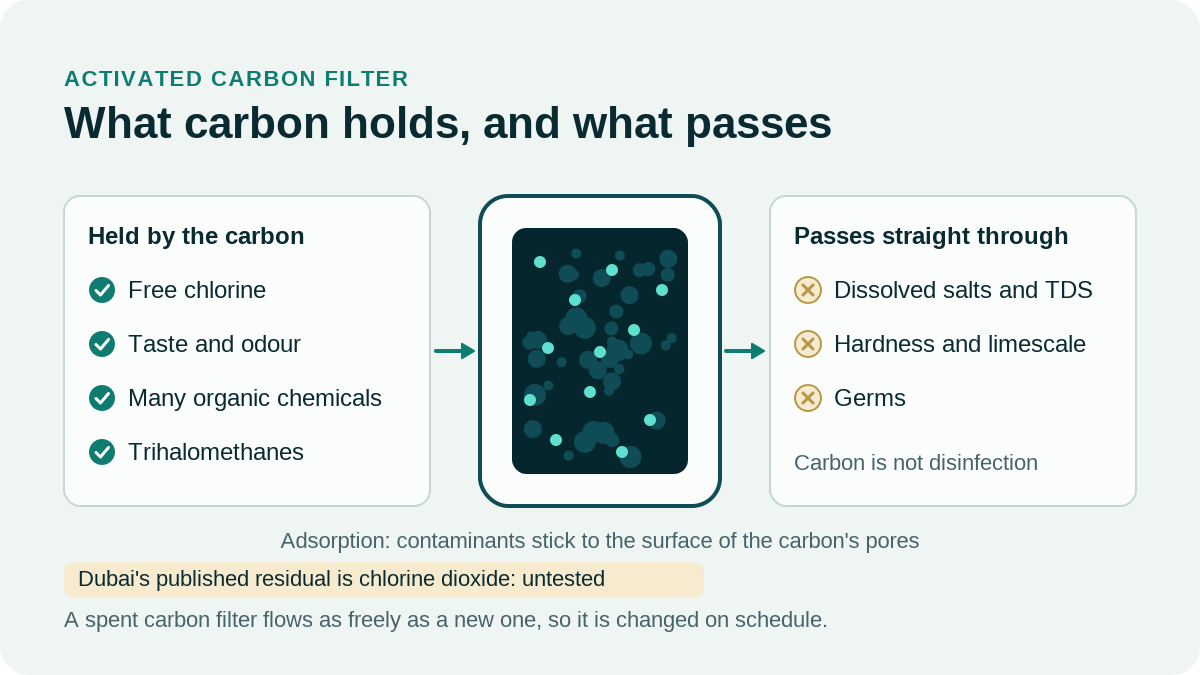
How an activated carbon filter works
Activated carbon starts as coconut shell, coal or wood. Heating it under controlled conditions opens up a huge network of microscopic pores. The Water Quality Association (WQA) notes that a single gram of granular activated carbon can have a surface area of more than 1,000 square metres.
That surface does two different jobs.
Adsorption. Organic molecules stick to the carbon surface and stay there. WQA describes this as the main mechanism, and the reason carbon is so widely used to reduce unwanted taste, odour and colour.
Chemical reduction of chlorine. Carbon also converts free chlorine into harmless chloride. WQA describes this reaction as very fast, needing well under a minute of contact between water and carbon.
Both jobs depend on contact time. The slower the water moves through the carbon, and the more carbon there is, the better the result. This is why a large whole-house carbon tank and a small shower cartridge are not equivalent, even though both contain "activated carbon".
What a carbon water filter removes
Based on the WQA technical fact sheet on granular activated carbon and CDC guidance, activated carbon is effective for:
- Free chlorine, and the taste and smell that come with it
- Many organic compounds, including chlorinated solvents and pesticides
- Trihalomethanes, the by-products formed when chlorine reacts with organic matter
- Colour and odour from organic sources
- Some heavy metals such as lead, in cartridges designed and certified for it
How much of each depends on the specific product. The CDC advises checking the label: certification to NSF/ANSI Standard 42 covers taste and odour claims such as chlorine, and Standard 53 covers health-related claims such as lead. A certificate only covers the substances named on it, and neither standard has a claim for chlorine dioxide, chlorite or chlorate.
What a carbon filter does not remove
- Dissolved salts and TDS. Carbon does not remove sodium, chloride, sulphate or other dissolved minerals. A TDS meter will read about the same before and after a carbon filter. See what TDS means.
- Hardness and limescale. Calcium and magnesium pass straight through. A carbon filter will not stop scale on taps, shower glass or kettles. That takes a water softener for the whole house or reverse osmosis for drinking water.
- Germs. The CDC states that common activated carbon filters are not designed to remove germs. Carbon is not a disinfection method.
- Chloramine, unless the filter is built for it. Chloramine is harder to remove than free chlorine. WQA advises that a standard carbon filter must be roughly four times larger to deal with chloramine, and that catalytic carbon does the job more effectively. In Dubai, the only disinfectant figure DEWA publishes is for chlorine dioxide (see below).
Types of carbon filter
Granular activated carbon (GAC). Loose granules in a cartridge or tank. Low resistance to flow, which suits whole-house use. Large tanks can be backwashed to keep the bed from packing down.
Carbon block. Fine carbon powder pressed into a solid block. Water has to pass through a dense wall of carbon, which gives longer contact in a small space and also strains out fine particles. Flow is lower, so carbon block suits under-sink drinking water filters.
Catalytic carbon. Carbon treated to speed up chemical reactions on its surface. Used where chloramine is present.
Where carbon sits in a home system
Carbon is the second stage in most systems, straight after the sediment filter. Sediment first keeps grit from coating the carbon surface.
- At the villa inlet. A carbon tank or large cartridge reduces free chlorine for every tap and shower in the house. See whole-house water filtration.
- Under the kitchen sink. One or two carbon cartridges sit ahead of a reverse osmosis membrane, where they protect the membrane from chlorine, and another small carbon stage often follows the storage tank to polish the taste.
- In a shower filter. A small amount of carbon or similar media reduces free chlorine at one shower. Contact time is short and the water is hot, so performance is more limited than at the inlet.
One caveat about whole-house carbon: the CDC points out that whole-home filters which remove chlorine may allow more germs to grow in the plumbing afterwards, because the disinfectant that was protecting the water is gone. Dubai Municipality's guideline likewise requires that residual disinfectant remain sufficient to prevent re-contamination, so where a carbon filter sits relative to the tank is decided at the survey. In practice this means keeping tanks clean, changing media on time and not oversizing storage. It is one reason we look at your water tank during a test visit.
Maintenance and lifespan
A carbon filter does not block up when it is finished. It simply stops adsorbing, and the water flows on as before. You cannot see or feel the difference, so replacement has to follow a schedule or a volume count, not a visual check.
Three things shorten carbon life: high chlorine levels, heavy water use and sediment reaching the carbon. The CDC also notes that filters should be changed as the manufacturer recommends to prevent germs growing in them.
To be confirmed
When you need a carbon filter, and when you do not
You are likely to benefit if:
- Your water carries free chlorine that you can taste or smell
- You are fitting a reverse osmosis purifier, which needs carbon ahead of the membrane
- You want better-tasting water for drinking and cooking without changing its mineral content
Carbon on its own is not the answer if:
- Your main complaint is limescale, soap that will not lather or spotted glass. That is hardness. See is Dubai water hard?
- You want a lower TDS reading
- You are worried about microbes from a storage tank. That is a cleaning and disinfection question.
No typical free chlorine level for Dubai taps is published. DEWA reports chlorine dioxide in the water it supplies: typical 0.44, specification 0.40 to 0.45 (2023 averages at the network; no units printed, conventionally mg/L). Dubai Municipality's 2024 guideline cites residual free chlorine of 0.2 to 0.5 ppm at the point of delivery. Neither is a reading at your tap. The WHO puts the taste and odour threshold of chlorine dioxide at about 0.2 to 0.4 mg/L, so some people may notice a disinfectant taste or smell.
The removal claims on this page concern free chlorine. Health agencies name carbon as the household option for chlorite, which chlorine dioxide leaves behind, but no device is certified for it, carbon does not remove chlorate, and we have found no tested figure for chlorine dioxide in a household cartridge. Ask for test data that names chlorine dioxide.
Next step
A free water test measures the disinfectant residual at your taps. A standard chlorine test kit also responds to chlorine dioxide and cannot tell the two apart, so the reading is an indication, not a breakdown. Book a water test with Dr Water Lab and you will get the results in writing, with no obligation.
Find out what is in your water
The free test measures hardness, TDS, disinfectant residual and pH at your own taps. We supply, install and maintain water treatment systems in every area of Dubai; message us for prices and service details.