Why a filter needs service at all
Sediment cartridges fill with particles. Carbon has a fixed capacity and stops working when it is used up, with no visible sign. A membrane slowly loses its ability to reject dissolved salts.
Leaving spent parts in place is worse than a drop in performance. The US Centers for Disease Control and Prevention (CDC) says you need to maintain any filter "to keep it working properly and prevent germs from growing in it". Dubai Municipality's drinking water guideline asks for "Regular maintenance and cleaning as recommended by the filter manufacturer", and notes that old carbon filters past their use-by date "can support the growth of microbes".
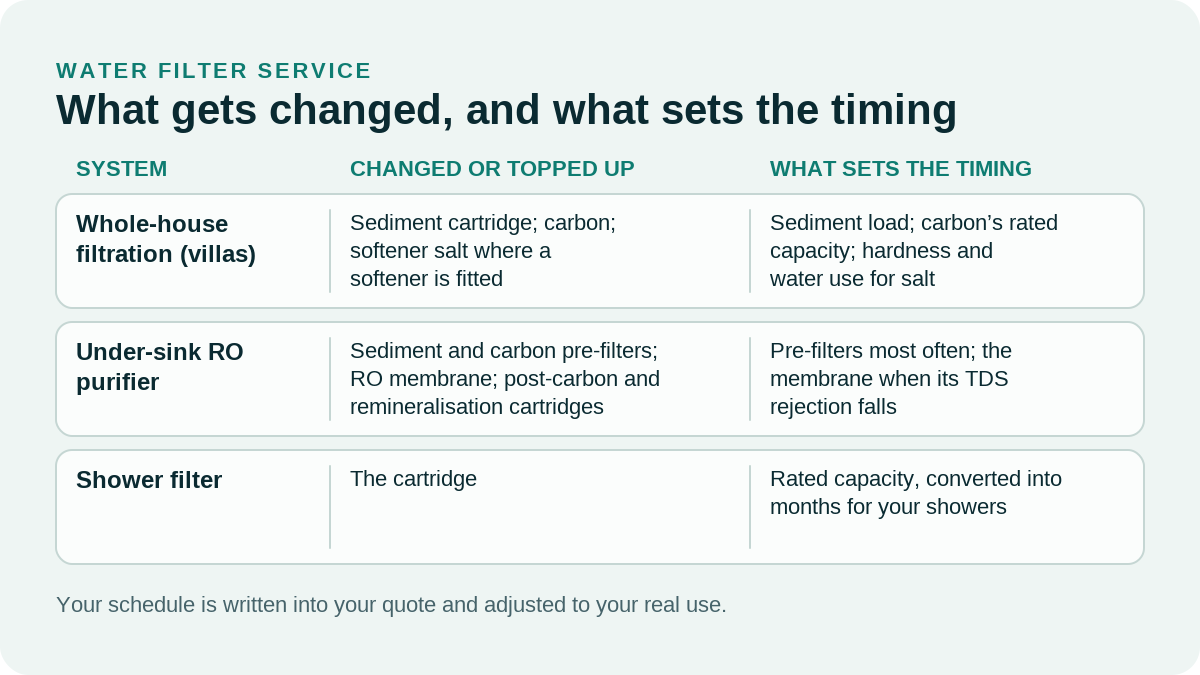
Service schedule by system type
We do not print one interval for everyone. The right interval depends on the cartridge's rated capacity, how much water passes through it and what that water carries. Your schedule is written into your quote and adjusted to your real use.
| System | What is changed or topped up | What sets the timing |
|---|---|---|
| Whole-house filtration (villas) | Sediment cartridge; carbon; softener salt where a softener is fitted | Sediment load from the supply and tank; carbon's rated capacity; hardness and water use for salt |
| Under-sink RO purifier | Sediment and carbon pre-filters; RO membrane; post-carbon and remineralisation cartridges | Pre-filters most often; the membrane when its TDS rejection falls |
| Shower filter | The cartridge | Rated capacity, converted into months for your household's showers |
- Pre-filters protect the membrane. Late pre-filter changes are the usual reason an RO membrane fails early.
- Softener salt is a top-up. Without salt in the brine tank, the softener keeps passing water but stops softening it.
- Shower cartridges are simple to change yourself: see how to install a shower filter and change the cartridge.
Cartridge types and ratings are explained in water filter cartridges.
What a filter change involves
For the systems we install, a change follows the same order each time:
- The water to the unit is shut off and the pressure released.
- Due cartridges are replaced with the same type and rating.
- The system is flushed, because new carbon and new membranes need rinsing before use.
- Every joint is checked for leaks.
- On an RO purifier, TDS is read at the kitchen tap and at the purifier tap, as a record of how the membrane is performing.
- Where a softener is fitted, the salt level and settings are checked.
- The date is recorded, which sets the next reminder.
Signs your system is overdue
- The date has passed. This is the only reliable sign for carbon, which gives no warning.
- Flow has dropped. A loaded sediment cartridge or pre-filter restricts the water.
- A taste or smell has come back that the system used to deal with.
- The purifier's TDS reading is creeping up. The US EPA's WaterSense specification requires certified RO systems to "reduce the influent challenge level of TDS by at least 75 percent". If the gap between your tap reading and your purifier reading narrows over the months, the membrane or pre-filters need attention.
- Scale is returning in a home with a softener, or the salt in the brine tank has formed a hard crust.
How to change RO filters yourself, and when not to
Many under-sink purifiers have twist-off or push-fit cartridges. If you change them yourself, use the cartridge specified for your model, follow the maker's steps, flush for as long as the maker says, and check for drips over the next day.
CDC gives one clear exception: "If you have a weakened immune system, avoid changing water filters yourself."
Installation: what we need from your home
Every water filter system installation starts with a free water test, so the system matches what is in your water. We then look at:
- Villas: access to the point where the supply enters the house, room for the housings, and a drain nearby if a softener is needed.
- Kitchens: space in the cabinet under the sink, a cold feed with an isolation valve, a drain connection and a place for the purifier's own tap.
- Apartments: point-of-use equipment only. We fit under-sink purifiers and shower filters and do not touch shared plumbing.
Moving house
Shower filters unscrew and go with you. An under-sink purifier can be disconnected and refitted. A whole-house system is plumbed into the inlet and is normally part of the villa. Tell us before you move and we will explain the options for your system.
Systems installed by other companies
This page describes maintenance of the systems we install. If your system came from another supplier, ask us before booking, with the make, the model and the date of the last cartridge change to hand.
What it costs
Our systems start from AED 1,000 and go up to AED 20,000, depending on what your home needs. The written quote after the test lists the consumables your system will need and how often.
Next step
If you do not have a system yet, start with the water. Book a free water test. We measure hardness, TDS, disinfectant residual and pH at your taps and give you the results in writing, with no obligation. Appointments are taken at least 10 days ahead.
Find out what is in your water
The free test measures hardness, TDS, disinfectant residual and pH at your own taps. We supply, install and maintain water treatment systems in every area of Dubai; message us for prices and service details.