What you need
- The filter and its cartridge
- The rubber washers supplied with it
- Thread seal tape (PTFE tape)
- A soft cloth
- An adjustable spanner, only if the old fitting is stuck
You do not need to turn off the water supply to the apartment or villa. Just make sure the shower valve is fully closed.
How to install a shower filter: fixed shower head
This is the common in-line fitting, where the filter sits between the arm coming out of the wall and the shower head.
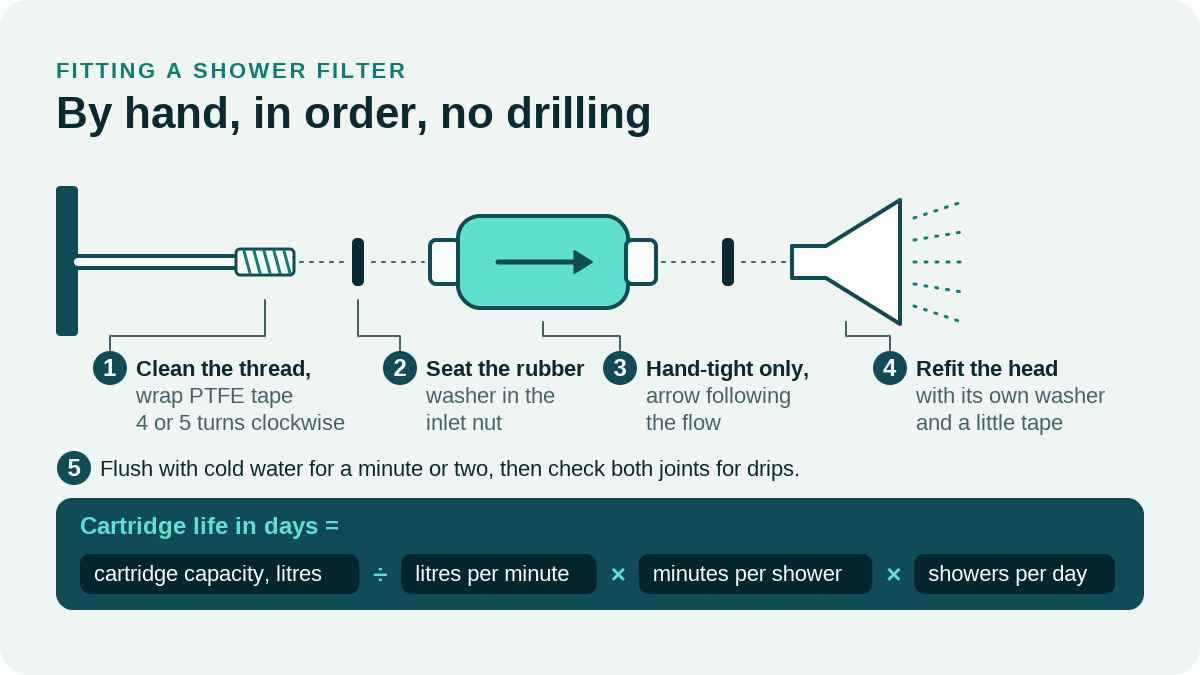
- Remove the shower head. Turn it anticlockwise by hand. If it is stuck with scale, wrap the cloth around the nut and use the spanner gently. Do not twist the arm itself, because that can loosen the joint inside the wall.
- Clean the thread. Pick off old tape and wipe away scale.
- Wrap the thread. Wind PTFE tape clockwise around the arm's thread, four or five turns, keeping it flat.
- Check the washer. Make sure a rubber washer is seated inside the filter's inlet nut.
- Screw on the filter. Hand-tight is enough. Check the arrow or the "inlet" marking so that water flows the right way.
- Refit the shower head to the filter's outlet, with its own washer and a few turns of tape.
- Flush. Run cold water for a minute or two. New carbon and KDF release fine dust at first, so grey water at the start is normal. Then run hot.
- Check for drips at both joints with the water running. A drip usually means a missing or twisted washer, not a joint that needs more force.
Handheld and rain showers: what changes
Handheld shower on a hose. The filter goes between the mixer outlet and the hose, or between the hose and the handset. Fitting it at the mixer end keeps weight off your hand. Hose connections seal with a flat rubber washer, so tape is usually not needed. Do not overtighten: the washer does the sealing.
Filter handsets. If the cartridge is inside the handle, you simply swap your handset for the new one. Unscrew the hose from the old handset, check the washer, screw on the new one.
Rain shower heads. A large overhead rain head adds leverage, and a filter between the arm and the head adds weight and length. Check that the arm is solid and that you still have headroom. On a ceiling-mounted arm there may be no space at all. In that case a filter fitted at the mixer outlet, if the mixer is exposed, is the better position.
Concealed mixers. If the valve and pipework are behind the tiles, you can only filter after the outlet that is visible: the hose connection or the arm.
Not sure which you have? Our guide will a shower filter fit my shower goes through each type and the thread sizes.
How often to change a shower filter cartridge
There is no single answer, because life depends on three things:
- The cartridge's rated capacity. Good filters state this in litres or gallons. In the NSF listings for shower filters certified to NSF/ANSI 177, each model is shown with a replacement service cycle, which is the tested volume.
- How much water passes through it. A couple taking short showers may use a third of what a family of five uses.
- Your water. More free chlorine and more sediment use up media faster. In Dubai, sediment from building tanks can clog a cartridge before its free chlorine capacity is spent. DEWA reports chlorine dioxide, not free chlorine, and we have found no tested figure for how these media handle it.
To turn a capacity into months, estimate your use. Multiply the shower's flow in litres per minute by the minutes per shower and the number of showers per day. Divide the cartridge capacity by that daily figure to get days of life. If the maker gives only "up to six months" with no volume, treat it as a maximum for light use.
For the filters Dr Water Lab fits, the change interval is To be confirmed.
Signs that a cartridge is due
- A disinfectant smell you had stopped noticing comes back.
- The flow drops. Sediment is blocking the cartridge.
- The date you wrote on it has passed. Write the fitting date on the housing with a marker, or set a phone reminder.
- A chlorine test strip held under the shower shows colour again. Strips are cheap, but we have found no data on how they read chlorine dioxide, so treat the result as a hint.
Hair and skin feel are unreliable signs, because they change with season and products.
What happens if you do not change the cartridge
- It stops reducing free chlorine. The media is used up. Water passes through untreated.
- Flow falls. Trapped sediment builds up. In low-pressure buildings this is noticeable.
- It can become a place for microbes to grow. Dubai Municipality's drinking water guideline notes that old carbon filters past their use-by date "can support the growth of microbes", and asks for maintenance as the filter manufacturer recommends. That is a good reason not to stretch the interval.
- It may release what it caught. Saturated carbon can let go of adsorbed material in hot water.
How to change the cartridge
- Close the shower valve.
- Unscrew the filter housing. Most open in the middle by hand. Some need the filter taken off the arm first.
- Lift out the old cartridge. Note which way up it sat.
- Rinse the inside of the housing and any mesh screen. If scale has built up, soak the housing parts in diluted white vinegar and rinse well. See how to remove limescale.
- Check the O-ring or washers. Replace any that are flattened or cracked.
- Fit the new cartridge the same way round.
- Close the housing hand-tight, flush with cold water for a minute, and check for drips.
Buy cartridges made for your model. A cartridge that is nearly the right size lets water bypass the media around the edges.
If you would rather not do it yourself
Dr Water Lab fits the filter for you after a free water test, checks the thread and the joints, and flushes the cartridge before you use it. Replacement arrangements: To be confirmed. The service is described on our shower filters in Dubai page. If you want to work out what your showers cost in water, the DEWA bill and water usage calculator gives you the daily litres to use in the sum above.
Next step
A water test tells you how much disinfectant residual and sediment your cartridge will be dealing with, and so how long it should last. Book a free water test. Appointments are taken at least 10 days ahead.
Find out what is in your water
The free test measures hardness, TDS, disinfectant residual and pH at your own taps. We supply, install and maintain water treatment systems in every area of Dubai; message us for prices and service details.