What limescale is
Limescale is the hard, chalky deposit left when water containing calcium and magnesium is heated or dries on a surface. The US Geological Survey explains that when hard water is heated, solid deposits of calcium carbonate can form. That is the crust inside a kettle. The white marks on taps and shower glass form the same way, as splashes evaporate and leave their minerals behind.
Because limescale is a carbonate mineral, acids dissolve it and ordinary soap or detergent does not. Scrubbing harder mostly scratches the surface underneath.
Which limescale remover to use
| Product | Good for | Keep in mind |
|---|---|---|
| Citric acid (food-grade powder, dissolved in warm water) | Kettles, coffee machines, shower heads, taps | No strong smell. Rinse well. |
| White vinegar (acetic acid) | Taps, glass, shower heads, kettles | Strong smell. Rinse kettles several times. |
| Commercial descaler | Heavy build-up, toilets, appliances where the maker specifies one | Often stronger acids. Follow the label exactly. |
Use one product at a time. For light marks, time does the work, not strength.
Safety first
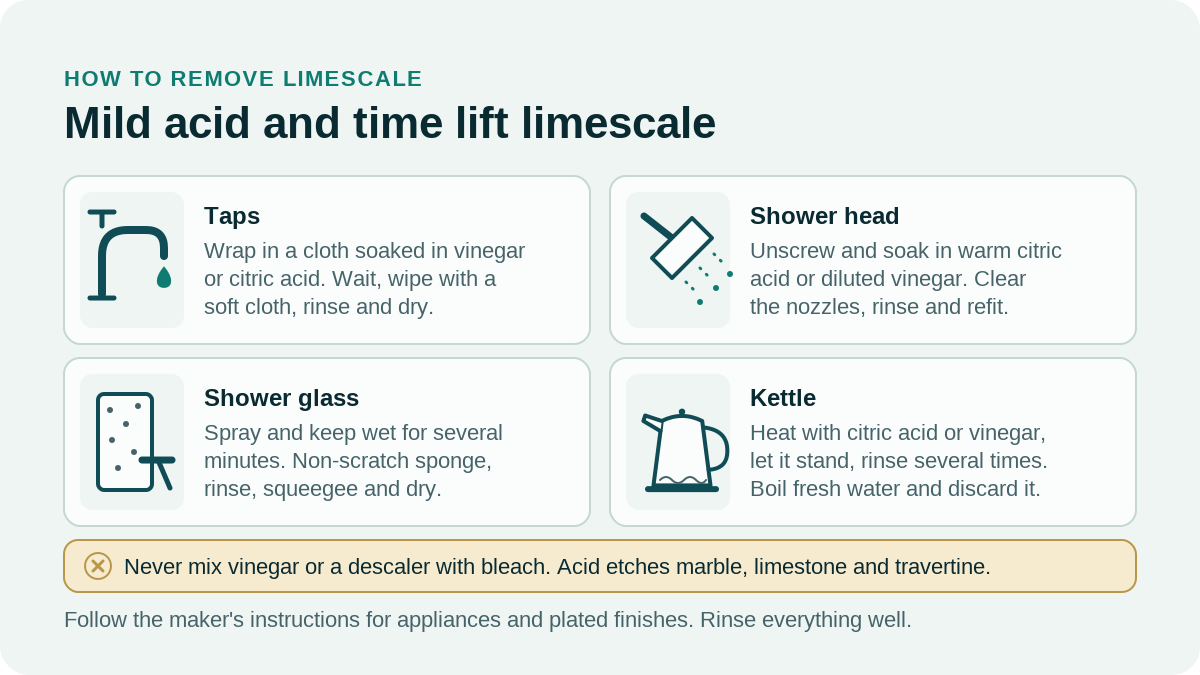
- Never mix a descaler or vinegar with bleach. Mixing chlorine bleach with an acid gives off chlorine gas, and the Washington State Department of Health lists vinegar among the acid products that must not be mixed with bleach. If a surface was cleaned with bleach, rinse it thoroughly with water before using any acid, and the other way round.
- Natural stone. Marble, limestone and travertine are carbonate stone. Acid that dissolves limescale will etch them. Use only a cleaner the stone supplier approves.
- Plated and coloured finishes. Gold, brass, black and brushed finishes can be marked by acids. Check the tap maker's care sheet and test on a hidden spot.
- Appliances. Kettles, coffee machines, washing machines and dishwashers come with descaling instructions. Follow them, because the wrong product can damage seals and may affect the warranty.
- Yourself. Wear gloves, keep the room ventilated, keep products away from children, and rinse everything after cleaning.
Taps and aerators
- Soak a cloth or kitchen paper in vinegar or citric acid solution.
- Wrap it round the scaled area so it stays wet against the metal. Leave it for a while; thick scale needs longer.
- Wipe with a soft cloth or a non-scratch sponge. An old soft toothbrush helps round the base.
- Rinse with clean water and dry.
If the flow has become uneven, unscrew the aerator at the tip of the spout, soak it in the solution, brush out the mesh, rinse and refit. On plated finishes, shorten the soak and check the maker's advice first.
How to remove limescale from a shower head
- Unscrew the shower head or handset from the hose or arm.
- Soak it in a bowl of warm citric acid solution or diluted vinegar until the deposits soften.
- Rub the nozzles with your thumb if they are rubber, or clear them with a soft brush or a wooden toothpick. Do not use a metal pin on rubber nozzles.
- Rinse inside and out, refit, and run the shower for a minute.
Fixed rain heads that cannot be removed can be treated with a soaked cloth held in place, then rinsed by running the shower.
Limescale on glass: shower screens
- Warm the glass with the shower for a minute, then turn it off.
- Spray the glass with diluted white vinegar or citric acid solution and leave it wet for several minutes. Re-spray if it starts to dry.
- Wipe with a non-scratch sponge or microfibre cloth. Do not use abrasive pads or scouring powder.
- Rinse with clean water, then squeegee and dry.
Some shower glass has a factory coating. Check the maker's cleaning advice so you do not strip it. Glass that has been left scaled for years can be etched; cleaning removes the deposit but cannot restore a surface that is already damaged.
How to remove limescale from a kettle
- Part-fill the kettle with water and add citric acid or white vinegar, in the amount the kettle's manual gives.
- Heat it, switch off, and leave it to stand until the scale has loosened.
- Pour away, rinse several times, then boil a kettle of fresh water and discard it.
Do not leave descaling solution in a kettle unattended where someone may use it, and never descale a kettle with bleach.
Washing machines and dishwashers
Scale builds on heating elements where you cannot see it. Run an empty hot cycle with a descaler made for the appliance, as often as the manual advises. Dishwashers also have a salt reservoir and a hardness setting; set it to your water. Use the detergent dose given for your hardness on the pack. Check the manual before using vinegar in a washing machine, because makers differ on whether it is safe for the rubber parts.
Water heaters are not a do-it-yourself job. Descaling or flushing a heater should be done by a technician.
How to stop limescale coming back
Habits that help straight away
- Squeegee shower glass and wipe taps dry after use. No standing water, no deposit.
- Empty the kettle after boiling and do not re-boil the same water all day.
- Descale lightly and often.
Prevention at source
- A softener at the villa inlet removes the calcium and magnesium that form scale, for every tap and appliance. It is the only treatment that removes hardness itself. It does not lower TDS and is not a drinking water purifier. See water softeners in Dubai.
- A reverse osmosis purifier at the kitchen sink greatly reduces scale in a kettle, but only if you fill the kettle from that tap.
- A shower filter does not soften water. It is certified for free chlorine. It will not stop marks on glass. See do shower filters remove hard water.
- Carbon and sediment filters do not remove hardness.
Before paying for a softener, find out how hard your water is. White marks can also be the dried residue of other dissolved salts, which shows up even where hardness is moderate. DEWA's typical total hardness for the water it supplies is 61.3 (2023 average at the network; no unit printed, conventionally mg/L as calcium carbonate), at the soft / moderately hard boundary on the US Geological Survey scale, so supplied water is not hard by that scale. Tap readings can differ, and even moderately mineralised water leaves deposits where it is heated or evaporates. See is Dubai water hard and, if you are wondering about health, is limescale harmful.
In an apartment you cannot fit equipment to the shared supply, so regular descaling and point-of-use equipment are the practical route. See water filters for apartments and renters.
Next step
If scale is a constant job in your home, measure the hardness before buying anything. Book a free water test. We measure hardness, TDS, disinfectant residual and pH at your taps and give you the results in writing, with no obligation. Appointments are taken at least 10 days ahead.
Find out what is in your water
The free test measures hardness, TDS, disinfectant residual and pH at your own taps. We supply, install and maintain water treatment systems in every area of Dubai; message us for prices and service details.