What is limescale
Limescale is the hard, off-white deposit left behind by water that carries dissolved calcium and magnesium. The harder the water, the faster it builds, but even moderately mineralised water leaves deposits. When that water is heated, or when it dries on a surface, the minerals come out of solution and stick. The US Geological Survey describes the deposit formed by heating hard water as solid calcium carbonate.
You see it as crust in a kettle, a white ring round a tap, cloudy marks on shower glass and stiff, grey laundry. Inside a water heater or washing machine you do not see it at all, which is where it does most of its damage.
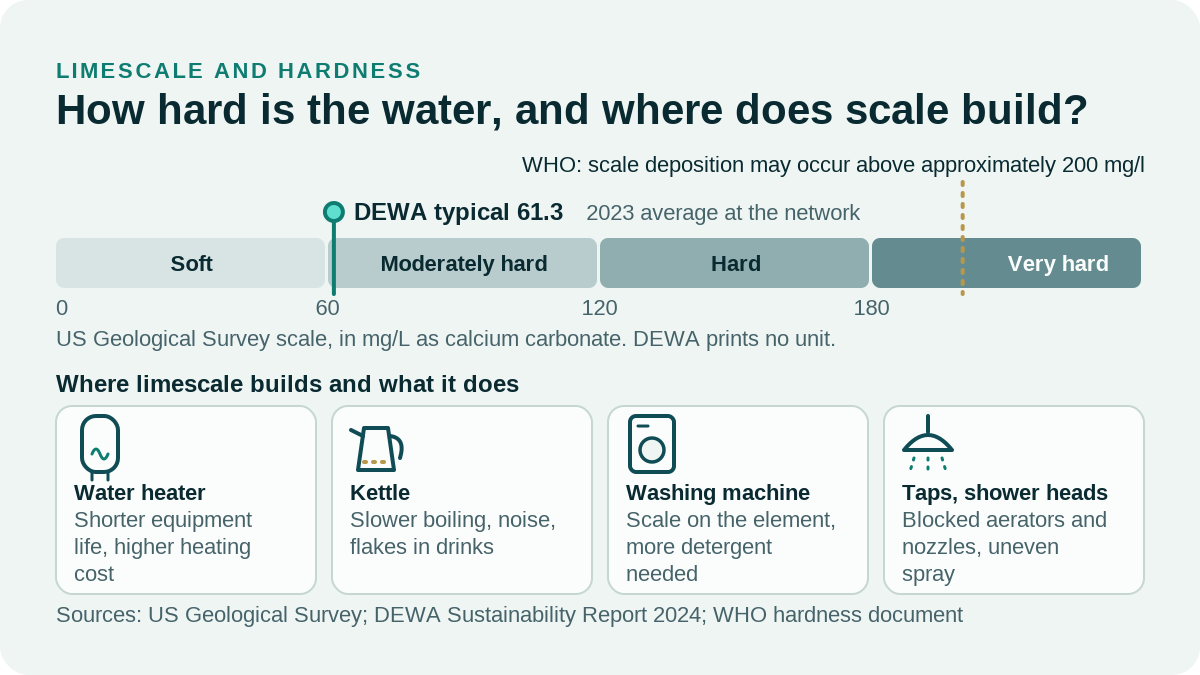
Water hardness is usually given as milligrams of calcium carbonate per litre:
| Hardness (mg/L as calcium carbonate) | Classification |
|---|---|
| 0 to 60 | Soft |
| 61 to 120 | Moderately hard |
| 121 to 180 | Hard |
| More than 180 | Very hard |
Source: US Geological Survey. DEWA's typical total hardness for the water it supplies to the network is 61.3 (2023 average; specification 40 to 120; no unit printed, conventionally mg/L as calcium carbonate). That is at the boundary between soft and moderately hard, so the water supplied in Dubai is not hard by this scale. The WHO notes that scale deposition in pipework and tanks may occur above approximately 200 mg/l. Readings at your tap can differ from the network figure, so a test decides. Limescale still forms from moderately mineralised water wherever it is heated or evaporates, as in kettles, heaters and on shower glass. For the local picture, see is Dubai water hard.
Is limescale bad for you to drink
No, on current evidence. The minerals in limescale are the same calcium and magnesium found in food.
- The WHO background document on hardness concludes that no guideline values are proposed for hardness, and describes hardness as important for acceptability to consumers and for economic and operational reasons.
- The US Geological Survey states that hardness is not a health concern, though it can be a nuisance.
- The WHO adds that drinking water may contribute calcium and magnesium to the diet, which could matter for people whose intake is marginal.
Flakes of scale that break off in a kettle are unpleasant to find in a cup, but they are the same mineral. Pour through a strainer or descale the kettle.
Two cautions keep this honest:
- This is about hardness, not about everything in water. A kettle full of scale tells you the water carries calcium and magnesium. It tells you nothing about chlorine, bacteria in a neglected tank, or metals from old pipes. Those need a test.
- Medical conditions. If you have kidney disease or have been told to restrict minerals, follow your doctor's advice on what to drink. This page is general information, not medical advice.
Limescale, skin and hair
Many residents report that hard water leaves skin feeling tight and hair feeling rough. The WHO document notes one suggested explanation: soap does not rinse away well in hard water and can leave residue on skin. That is a comfort issue for some people, and research on whether it worsens skin conditions is mixed. A randomised trial of 336 children with eczema in hard water areas found that fitting a water softener gave no additional benefit over usual care.
Water treatment is not medical treatment. If you have a rash, eczema or hair loss, see a doctor. More detail is in signs of hard water on hair and skin.
Is limescale harmful to appliances
This is where limescale costs money.
- Water heaters and boilers. Scale forms on the heating surface and acts as a layer between the element and the water. The US Geological Survey notes that this scale can reduce the life of equipment and raise the cost of heating water. The WHO document describes the same effect as reduced efficiency of heat exchangers.
- Kettles and coffee machines. Slower boiling, noise, flakes in drinks and blocked pipes in espresso machines.
- Washing machines and dishwashers. Scale on the element and in valves, more detergent needed, and a white film on glasses.
- Taps and shower heads. Blocked aerators and nozzles, uneven spray, stiff cartridges.
- Surfaces. Glass that is left scaled for years can become permanently etched.
The WHO document also records the other side: softened water gives minimal scaling, more efficient heat transfer, and probably longer life for water heaters.
When limescale matters, and when it does not
| Situation | Does it matter? | What to do |
|---|---|---|
| Light white marks on taps and glass | Cosmetic | Wipe dry after use; descale now and then |
| Crust in the kettle every few weeks | Nuisance | Descale regularly; consider purified water for the kettle |
| Water heater noisy, slow, or failing early | Yes, a real cost | Have it serviced; measure hardness |
| Shower heads and aerators blocking often | Yes | Measure hardness; consider treating at source |
| Worried about drinking it | Not a health concern for hardness itself | Test the water for what scale cannot tell you |
For the cleaning side, see how to remove limescale.
What treatment does and does not do
- An ion-exchange softener at the villa inlet removes the calcium and magnesium that form scale. It is the treatment that stops limescale. It does not lower TDS, it adds a little sodium to the water, and it is not a drinking water purifier. See water softeners in Dubai.
- A reverse osmosis purifier in the kitchen removes most minerals from drinking water, so a kettle filled from it scales far less. It does nothing for the rest of the house.
- A shower filter does not soften water and will not stop scale.
- Carbon and sediment filters do not remove hardness.
- Boiling forces some scale out of the water into the kettle. It does not make hard water soft in any useful sense for the home.
A softener is worth its cost only where the hardness is high enough to cause real trouble. Measure first.
Next step
To know whether limescale is worth treating in your home, measure the hardness. Book a free water test. We measure hardness, TDS, disinfectant residual and pH at your taps and give you the results in writing, with no obligation. Appointments are taken at least 10 days ahead.
Find out what is in your water
The free test measures hardness, TDS, disinfectant residual and pH at your own taps. We supply, install and maintain water treatment systems in every area of Dubai; message us for prices and service details.