Read this first
Water treatment is not medical treatment. Hair loss, eczema, persistent rashes and scalp problems have many causes, and most have nothing to do with water. See "When to see a doctor" below.
Why hard water behaves differently on hair and skin
Hard water contains dissolved calcium and magnesium. The World Health Organization describes hardness as the capacity of water to react with soap: hard water needs considerably more soap to produce a lather and often leaves a deposit. The US Geological Survey explains that soap reacts with the calcium to form soap scum.
That reaction is the basis of most of what people notice. Less lather, more product used, and a residue that is harder to rinse away. The WHO document records a suggested explanation for skin irritation along the same lines: soap or mineral residues left on skin or clothes that are not easily rinsed off. It is a suggested mechanism, not an established cause of any skin condition.
Signs of hard water on hair
Many residents report some of the following. They are observations, not proof.
- Shampoo lathers poorly, so you use more
- Hair feels coated, stiff or straw-like after washing, even with conditioner
- Dullness and less shine
- More tangling and frizz
- Colour-treated hair seems to fade or turn brassy sooner
What the research shows is limited, and it disagrees. In small laboratory studies on cut hair, one (15 volunteers, 30 days) found no significant difference in tensile strength or elasticity between hard and distilled water, while two (76 and 70 men) found tensile strength roughly 7 to 8 per cent lower after hard water. Another found that hair takes up calcium and magnesium from water, more when chemically damaged, and becomes stiffer, which fits the rough feel people describe. None measured hair shedding or growth, and our search found no study testing hard water as a cause of hair loss.
Signs of hard water on skin
- Skin feels tight or dry soon after a shower
- A "squeaky" feel, or a film that seems not to rinse off
- Soap and body wash lather poorly
- Itchiness that eases with moisturiser
Can hard water cause dry skin?
It may contribute for some people, mainly through soap residue and the extra product used. The evidence that it causes or worsens skin disease is mixed.
- A 2021 systematic review of seven observational studies (385,901 participants) found higher odds of atopic eczema in children exposed to harder water (odds ratio 1.28), and rated the certainty of that evidence very low.
- When this was tested directly, the result was negative. A randomised controlled trial in the UK fitted ion-exchange water softeners in the homes of children with moderate to severe eczema, all in hard water areas. Among 336 children, softeners gave no additional benefit over usual care, and a 2021 review of the randomised trials reached the same conclusion.
Softer water may feel nicer, and many people prefer it. It should not be bought as a treatment for a skin condition.
What else produces the same signs
Before blaming hardness, note that the water DEWA supplies is not hard by the standard scale (see below), and consider the other usual suspects in Dubai.
| Possible cause | Typical clues |
|---|---|
| A disinfectant residual | Disinfectant smell in a hot shower |
| Climate and air conditioning | Worse in summer or after long hours in cooled, dry rooms; lips and hands dry too |
| Hot showers and long showers | Tightness straight after washing, better with cooler water |
| A change of products | Began when you changed shampoo, soap or detergent |
| Building tank or pipework | Sediment or discolouration in the water; varies between taps |
| A medical cause | Patches, scaling, hair coming out in clumps, symptoms that keep getting worse |
If you moved recently, several of these changed at once; see new to Dubai: what the water does to hair and skin.
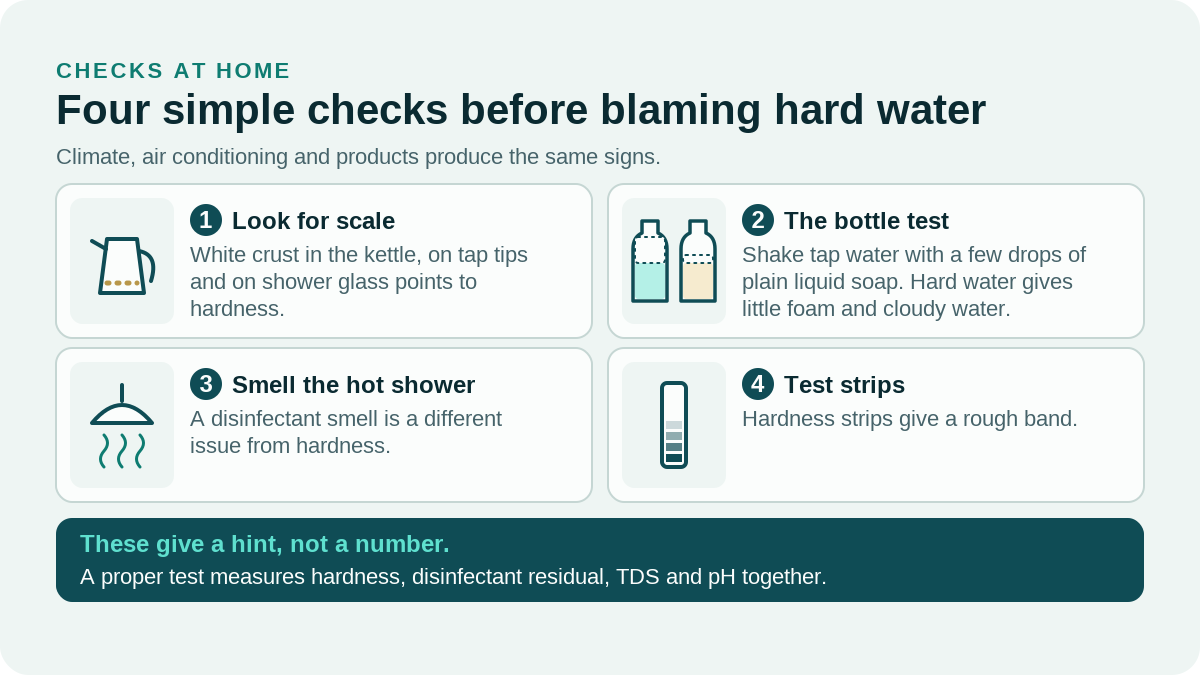
Simple checks at home
These give a hint, not a number.
- Look for scale. White crust in the kettle, on tap tips and on shower glass points to hardness.
- The bottle test. Half-fill a clear bottle with tap water, add a few drops of plain liquid soap (not detergent), and shake. Soft water gives a deep foam and clear water below. Hard water gives little foam and cloudy water.
- Smell the hot shower. A disinfectant smell is a different issue from hardness.
- Test strips. Hardness strips give a rough band.
The definite answer: measure it
Hardness is reported in milligrams of calcium carbonate per litre. The US Geological Survey classes 0 to 60 as soft, 61 to 120 as moderately hard, 121 to 180 as hard and more than 180 as very hard. DEWA's typical total hardness for supplied water is 61.3 (2023 average at the network; no unit printed, conventionally mg/L as calcium carbonate): the soft / moderately hard boundary, not hard. The studies above concern water of about 200 mg/L and above. Water at your tap can also differ from the mains because of the building's tank and pipes. See is Dubai water hard.
A proper test measures hardness, disinfectant residual, TDS and pH together.
What helps, matched to the cause
- Hardness confirmed, in a villa: an ion-exchange water softener at the inlet is the treatment that removes hardness. It does not lower TDS.
- Disinfectant smell: a shower filter is a low-cost thing to try. It is certified for free chlorine only, and its effect on Dubai's chlorine dioxide is untested. It does not soften water; see do shower filters remove hard water.
- In an apartment: you cannot soften the shared supply. Use less soap-based product, rinse longer, finish with cooler water, and moisturise after showering.
- Neither is high: look to products, climate and habits, or speak to a doctor.
When to see a doctor
See a doctor or dermatologist, and do not wait for a water fix, if you have:
- hair coming out in clumps, bald patches, or shedding that continues for more than a few weeks
- a scalp that is sore, scaly or inflamed
- skin that is cracked, bleeding, blistered, weeping or painful
- a rash that is spreading, or eczema that is not improving with your usual treatment
- any of the above in a baby or young child
The UK National Health Service advises seeing a GP if you or your child have symptoms of atopic eczema or if treatments are not helping, and urgently if the skin is blistered, leaking, painful or suddenly worse.
Next step
The quickest way to stop guessing is to measure. Book a free water test. We measure hardness, disinfectant residual, TDS and pH at your taps and give you the results in writing, with no obligation. Appointments are taken at least 10 days ahead.
Find out what is in your water
The free test measures hardness, TDS, disinfectant residual and pH at your own taps. We supply, install and maintain water treatment systems in every area of Dubai; message us for prices and service details.