The short answer
If your complaint is white scale on the glass, crusted shower heads and soap that will not lather, a shower filter will not fix it. If your complaint is grit or a disinfectant smell, a shower filter is something to try, though its effect on chlorine dioxide, the disinfectant DEWA reports for Dubai, is untested.
What a hard water shower filter does and does not do
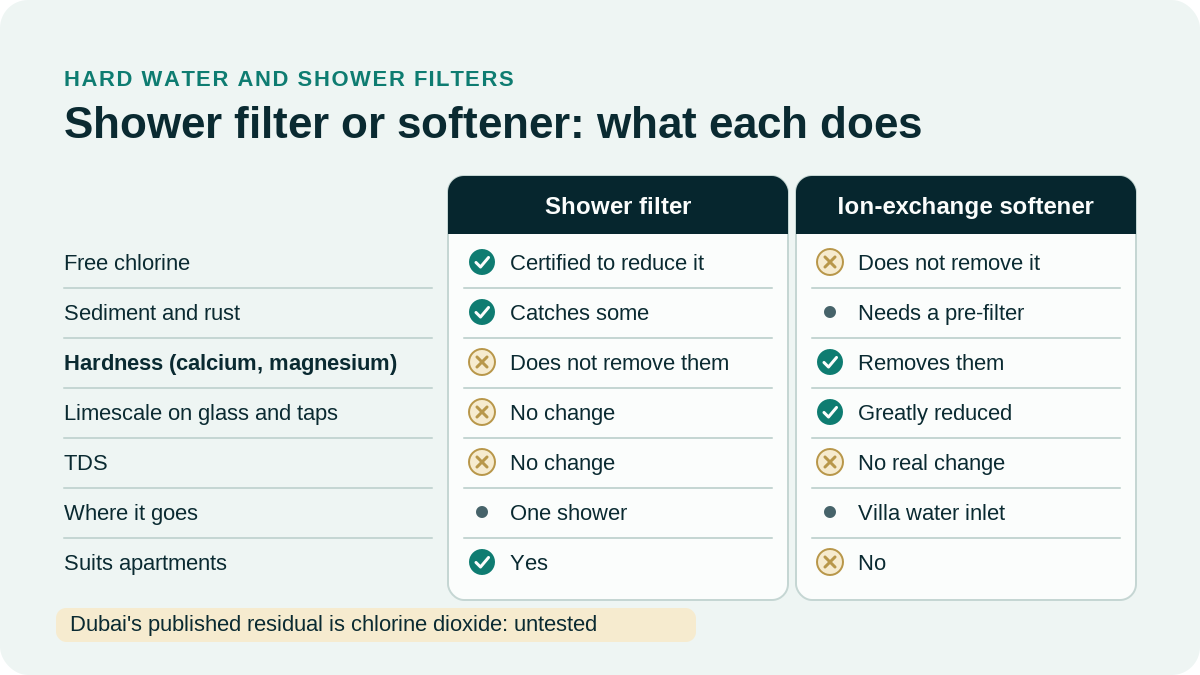
| Shower filter | Ion-exchange softener | |
|---|---|---|
| Free chlorine | Certified to reduce it | Does not remove it |
| Chlorine dioxide (Dubai's published residual) | Untested | Not designed for it |
| Sediment and rust | Catches some | Needs a pre-filter |
| Calcium and magnesium (hardness) | Does not remove them | Removes them |
| Limescale on glass and taps | No change | Greatly reduced |
| TDS | No change | No real change |
| Where it goes | One shower | Villa water inlet |
| Suits apartments | Yes | No |
Why a cartridge cannot soften
Softening works by ion exchange. Water passes through a bed of resin beads that hold on to calcium and magnesium and release sodium in their place. The resin fills up, so a softener has a large resin tank and a brine tank that washes the resin clean with salt water at regular intervals.
A shower cartridge has room for a handful of media and no way to regenerate it. Even if it were packed with softening resin, the resin would be exhausted quickly at shower flow rates, and then it would do nothing. How quickly depends on how hard the water is.
How hard is Dubai's water?
DEWA's published typical total hardness for the water it supplies is 61.3. That is a 2023 average at the network, not at your tap, and the table prints no unit (the convention is mg/L as calcium carbonate). On the US Geological Survey scale, soft is 0 to 60 and moderately hard is 61 to 120, so the supplied water sits at the boundary and is not hard by the standard scale. Readings at the tap can differ, and scale marks alone do not tell you the number. A test decides; see is Dubai water hard for the detail.
What about "water softener shower heads"?
Products sold as a water softener for the shower, or a water softener shower head, usually contain KDF, calcium sulfite, carbon, or mineral beads. These are free chlorine media, not softening media. KDF's manufacturer describes it as controlling scale, but that is not the same as removing calcium and magnesium from the water.
The Water Quality Association makes a similar point about anti-scale devices in general: they may discourage scale from forming, but they do not reduce the total calcium or magnesium content of the water. The same body defines soft water, following NSF/ANSI 44, as water with less than 1 grain of hardness per gallon, which is under 17.1 mg/L. A shower cartridge does not get hard water anywhere near that.
A simple check: a home hardness test strip before and after the filter. If the two readings match, the filter is not softening.
Hard water or chlorine: how to tell which you have
The signs overlap on hair and skin, but they differ around the bathroom.
| Sign | Points to hard water | Points to disinfectant |
|---|---|---|
| White or chalky marks on glass, tiles and taps | Yes | No |
| Shower head nozzles blocking with crust | Yes | No |
| Soap and shampoo slow to lather | Yes | No |
| A film that is hard to rinse off skin | Yes | No |
| Kettle furring up | Yes | No |
| Swimming-pool smell, stronger in hot water | No | Yes |
| Hair colour fading quickly | Possibly | Possibly |
| Dry or tight skin after washing | Possibly | Possibly |
The top five are visible and reliable. The bottom rows are not, because dry skin and dull hair also come from the climate, air conditioning, sun and the products you use. Our page on the signs of hard water on hair and skin goes through these one by one.
The dependable way to tell is to measure. A test gives you hardness and disinfectant residual as two separate numbers. A standard chlorine test kit also responds to chlorine dioxide and cannot tell the two apart, so the second is an indication, not a breakdown.
What does remove hard water
If you are looking for a hard water filter, the equipment that removes hardness is a softener: calcium and magnesium are dissolved and pass through filters.
In a villa: a softener at the inlet
An ion-exchange water softener fitted where the mains or tank supply enters the house treats every tap, shower and appliance. It is usually installed after sediment and carbon filters, which protect the resin from grit and chlorine. It is worth fitting only if the reading at your taps justifies it: DEWA's published figure for supplied water is below the hard band. This is the Water Quality Association's general advice too: hardness is best treated for the whole building.
A softener has limits of its own. It does not lower TDS, it does not remove chlorine, and softened water contains a little more sodium. It needs salt top-ups and a drain connection.
In an apartment: manage it
You cannot fit a softener on shared plumbing. What you can do:
- Squeegee the glass after each shower so that water does not dry on it.
- Descale shower heads and taps regularly. See how to remove limescale.
- Use a chelating or clarifying shampoo from time to time to lift mineral build-up from hair. Ask a hairdresser what suits your hair type.
- Fit a shower filter for sediment or a disinfectant smell if you want to try one; its effect on chlorine dioxide is untested.
What does not work
Magnetic and electronic gadgets clipped to a pipe do not remove calcium or magnesium. Boiling removes some hardness from a kettle's worth of water, which is no use for a shower.
Which is right for you
- Villa owner, scale everywhere: softener, after a test confirms the hardness level.
- Villa owner, mostly disinfectant smell: a shower filter to try in one bathroom, or whole-house carbon filtration if the survey supports it. Carbon is certified for free chlorine; we have found no tested figure for chlorine dioxide.
- Tenant in an apartment, scale and a disinfectant smell: a shower filter to try for the smell, cleaning for the scale.
- Tenant in an apartment, scale only: a shower filter will probably disappoint you. Save the money.
If a shower filter does fit your case, our shower filters in Dubai page explains how we choose and fit one, and the guide to the best shower filter in UAE lists what to check before buying any brand.
Next step
Find out whether hardness, disinfectant or both are behind what you are noticing. Book a free water test. We measure hardness, disinfectant residual, TDS and pH at your taps and give you the results in writing, with no obligation. Appointments are taken at least 10 days ahead.
Find out what is in your water
The free test measures hardness, TDS, disinfectant residual and pH at your own taps. We supply, install and maintain water treatment systems in every area of Dubai; message us for prices and service details.