The main cartridge types
| Cartridge | What it does | What it does not do |
|---|---|---|
| Sediment (spun or pleated polypropylene, polyester and similar) | Strains particles such as sand, silt and rust | Does not remove anything dissolved; does not disinfect |
| Granular activated carbon (GAC) | Adsorbs taste and smell compounds as water passes loose carbon granules; certified claims cover free chlorine | Does not remove dissolved salts or hardness; does not disinfect |
| Carbon block, often labelled CTO | The same carbon, bound into a solid block that also acts as a fine particle filter | Same limits as GAC |
| Reverse osmosis membrane | Lowers dissolved solids (TDS) | Does not work alone: it needs sediment and carbon cartridges ahead of it |
| Post-carbon | A small carbon cartridge after the RO tank, for taste | Does not lower TDS further |
| Remineralising, sometimes sold as an alkaline cartridge | Adds minerals back to RO water for taste | Does not purify; it is a taste stage |
CTO is a trade label. One carbon block maker's data sheet spells it out as "Chlorine Taste and Odor reduction", and notes that its capacity figures are based on free chlorine and are "Not performance tested or certified by NSF". That is a useful reminder: a label is not a certification. For Dubai there is a further point. DEWA's published disinfectant is chlorine dioxide, and no filter cartridge is certified for it, so we do not claim that a CTO or any other carbon water filter cartridge reduces the disinfectant in Dubai's water. The detail is on activated carbon filters.
How these cartridges are arranged in sequence is covered in how a water filter system works, and how many you need in 3-stage, 5-stage and 7-stage filters.
Micron ratings explained
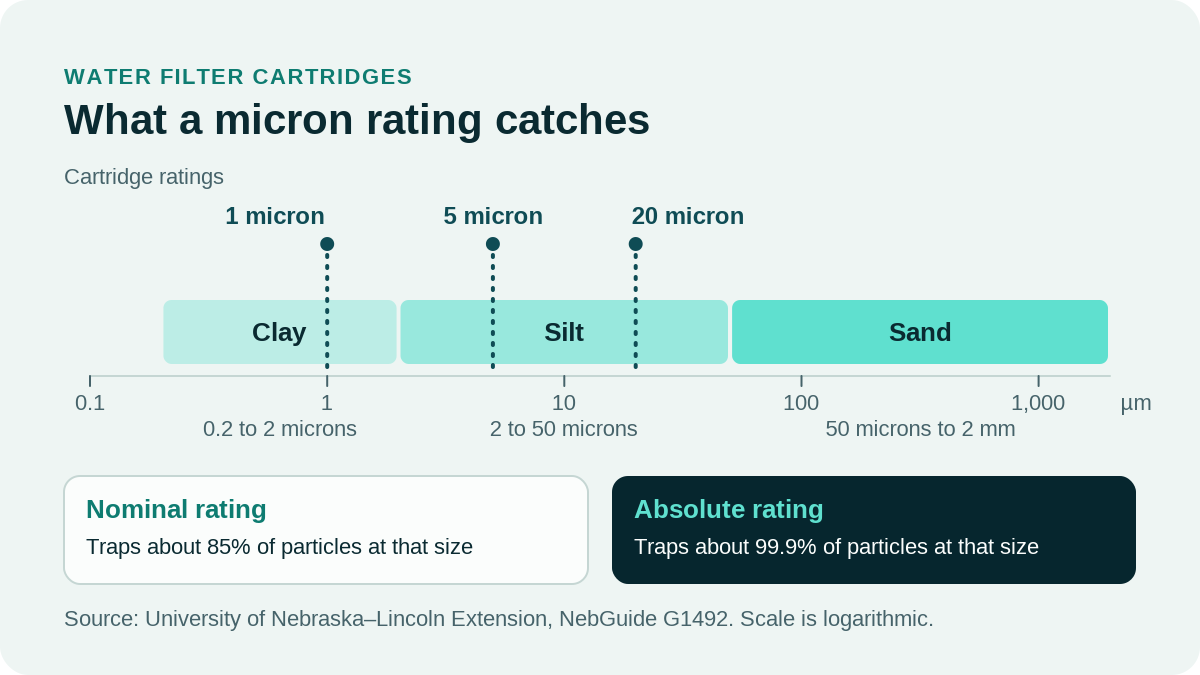
A micron is one thousandth of a millimetre. University of Nebraska–Lincoln Extension explains the rating this way: "a 10 micron (ten thousandths of a millimeter) filter would trap contaminants 10 microns in diameter or larger".
The same guide gives the size of what you are trying to catch:
| Particle | Typical size |
|---|---|
| Sand | 50 microns to 2 millimetres |
| Silt | 2 to 50 microns |
| Clay | 0.2 to 2 microns |
So a 20 micron cartridge traps sand but, as the guide puts it, "may not effectively remove some silt particles". A 5 micron sediment filter cartridge catches most of the silt range. A 1 micron cartridge reaches the top of the clay range.
Two words on the box change what the number means:
- Nominal. The Nebraska guide says cartridges rated nominal "should trap approximately 85 percent of particles equal to the pore size rating".
- Absolute. Those rated absolute "should trap approximately 99.9 percent".
Finer is not always better. A finer cartridge holds back more, so it loads up sooner. That is why a coarse sediment filter usually goes first and protects the finer and more costly stages behind it.
Sizes: 10 inch, 20 inch, slim and jumbo
Most drop-in cartridges follow a few industry sizes, so cartridges from different makers fit the same housings. One carbon block manufacturer lists its range for "industry standard 10 inch and 20 inch open sump housings" in four sizes:
| Common name | Diameter × length | In millimetres |
|---|---|---|
| 10 inch slim | 2¾ × 9¾ inches | 70 × 248 |
| 20 inch slim | 2¾ × 20 inches | 70 × 508 |
| 10 inch jumbo | 4½ × 9¾ inches | 114 × 248 |
| 20 inch jumbo | 4½ × 20 inches | 114 × 508 |
A "10 inch" cartridge is therefore a little under 10 inches long. Slim cartridges suit the space under a kitchen sink. Jumbo housings take 4½ inch diameter cartridges and are used where the whole flow of a house passes through, as in whole-house water filtration for villas.
Not every system uses these sizes. Many compact under-sink units and shower filters take cartridges made only for that model. Before buying 20 inch water filter cartridges, or any other, measure the old one and check the housing's label.
How often to replace each cartridge
There is no single interval that is true for every home. The Nebraska guide on reverse osmosis says the life of a pre-filter "depends upon water volume, quality and contaminant concentration". What the sources do give is a rule for each type.
| Cartridge | What decides replacement | What the sources say |
|---|---|---|
| Sediment | Flow | "When a noticeable drop in water flow through the filter occurs, clean or replace the cartridge" (Nebraska Extension) |
| Carbon, GAC or block | Rated volume or time, whichever comes first | Saturation can occur long before any pressure change; tested performance fell significantly after 75 per cent of the manufacturer's stated lifetime (Nebraska Extension) |
| RO pre-filter and post-filter | Manufacturer's schedule | One manufacturer's support page: "changed every six months" |
| RO membrane | TDS reduction, or the maker's maximum age | The same page: replace when TDS reduction falls below 75 per cent, or at most every 3 to 5 years |
| Remineralising | Manufacturer's schedule | No independent figure found; follow the system's manual |
The membrane figures are one manufacturer's. Others publish different intervals, and the schedule printed for your own model is the one to follow. Dubai Municipality's guideline for drinking water in buildings asks for filters to be changed "according to the manufacturer, with labels showing this", and adds that consumption volume must be considered. It also warns that old carbon filters past their use-by date "can support the growth of microbes". In a warm climate that is a reason to change cartridges on time.
Signs a cartridge is spent
- Flow has dropped. The usual sign for a sediment cartridge.
- A taste or smell has returned. A late sign for carbon. The Nebraska guide says the only certain check is repeated testing of the filtered water.
- TDS after the purifier is creeping up. The sign for an RO membrane. Compare tap and purified readings with a TDS meter.
- The date has passed. For carbon this is often the only sign you will get.
How to change a water filter cartridge safely
Follow the manual for your system. The usual sequence for a drop-in housing is:
- Close the valve that feeds the filter and open the filtered tap to release pressure.
- Unscrew the housing, with a bowl or towel underneath.
- Remove the old cartridge and wash the inside of the housing.
- Check the O-ring is clean and seated.
- Fit the new cartridge the right way up and tighten the housing by hand.
- Open the valve slowly, check for leaks, and flush for as long as the manufacturer states before drinking.
- Write the date on the housing or set a reminder.
The CDC advises people with weakened immune systems not to change filters themselves, because the old cartridge holds what it has caught. Shower cartridges are a different job, covered in how to install a shower filter and when to change the cartridge.
Next step
The right cartridges depend on what is in your water. Book a free water test. We measure hardness, TDS, disinfectant residual and pH at your taps, check the tank and inlet, and give you the results in writing with no obligation. Appointments are taken at least 10 days ahead.
Find out what is in your water
The free test measures hardness, TDS, disinfectant residual and pH at your own taps. We supply, install and maintain water treatment systems in every area of Dubai; message us for prices and service details.