What "stage" means, and why the number can mislead
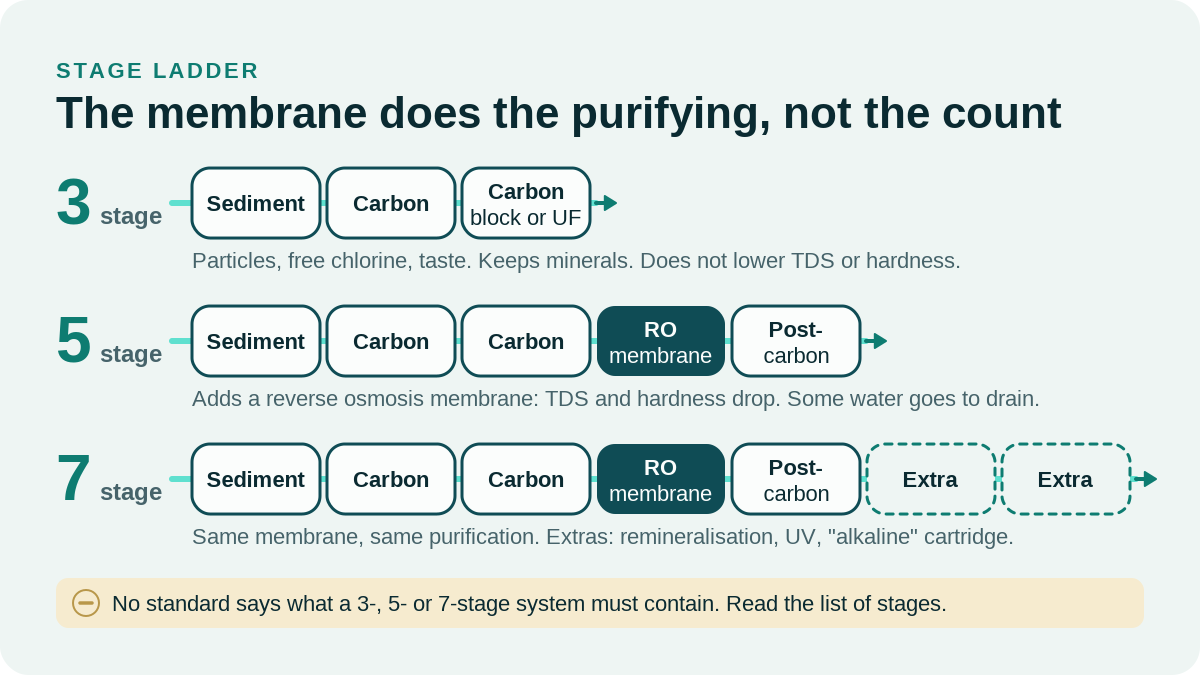
A stage is one cartridge or component that the water passes through. There is no standard that says what a 3-, 5- or 7-stage system must contain. Manufacturers choose what to include and how to count.
Two things follow from that:
- Two "5-stage" systems can be quite different products. One may be five cartridges with a reverse osmosis membrane. Another may have no membrane at all.
- A stage count can be raised without adding a new kind of treatment, for example by fitting two carbon cartridges in a row or by counting several media layered inside one cartridge as separate stages.
So read the list of stages, not the number on the box. The principles behind the sequence are covered in how a water filter system works. This page is about how many stages are worth paying for.
What each stage does
The table lists the most common stages, roughly in the order they are added.
| Stage | What it adds | What it does not do | Typically found in |
|---|---|---|---|
| Sediment filter | Traps sand, silt and rust. Protects later stages | Removes nothing dissolved | 3, 5, 7 |
| Carbon filter (granular) | Reduces free chlorine, taste, odour, many organic compounds | Does not lower TDS or hardness | 3, 5, 7 |
| Second carbon filter (block) | Longer contact with carbon and finer straining. Extra protection for a membrane | Adds no new type of removal | 3, 5, 7 |
| Ultrafiltration membrane (alternative third stage) | Holds back very fine particles and bacteria | Does not remove dissolved salts | Some 3- and 4-stage |
| Reverse osmosis membrane | Rejects most dissolved salts, hardness, microbes, many chemicals. Lowers TDS | Leaves very few minerals. Sends some water to drain | 5, 7 |
| Post-carbon filter | Polishes taste after the storage tank | Adds no new type of removal | 5, 7 |
| Remineralisation cartridge | Puts some calcium and magnesium back. Improves taste | Removes nothing | 6, 7 |
| UV lamp | Inactivates microbes after the tank | Removes nothing | 7 and above |
| "Alkaline", "mineral ball", "infrared" or similar cartridges | Usually a variation on remineralisation that raises pH slightly | Removes nothing. Research on health claims for these is mixed | 7 and above |
What the membrane stages remove is taken from CDC guidance: ultrafiltration removes parasites and bacteria but not dissolved chemicals, and reverse osmosis also removes dissolved substances such as sodium and chloride. Each stage has a fuller explanation: sediment, activated carbon and reverse osmosis.
A 3 stage water filter compared with 5 and 7 stages
A 3 stage water filter system
The usual layout is sediment, granular carbon, then carbon block or ultrafiltration. It fits under a sink or, in a larger format, at a whole-house inlet.
- Does: clearer water, less free chlorine taste and smell, no reject water, natural minerals kept.
- Does not: lower TDS, remove hardness or stop limescale in the kettle.
- Suits: homes where tap water TDS is already acceptable to you and taste is the complaint.
5 stage reverse osmosis
The usual layout is sediment, carbon, carbon, RO membrane, post-carbon. The first three stages exist mainly to protect the membrane. The membrane does the purifying. The fifth stage tidies up the taste.
- Does: everything a 3-stage does, plus a sharp drop in TDS and hardness in drinking water.
- Does not: keep minerals, or work without sending some water to drain.
- Suits: homes that want low-TDS drinking water or want to replace bottled water.
A 7 stage reverse osmosis system
Take the five stages above and add two from this list: remineralisation, UV, an "alkaline" cartridge.
- Does: the same purification as a 5-stage, with a better taste if remineralisation is one of the extras, and a second microbial barrier if UV is.
- Does not: purify more deeply than a 5-stage. The membrane is the same.
- Suits: people who find plain RO water flat. Of the possible extras, remineralisation is the one with a clear, everyday benefit.
Seven-stage water filtration systems without a membrane also exist. These are multi-media filters, and seven layers of media still leave dissolved salts in the water.
Why more stages is not automatically better
The membrane sets the ceiling. In an RO system, purification is done by one component. Stages after it cannot remove more, because there is very little left to remove.
Duplicate stages add capacity, not capability. A second carbon cartridge means the carbon lasts longer and the membrane is better protected. It does not remove a new class of contaminant.
Every stage is a cartridge to replace. More stages mean a higher running cost and more to keep track of. The CDC notes that filters must be changed as the manufacturer recommends, both to keep them working and to prevent germs growing in them. A 7-stage system with overdue cartridges is worse than a 3-stage system that is looked after.
Every stage costs a little pressure and adds joints. More housings mean more resistance to flow and more connections that can leak.
Some extra stages have mixed evidence behind them. Cartridges sold with health claims about alkalinity, energy or "structured" water are the main examples. See alkaline water at home: worth it?
Certification tells you more than a count. The CDC advises looking for NSF certification on the label to see what a filter will remove. NSF/ANSI 42 covers taste and odour claims, 53 covers health-related contaminants and 58 covers reverse osmosis systems. A certificate names specific substances. A stage count does not.
How many stages are enough for Dubai water?
The answer depends on three readings taken at your tap.
- TDS. If it is at a level you are happy to drink, a 3-stage filter may be all you need. If you want it lower, you need a membrane, which means a 5-stage layout or more. DEWA's typical TDS for supplied water is 216, which WHO taste panels would rate as excellent (below 300 mg/litre).
- Free chlorine. Any of the three layouts deals with it, because all include carbon. DEWA publishes no free chlorine figure; it reports chlorine dioxide (typical 0.44), for which no filter is certified and we have found no tested figure.
- Hardness. Only a membrane removes it from drinking water. For scale around the whole house, no under-sink stage count helps. That is a softener's job. DEWA's typical total hardness is 61.3, at the soft / moderately hard boundary on the US Geological Survey scale, so supplied water is not hard by that scale.
The DEWA figures are 2023 averages for water supplied to the network (no units printed, conventionally mg/L), not readings at your tap.
As a rule of thumb for drinking water: three well-chosen stages for taste, five for low TDS, and one extra stage for remineralisation if you prefer the taste. Dr Water Lab fits under-sink drinking water systems built around reverse osmosis with a remineralisation stage, and will tell you if your test results suggest something simpler would do. Our systems start from AED 1,000 and go up to AED 20,000, depending on what your home needs.
Next step
A free water test gives you the three numbers that decide this: TDS, hardness and disinfectant residual. Dr Water Lab measures them at your taps and puts the results in writing. Book a water test.
Find out what is in your water
The free test measures hardness, TDS, disinfectant residual and pH at your own taps. We supply, install and maintain water treatment systems in every area of Dubai; message us for prices and service details.