What is alkaline water?
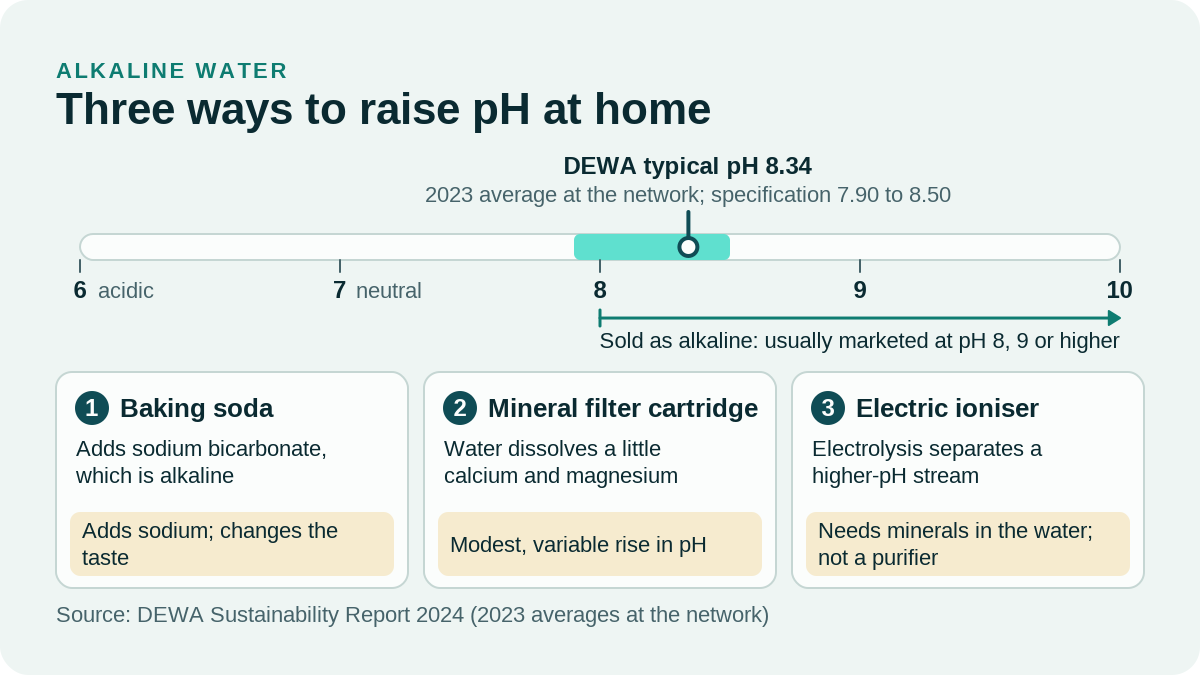
pH measures how acidic or alkaline a liquid is. Seven is neutral. Below seven is acidic, above seven is alkaline. Plain water is typically around neutral, and water sold as alkaline is usually marketed at pH 8, 9 or higher. Dubai's supply is already on the alkaline side: DEWA's typical pH for the water it supplies is 8.34 (2023 average at the network; specification 7.90 to 8.50).
Two different things are sold under the same name:
- Water that is alkaline because of its minerals. Dissolved calcium, magnesium and bicarbonate raise pH slightly and give water more body and taste.
- Water made alkaline by a machine. An ioniser uses electricity to split the water stream and delivers the higher-pH part to the tap.
pH alone says little about quality. The World Health Organization proposes no health-based guideline value for pH in drinking water. It describes pH as not of health concern at the levels found in drinking water, and as one of the most important operational parameters for water suppliers, because it affects corrosion and disinfection.
How to make alkaline water: three ways at home
| Method | How it raises pH | Cost and effort | Keep in mind |
|---|---|---|---|
| Baking soda | Adds sodium bicarbonate, which is alkaline | Lowest cost, no equipment | Adds sodium; changes the taste |
| Mineral or alkaline filter cartridge | Water dissolves a little calcium and magnesium as it passes | A cartridge to replace on schedule | Modest, variable rise in pH |
| Electric water ioniser | Electrolysis separates a higher-pH stream | Highest cost; needs power and cleaning | Needs minerals in the water to work; pH claims vary |
1. Baking soda
A small pinch of baking soda (sodium bicarbonate) stirred into a glass of water raises its pH. It is the simplest way to alkalise water.
The caution is sodium. Baking soda is a sodium salt, and regular use adds to your daily sodium intake. People with high blood pressure, heart or kidney disease, anyone on a sodium-restricted diet, and anyone taking regular medication should ask a doctor before making this a habit. It is not suitable for infants.
Lemon juice is often suggested as well. Lemon juice is acidic, so it lowers the pH of water in the glass. It may be pleasant to drink, but it does not make water alkaline.
2. A mineral or alkaline filter cartridge
Alkaline pitchers and the "alkaline" or remineralisation stage on some purifiers hold mineral media. As water passes through, it picks up a little calcium and magnesium, and the pH rises slightly.
This is the most common route for people who own a reverse osmosis purifier. Reverse osmosis removes most dissolved minerals, and the water it produces can taste flat and may read slightly below neutral pH. A remineralisation stage after the membrane puts some minerals back, which improves taste and brings the pH up. That is what "alkaline water RO" and "alkaline RO water purifier" usually mean in practice. See how to add minerals back to RO water.
How far the pH rises depends on the media, the contact time and the age of the cartridge, so a fixed figure on a box is a best case. The cartridge is spent when the media is used up and needs changing on schedule.
3. An electric water ioniser
An ioniser connects to the tap or sits under the sink. It passes water over charged plates and separates it into a higher-pH stream for drinking and a lower-pH stream that goes to waste or is kept for cleaning.
Ionisers rely on minerals already in the water, so they do little with very low-mineral water such as plain reverse osmosis output. Plates need regular cleaning to stay free of scale. An ioniser is not a purifier: unless it has its own filters, it does not remove chlorine, sediment or dissolved salts.
What the evidence does and does not support
Alkaline water is marketed with claims about hydration, digestion, ageing, bone health and disease prevention. Here is where the evidence stands, as summarised by Cleveland Clinic.
Not supported
- Its dietitian states that science does not support these claims, and that there have been no empirical studies showing that alkaline water has health benefits.
- Cleveland Clinic reports that the US Food and Drug Administration has banned health claims about alkaline water and bone health, because the evidence is insufficient.
- Drinking alkaline water does not change the body's pH in any lasting way. Stomach acid neutralises it, and the body regulates blood pH itself through breathing and the kidneys.
What can fairly be said
- For healthy people, drinking it is not considered harmful.
- Total fluid intake matters more than the type of water.
- Some people prefer the taste of water with minerals in it.
Who should take care
People with kidney disease or a respiratory condition do not regulate pH in the usual way and should ask their doctor before changing what they drink. The same applies to the baking soda method for anyone limiting sodium.
Research in this area is still small, and some studies are funded by sellers. Source to be confirmed
Alkaline water vs RO water
These are not opposites. Reverse osmosis is a purification method: it lowers TDS by removing dissolved salts. Alkaline describes pH. You can have reverse osmosis water that is then remineralised and reads slightly alkaline, and you can have alkaline water from an ioniser that has not been purified at all.
If you want cleaner drinking water, decide on the purification first, based on a test. Then decide whether you prefer the taste with minerals added back. See RO water purifiers and purified, distilled, mineral and RO water.
Is a purifier with an alkaline cartridge worth it?
For taste, often yes. A remineralisation stage is a low-cost addition that makes reverse osmosis water more pleasant to drink, and it is part of the under-sink systems Dr Water Lab fits. We describe it as a taste and mineral stage. We do not sell it as a health product.
For health, there is no sound basis to pay extra. Be cautious with any seller who promises that alkaline water treats or prevents a condition, quotes a very high pH as a selling point, or prices an alkaline cartridge far above an ordinary remineralisation cartridge that does the same job.
A short checklist:
- What media is in the cartridge, and how often is it changed?
- What does it cost per year?
- Is the pH figure measured on water like mine, or a best case?
- Does the system purify the water first? See under-sink drinking water systems.
Next step
Before choosing between purified, remineralised or alkaline water, find out what your tap water contains. Book a free water test. We measure pH, TDS, hardness and disinfectant residual at your taps and give you the results in writing, with no obligation. Appointments are taken at least 10 days ahead.
Find out what is in your water
The free test measures hardness, TDS, disinfectant residual and pH at your own taps. We supply, install and maintain water treatment systems in every area of Dubai; message us for prices and service details.