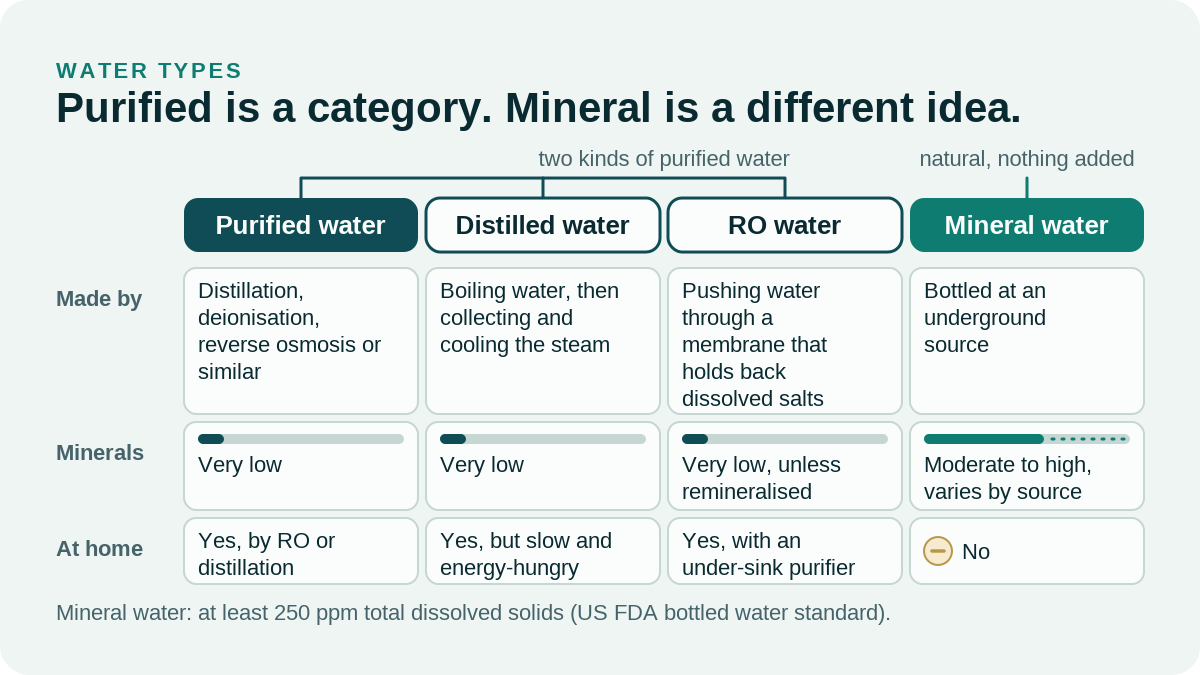
The four types in one table
| Purified water | Distilled water | RO water | Mineral water | |
|---|---|---|---|---|
| What it is | A category: water treated to a very low dissolved-solids level | Purified water made by boiling and condensing | Purified water made by membrane filtration | Natural underground water with its own minerals |
| How it is made | Distillation, deionisation, reverse osmosis or similar | Water is boiled, the steam is collected and cooled | Water is pushed through a membrane that holds back dissolved salts | Bottled at source. No minerals may be added |
| Mineral content | Very low | Very low | Very low, unless remineralised | Moderate to high, varies by source |
| Taste | Neutral to flat | Flat | Neutral, or rounder if minerals are added back | Distinct, depends on the source |
| Made at home | Yes, by RO or distillation | Yes, but slow and energy-hungry | Yes, with an under-sink purifier | No |
The definitions above follow the wording of the US Food and Drug Administration's bottled water standard, which is one of the clearest published. Under it, purified water is water produced by distillation, deionisation, reverse osmosis or other suitable processes, and it may be labelled "distilled water" if made by distillation or "reverse osmosis water" if made by RO. Mineral water must contain at least 250 parts per million of total dissolved solids, come from a protected underground source, and have no minerals added.
Two more names on labels: spring water and deionised water
| What it is | How it differs | |
|---|---|---|
| Spring water | Water from an underground formation from which water flows naturally to the surface, collected at the spring or through a borehole tapping the same formation | Defined by where it comes from. The definition sets no minimum mineral content, which is the difference from mineral water |
| Deionised water | Purified water made by deionisation, a process that takes dissolved mineral ions out of the water | A kind of purified water, like distilled and RO water. Under the US standard it may be labelled "deionized water" or "demineralized water" |
Both rows follow the same US standard as the main table. That standard is itself titled "Bottled water", which answers a common question: bottled water is not a type. Purified, mineral and spring water are all bottled water when they are sold in a bottle, so "mineral water vs bottled water" is a comparison between one type and the whole shelf.
Bottled water sold in the UAE is labelled under Gulf and UAE standards, which use their own definitions. To be confirmed
How each type is made
Purified water
"Purified" describes the result, not the method. Any process that strips water down to a very low level of dissolved solids qualifies. The World Health Organization notes that producers of demineralised bottled water often add some minerals back for taste. The label normally says which kind of water is in the bottle.
Distilled water
Water is boiled. Steam rises, leaving most dissolved material behind, and is condensed back into liquid. The CDC lists distillation as removing parasites, bacteria, viruses and many chemicals, including arsenic, lead, nitrate, sodium, calcium and magnesium. It also notes the limits: distillation uses more energy and takes longer than other systems, and it does not remove some volatile organic compounds, which can evaporate and carry over with the steam. What distilled water is used for, and how it differs from deionised water, is covered in our guide to distilled water.
RO water
Water is pushed under pressure through a membrane with pores of about 0.0001 micron. Dissolved salts, microbes and many chemicals are held back and rinsed to drain. The CDC lists RO as removing parasites, bacteria and viruses and reducing a wide range of dissolved substances. Home units pair the membrane with carbon filters, which deal with free chlorine and organic compounds. Full explanation: what is reverse osmosis?
Mineral water
Mineral water is not manufactured. It is collected from an underground source and bottled. Its character comes from the rock it has passed through, so two mineral waters can taste quite different. Under the US standard, a mineral water below 500 ppm TDS is labelled "low mineral content" and one above 1,500 ppm "high mineral content".
The difference between distilled and purified water
Distilled water is purified water. Purified water is not necessarily distilled. If a bottle says "purified", the water may have been made by reverse osmosis, deionisation or distillation. If it says "distilled", you know the method.
The difference between RO and distilled water
Both end up with very low TDS. They get there differently.
- Energy and speed. Distillation boils every drop. RO uses pressure, usually just mains pressure, and produces water faster.
- What slips through. Some volatile compounds can carry over in distillation. Some dissolved gases and small molecules pass RO membranes. Both are normally paired with carbon for this reason.
- Waste. RO sends part of the water to drain. A distiller leaves a residue of scale to clean out.
- Practicality at home. An under-sink RO purifier gives water on demand at the tap. A countertop distiller makes a few litres per batch.
For drinking water at home, RO is the practical choice. Distilled water remains the usual pick for steam irons, humidifiers and similar appliances.
The difference between mineral water and RO water
Mineral water keeps what nature put in. RO water has had almost everything taken out, and may have a little calcium and magnesium put back.
Neither is automatically "better". Mineral water gives you a consistent natural mineral profile and a taste many people like, at the cost of bottles, storage and delivery. RO water gives you low-TDS water from your own tap, with minerals at whatever level the remineralisation cartridge provides. To be confirmed
Which is best for drinking?
All four are sold and drunk as drinking water. The differences that matter in practice are taste, mineral content and convenience.
Taste. The World Health Organization (WHO) reports that taste panels rate water below 300 mg/litre TDS as excellent and 300 to 600 mg/litre as good, with ratings falling as TDS climbs. It also notes that water with extremely low TDS may be unacceptable to some people because of its flat, insipid taste. That is why purified bottled water and good RO purifiers add some minerals back.
Minerals. The WHO states that drinking water can contribute to calcium and magnesium intake and could be important for people whose intake is marginal, but that there are insufficient data to set minimum or maximum mineral concentrations, so no guideline values are proposed. For most people, food is the main source. If you drink very low-mineral water as your main fluid and have a restricted diet, are pregnant or have a medical condition, it is reasonable to mention it to your doctor. More on this: how to add minerals back to RO water.
What is possible at home in Dubai
- Tap water. Treated mains water, with dissolved minerals and a disinfectant residual. See can you drink tap water in Dubai? DEWA's typical TDS for the water it supplies is 216 (2023 average at the network, not your tap; no unit printed, conventionally mg/L).
- Filtered tap water. Carbon filtration improves taste and removes free chlorine but leaves TDS as it is.
- RO water. An under-sink drinking water system produces purified water at your own tap, with remineralisation if fitted.
- Distilled water. Possible with a countertop distiller, but slow and costly to run for a household's drinking needs.
- Mineral water. Bottled only.
If you currently buy bottled water, our bottled water vs purifier calculator compares the yearly cost. The meaning of the TDS numbers on labels and meters is covered in what is TDS?
Next step
Before choosing between bottles and a purifier, find out what is in your tap water now. Dr Water Lab measures TDS, hardness, disinfectant residual and pH at your home for free, with written results. Book a water test.
Find out what is in your water
The free test measures hardness, TDS, disinfectant residual and pH at your own taps. We supply, install and maintain water treatment systems in every area of Dubai; message us for prices and service details.