Does RO water have minerals? What reverse osmosis removes
Very few. A reverse osmosis membrane does not tell useful minerals from unwanted salts. It rejects dissolved ions as a group.
The CDC lists calcium, magnesium, potassium, sodium, chloride, sulphate and fluoride among the substances reverse osmosis removes or reduces. The World Health Organization (WHO) puts it more bluntly: point-of-use reverse osmosis and distilling devices remove virtually all the minerals from the input water.
You can see this on a TDS meter. Tap water gives one reading and RO water a much lower one. The gap is mostly mineral salts. See what TDS means and what reverse osmosis is.
DEWA's typical TDS for the water it supplies is 216 (2023 average at the network, not your tap; no unit printed, conventionally mg/L). To be confirmed
Is RO water safe to drink without minerals? What WHO and others say
This is the most common worry about RO, so it is worth being precise about what the evidence does and does not say.
What WHO says. In its background document on hardness for the Guidelines for Drinking-water Quality, WHO states that drinking water may be a contributor of calcium and magnesium in the diet and could be important for people whose intake is marginal. It also concludes that there are insufficient data to suggest either minimum or maximum concentrations of minerals in drinking water, and so it proposes no guideline values.
On home devices specifically, WHO notes that RO and distillation leave water devoid of minerals, that this may reduce a household's overall mineral intake, and that users should be made aware of the change. It mentions adding a remineralising unit before the point of consumption as one approach.
The 2005 WHO report people quote. Many websites cite a chapter in a 2005 WHO publication, "Nutrients in Drinking Water", as proof that demineralised water is dangerous. That chapter was one author's review and proposed minimum mineral levels. In a 2020 assessment, Germany's Federal Institute for Risk Assessment (BfR) described those statements as outdated in light of WHO's later work, and noted that WHO's subsequent reports no longer refer to the studies the chapter relied on.
What BfR concluded. Looking at water with very low mineral content, BfR found that the data are limited, but that on current knowledge such water is not expected to have long-term adverse health effects for people who eat a balanced diet and drink normal amounts. It added that some groups should pay attention to their total mineral intake if low-mineral water is their main drink over a long period: people with very unbalanced or restricted diets, people who fast for long periods, and pregnant or breastfeeding women. It also advised against relying on very low-mineral water alone during prolonged strenuous exercise.
In plain terms. No international body sets a minimum mineral level for drinking water. Water is a minor source of minerals for most people, and food is the major one. Putting some calcium and magnesium back is a sensible, low-cost step, mainly for taste and partly as a precaution. It is not medical treatment. If you are pregnant, on a restricted diet or managing a health condition, ask your doctor about your mineral intake overall.
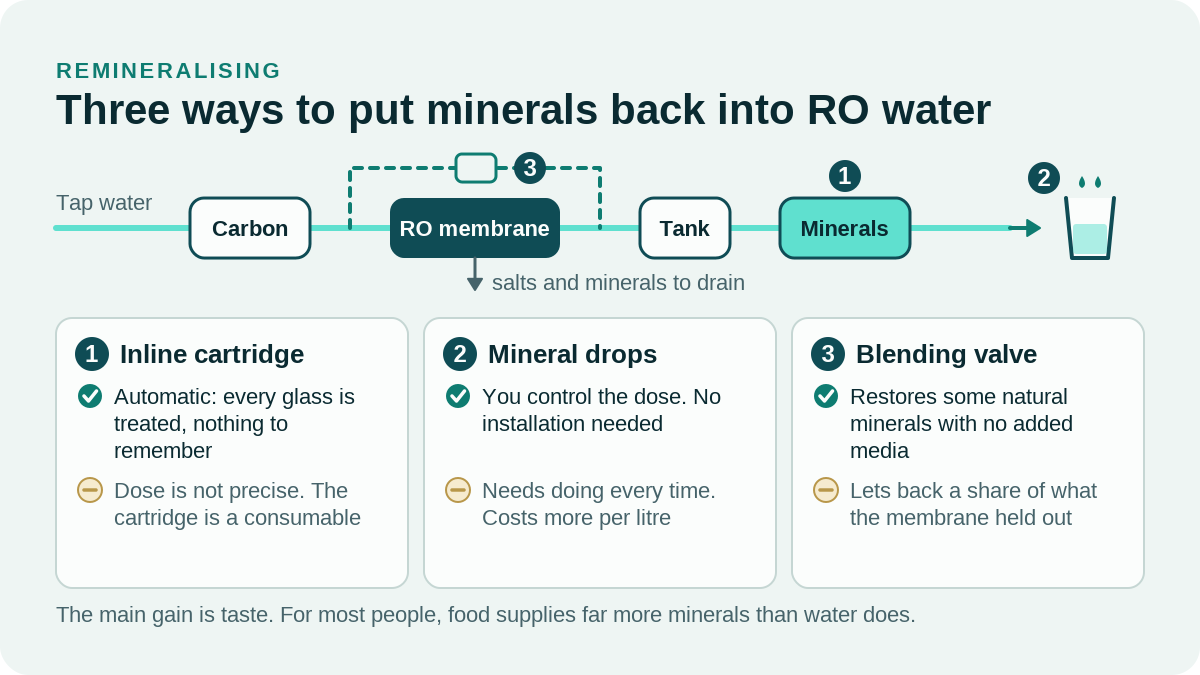
Ways to add minerals to RO water
1. Inline remineralisation cartridge
A cartridge fitted after the RO membrane, usually after the storage tank. Water passes over mineral media, typically forms of calcium carbonate and magnesium, and dissolves a little on the way to the tap.
- For: automatic, every glass is treated, nothing to remember day to day. Also raises pH slightly, which makes the water less aggressive to fittings.
- Against: the dose is not precise. The cartridge is a consumable.
- Best for: most households. This is what Dr Water Lab fits as standard on its RO water purifiers.
Many cartridges sold as "alkaline filters" are the same idea under a different name. See alkaline water at home: worth it?
2. Mineral drops
Concentrated liquid minerals added by hand to a glass or jug.
- For: you control the dose, and no installation is needed.
- Against: you have to remember every time. Taste can be sharp if you overdo it. Running cost per litre is higher than a cartridge.
- Best for: people who want a specific mineral level, or who rent and cannot modify their purifier.
3. Blending
Some purifiers have a blending or TDS-adjust valve that mixes a small amount of filtered, non-RO water back into the RO water.
- For: restores some of the natural mineral profile with no added media.
- Against: it also lets back a share of whatever else the membrane was holding out. The blended water must at least have passed the carbon stages.
- Best for: homes where the incoming water is already of good quality and only the TDS is being moderated.
4. Mineral-rich foods and drinks
Not a way of treating the water, but the most significant source of minerals in practice. Dairy foods, leafy greens, nuts, seeds, pulses and whole grains generally supply calcium and magnesium in larger amounts than drinking water does.
Price to be confirmed
How remineralising changes the taste
Taste is where you will notice the difference.
WHO notes that demineralised water tends to have a flat taste, and that producers of demineralised bottled water often add some minerals for that reason. In its review of total dissolved solids, WHO reports that taste panels rated water below 300 mg/litre TDS as excellent, while also noting that water with extremely low TDS may be unacceptable because of its flat, insipid taste.
A remineralisation stage moves RO water from the "flat" end towards the range most people find pleasant. Calcium and bicarbonate give a rounder, softer mouthfeel. Magnesium adds body, and in excess a slight bitterness.
Preference is personal. Some people like plain RO water. If you have lived on bottled water in the Gulf, remineralised RO water will taste familiar, because some bottled drinking waters are made the same way: purified, then given a measured amount of minerals. More on the categories: purified, distilled, mineral and RO water.
Disadvantages of RO water, stated fairly
- Very low mineral content unless remineralised
- Flat taste unless remineralised
- Some water goes to drain during production
- Filters and membrane need changing on schedule
- Very low-mineral water is more corrosive to metal, which is why RO water runs in plastic tubing to its own tap
A remineralisation stage deals with the first two and helps with the last. For how RO compares with other methods, see our guide to water purification systems.
Next step
If you already have an RO purifier, or are thinking about one, Dr Water Lab can measure your tap water and your RO water side by side during a free home water test. Book a water test.
Find out what is in your water
The free test measures hardness, TDS, disinfectant residual and pH at your own taps. We supply, install and maintain water treatment systems in every area of Dubai; message us for prices and service details.