Reverse osmosis meaning: the name explained
Osmosis is a natural process. Put fresh water and salty water on either side of a fine membrane, and water moves from the fresh side to the salty side until the two even out.
Reverse osmosis runs that process backwards. Pressure is applied to the salty side, which forces water through the membrane in the other direction and leaves the salts behind. The CDC describes it as pushing water from a more substance-laden solution through a filter to a cleaner one.
The same principle, at far larger scale and pressure, is used to turn seawater into drinking water. See where Dubai's tap water comes from.
How does reverse osmosis work in a home purifier?
A household RO unit is a small set of stages under the kitchen sink, feeding its own tap.
- Sediment pre-filter. Traps particles that would foul the membrane.
- Carbon pre-filter. Removes free chlorine, which damages most RO membranes, and improves taste.
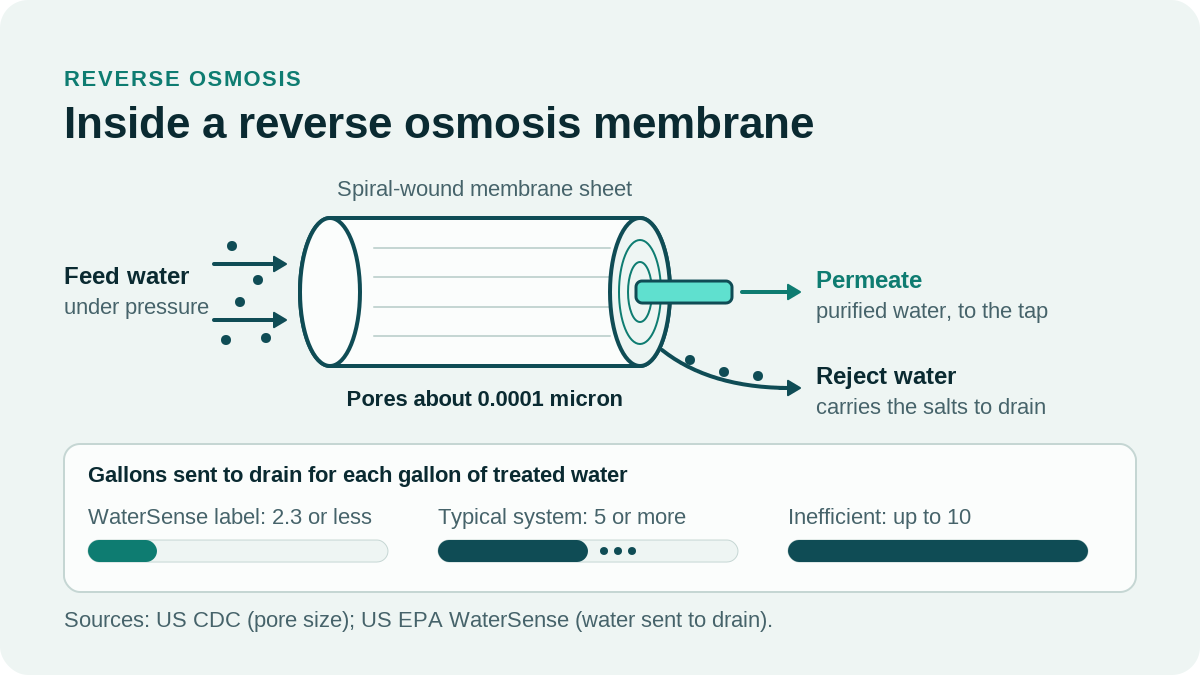
- RO membrane. A sheet rolled into a spiral. Feed water flows across its surface. Part of it passes through as purified water, called permeate. The remainder sweeps the rejected salts along the membrane and out to the drain. This stream is the reject water or concentrate.
- Storage tank. RO produces water slowly, so most units fill a small pressurised tank to give a usable flow at the tap. Tankless units use a larger membrane and a pump.
- Post-carbon filter. Polishes the taste after storage.
- Remineralisation (optional). Adds a little calcium and magnesium back for taste.
The membrane is the heart of the unit. The CDC gives its pore size as about 0.0001 micron, around a hundred times finer than ultrafiltration at about 0.01 micron. The other stages exist to protect it or to finish the water. For the reasoning behind the order, see how a water filter system works.
What reverse osmosis removes
According to the CDC, reverse osmosis:
- Removes parasites, bacteria and viruses
- Removes some chemicals, including lead, copper, chromium, chloride and sodium
- May reduce arsenic, fluoride, radium, sulphate, calcium, magnesium, potassium, nitrate and phosphorus
The US EPA also lists volatile organic compounds and PFAS among the contaminants point-of-use RO systems can remove.
In everyday terms, RO lowers TDS sharply, removes hardness from your drinking water and takes away the salty or mineral taste some people notice. See what TDS means.
Exact performance depends on the product. The CDC advises checking the label for the specific chemicals a unit is certified to reduce. The relevant standard is NSF/ANSI 58.
What reverse osmosis does not do
- It does not keep the minerals. The World Health Organization notes that point-of-use RO and distilling devices remove virtually all the minerals from the input water. Calcium and magnesium go along with everything else. A remineralisation stage puts a small amount back. See how to add minerals back to RO water.
- It does not treat the whole house. A domestic RO unit serves one tap. It does nothing for showers, limescale on glass or your water heater. Scale across the house needs a water softener.
- It does not work without waste. Some water always goes to drain.
- It does not remove every chemical equally. Some dissolved gases and small organic molecules pass through membranes more readily than salts, which is one reason carbon stages are always included alongside.
- It does not stay effective without maintenance. Overdue pre-filters let chlorine and sediment reach the membrane.
Reject water: how much is wasted
Rejecting salts requires a flow of water to carry them away. The US EPA states that a typical point-of-use RO system sends five gallons or more to drain for every gallon of treated water, and that some inefficient units send up to ten. Under the EPA's WaterSense specification, labelled systems must send 2.3 gallons or less to drain per gallon of treated water.
Two things keep this in proportion. A household uses RO water only for drinking and cooking, so the volumes are small compared with showers and laundry. And efficiency varies a great deal between units, so it is worth asking for the recovery ratio before buying. To be confirmed
Maintenance and lifespan
- Pre-filters (sediment and carbon) are the frequent items. They protect the membrane and are changed on the manufacturer's schedule.
- The membrane lasts considerably longer than the pre-filters when they are changed on time. The EPA's WaterSense criteria require a membrane life of at least one year. A rising TDS reading at the RO tap is the usual sign it is wearing out.
- Post-filter and mineral cartridge are changed on schedule.
- The storage tank and lines benefit from periodic sanitising, since chlorine has been removed from the water sitting in them.
To be confirmed The annual maintenance cost is listed in your written quote.
When you need reverse osmosis, and when you do not
RO makes sense when:
- You want to lower TDS in drinking water, for taste or preference
- You want one device at the kitchen tap that deals with dissolved salts, hardness, microbes and a wide range of chemicals
- You are replacing bottled water and want low-TDS water from your own tap
RO may be more than you need when:
- Your tap water TDS is already low and you only dislike the taste. Carbon filtration is the simpler thing to try, with no reject water; it is certified for free chlorine, not chlorine dioxide.
- Your concern is limescale in the bathroom and on appliances. RO at the kitchen tap will not touch it.
DEWA's typical TDS for the water it supplies is 216 (2023 average at the network, not your tap; specification 100 to 450; no unit printed, conventionally mg/L). WHO taste panels rate water below 300 mg/litre as excellent, so on that figure RO is a matter of preference. A reading at your tap decides.
Common misconceptions
"RO water is dead water." It is water with very few minerals. The WHO has not set a minimum mineral level for drinking water. Germany's Federal Institute for Risk Assessment notes that water is only one of several everyday sources of minerals, alongside food. Taste is the more practical issue, and remineralisation addresses it.
"RO removes 100 per cent of everything." No membrane does. Performance varies by contaminant and by product, which is why certification lists specific substances.
"More stages mean better RO." The membrane does most of the work. See 3-stage, 5-stage and 7-stage filters.
Next step
Whether RO is worth it in your home depends on the TDS at your tap. Dr Water Lab measures it for free, along with hardness, disinfectant residual and pH, and gives you the results in writing. Book a water test.
Find out what is in your water
The free test measures hardness, TDS, disinfectant residual and pH at your own taps. We supply, install and maintain water treatment systems in every area of Dubai; message us for prices and service details.