The basic idea: one job per stage
No single filter removes everything. The US Centers for Disease Control and Prevention (CDC) puts it plainly: filters that remove germs often do not remove chemicals, and the reverse is also true. So a water filter system combines several methods, and each one handles what the others cannot.
There are four kinds of work a stage can do:
- Straining. A physical barrier holds back particles larger than its pores. Sediment filters and membranes work this way.
- Adsorption. Activated carbon holds certain dissolved substances on its surface, including free chlorine and many organic compounds.
- Ion exchange. A softener resin swaps calcium and magnesium for sodium.
- Disinfection. Ultraviolet light inactivates microbes. It takes nothing out of the water.
The stages in order, and what each one does
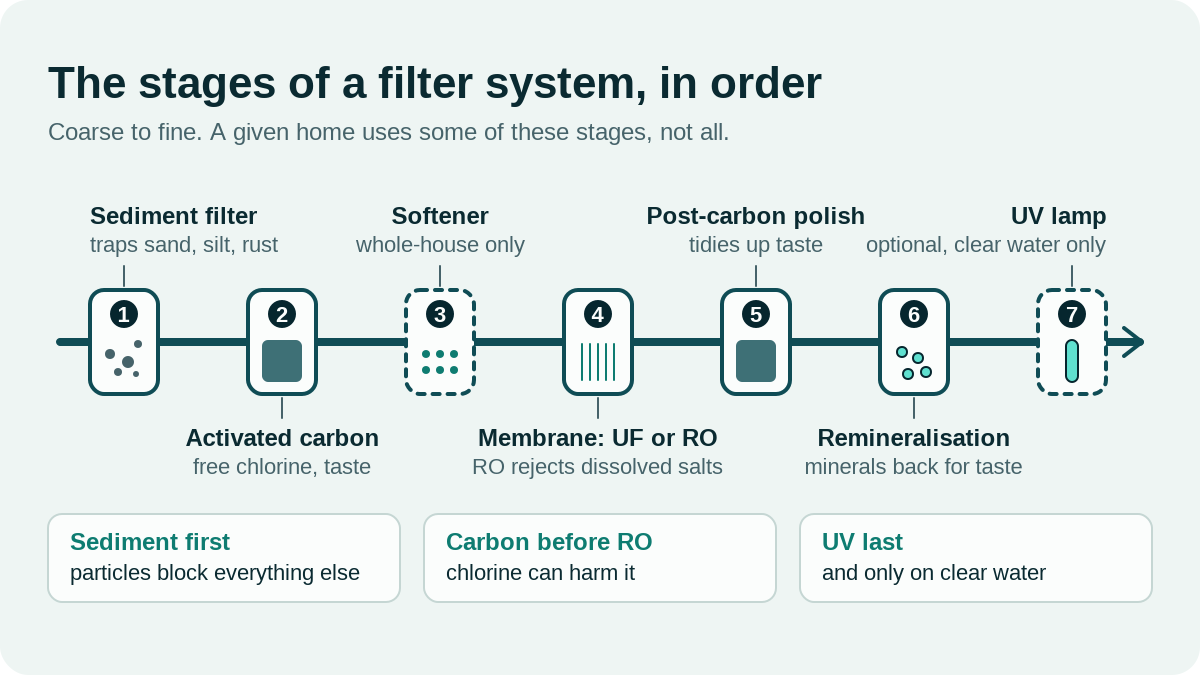
The table shows the usual sequence. A given home will use some of these stages, not all of them.
| Order | Stage | What it does | What it does not do |
|---|---|---|---|
| 1 | Sediment filter | Traps sand, silt, rust and loose scale | Does not remove anything dissolved |
| 2 | Activated carbon | Reduces free chlorine, taste, odour and many organic compounds | Does not remove dissolved salts or hardness |
| 3 | Softener (whole-house only, if hardness needs it) | Swaps calcium and magnesium for sodium to stop scale | Does not lower TDS and does not disinfect |
| 4 | Membrane: ultrafiltration or reverse osmosis | UF strains out very fine particles and bacteria. RO also rejects most dissolved salts | UF does not remove dissolved salts. RO sends part of the water to drain |
| 5 | Post-carbon polish | Tidies up taste after a storage tank | Adds no new kind of removal |
| 6 | Remineralisation | Puts a little calcium and magnesium back into RO water for taste | Does not purify |
| 7 | UV lamp (optional) | Inactivates bacteria, viruses and parasites | Removes no particles or chemicals |
More detail: sediment filters, activated carbon filters and reverse osmosis.
Why the order matters
Each stage prepares the water for the next one.
Sediment goes first because particles block everything else. A University of Nebraska–Lincoln Extension guide notes that sediment filters are used as pretreatment to improve the performance of activated carbon and reverse osmosis units. Grit that reaches a carbon cartridge coats the surface the carbon needs for adsorption. Grit that reaches a membrane fouls it.
Carbon goes before a reverse osmosis membrane because chlorine can harm it. Most household RO membranes are made of a material that chlorine degrades over time, so manufacturers place carbon ahead of the membrane to take the chlorine out first. The carbon stage also does useful work of its own on taste and odour.
Fine stages go after coarse stages because fine pores clog fast. The Nebraska guide makes the same point about cartridges in general: if the pore size is too small for the amount of solids in the water, the filter clogs quickly, and the largest rating that still removes the target particles needs the least maintenance.
UV goes last, and only on clear water. Particles can shade microbes from the light. Scotland's Drinking Water Quality Regulator advises that water entering a UV unit should be below 1 NTU turbidity, which is why cartridge filters always sit ahead of the lamp. UV also leaves no disinfectant in the water afterwards, so it belongs as close to the tap as possible.
Remineralisation goes after the membrane. If the mineral cartridge came first, the membrane would strip the minerals straight back out.
A 3 stage water filter system as an example
A typical 3 stage water filter system for drinking water has a sediment cartridge, a carbon cartridge and a third stage that is either a second, finer carbon block or an ultrafiltration membrane. It improves clarity, taste and odour. It does not lower TDS, because nothing in it removes dissolved salts.
Adding a reverse osmosis membrane and a post-carbon stage turns this into the common five-stage layout. Stage counts are a labelling habit more than a standard, and manufacturers count differently. Our page on 3-stage, 5-stage and 7-stage filters explains what each extra stage adds and when it is worth having.
Whole-house and under-sink systems follow the same logic
A whole-house system sits where the mains supply enters the villa. It usually runs sediment, then carbon, then a softener if the water is hard enough to justify one. It treats every tap and shower, and it protects water heaters and appliances. It is not designed to produce drinking water of RO quality. See whole-house water filtration for villas.
An under-sink system treats only the water you drink and cook with. It can afford finer stages, such as a reverse osmosis membrane, because it handles a few litres a day instead of the whole household flow. See under-sink drinking water systems.
Apartments normally use the under-sink part only, because the shared plumbing is not yours to alter.
When each stage needs changing
Every stage wears out in its own way. Sediment cartridges fill with dirt, and the flow at the tap drops as they load up. Carbon cartridges run out of capacity with no visible sign, so they are changed on schedule. RO membranes last longer than the cartridges around them, provided the pre-filters are changed on time. UV lamps are replaced on hours of use, not when they stop glowing.
The CDC adds a hygiene reason: filters need regular maintenance to keep working and to stop germs growing in them. An overdue cartridge is not a neutral thing to leave in the line.
Change intervals depend on your water and how much of it you use. To be confirmed The cartridge types and how to tell when each one is spent have their own guide: water filter cartridges.
What a filter system does not tell you
The right set of stages depends on what is in your water, and that cannot be read from a brochure. Hardness decides whether a softener is worth fitting. TDS decides whether reverse osmosis will change the taste much. The disinfectant residual is the third reading. DEWA's typical figures for the water it supplies to the network (2023 averages; no units printed, conventionally mg/L) are TDS 216, total hardness 61.3 and chlorine dioxide 0.44; it lists no free chlorine figure. Carbon is certified for free chlorine only, and we have found no tested figure for chlorine dioxide. That hardness is at the soft / moderately hard boundary on the US Geological Survey scale. Tap readings can differ after a building's tank and pipes.
Next step
Book a free water test and Dr Water Lab will measure hardness, TDS, disinfectant residual and pH at your taps, then tell you which stages your home needs and which it does not. Book a water test.
Find out what is in your water
The free test measures hardness, TDS, disinfectant residual and pH at your own taps. We supply, install and maintain water treatment systems in every area of Dubai; message us for prices and service details.