How does Dubai get drinking water?
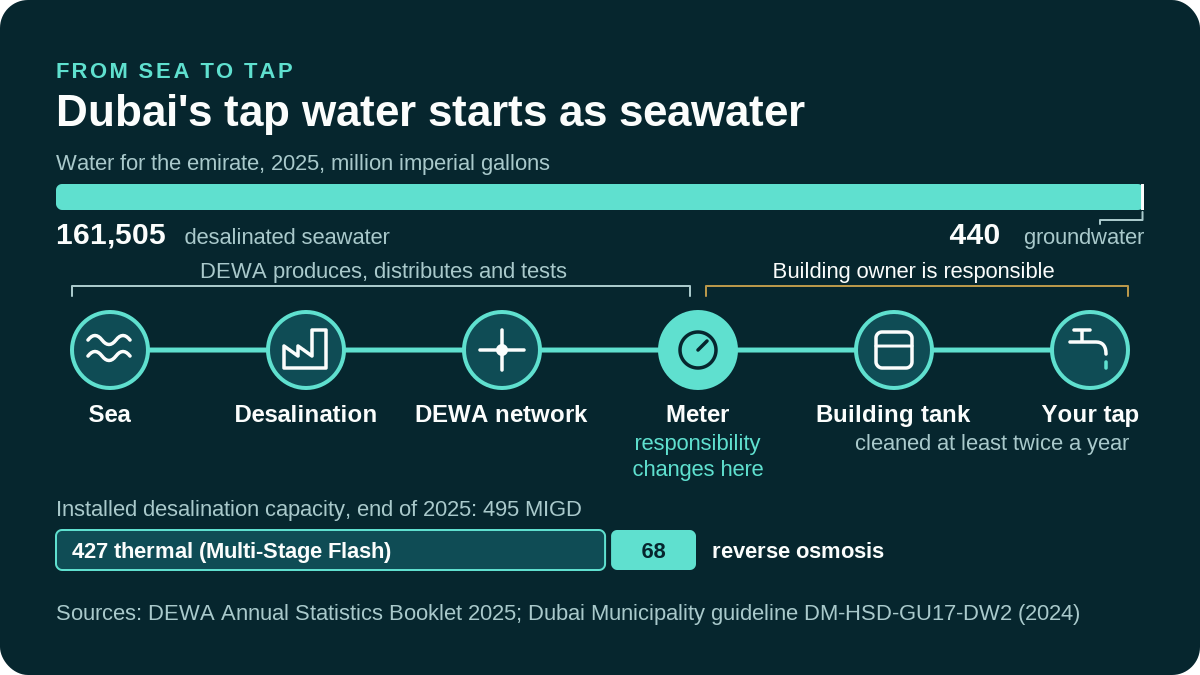
Dubai Electricity and Water Authority (DEWA) makes fresh water from seawater. Its Annual Statistics Booklet 2025 gives the split for the year:
| Source, 2025 | Volume (million imperial gallons) |
|---|---|
| Desalinated water | 161,505 |
| Groundwater | 440 |
DEWA does not publish this as a percentage. On those two figures, groundwater is well under one per cent of the total (our arithmetic, not a published number). The 2024 figures were 151,475 and 386.
The desalination plants
At the end of 2025 DEWA's installed desalination capacity was 495 million imperial gallons per day (MIGD), unchanged from 2024. Using DEWA's own conversion factor, "1 m3 = 219.9692 IG", that is about 2.25 million cubic metres a day (our arithmetic).
The booklet lists the capacity by station:
| Station | Installed capacity 2025 (MIGD) |
|---|---|
| Jebel Ali D | 34.5 |
| E | 25 |
| G | 81 |
| Palm SWRO | 5 |
| K | 96 |
| L Phase I | 67.5 |
| L Phase II | 52 |
| M | 134 |
| Total | 495 |
DEWA's Sustainability Report 2024 notes that Guinness World Records confirmed the Jebel Ali complex as the largest water desalination plant, at 490 MIGD, "equivalent to 2,227,587 cubic metres per day". That figure is from the 2024 report; the 495 figure is from the 2025 booklet.
Peak demand sits close to installed capacity. The booklet gives peak desalinated water demand of 477 MIGD in 2025 (a monthly average peak), up from 445 in 2024. DEWA also held 1,062 million imperial gallons in reservoirs in 2025 and reports water network losses of 4.4%.
Two technologies: thermal and reverse osmosis
Dubai's plants use two methods.
| Technology | Capacity 2025 (MIGD) | How it works |
|---|---|---|
| Multi-Stage Flash (MSF) | 427 | Seawater is heated and evaporated in a series of chambers; the vapour is condensed as fresh water and the salt stays behind |
| Reverse osmosis | 68 | Seawater is pushed at high pressure through membranes that hold back dissolved salts |
Most of today's capacity is thermal. That is changing. DEWA's Sustainability Report 2024 says "all future water production expansions will utilise seawater reverse osmosis (SWRO) technology powered by renewable energy sources". The 2025 booklet says: "By 2030, DEWA will add 240 MIGD of desalination capacity using seawater reverse osmosis technology", for a total of 735 MIGD.
More recent numbers exist only as news. Zawya reported in 2026, citing DEWA's first-quarter results statement, a total capacity of 555 MIGD with reverse osmosis at about 23%, and 120 MIGD of reverse osmosis expected to be added during 2026. That is a news report, not a DEWA document we read, so we keep the official 2025 figures above as the baseline.
For one of the reverse osmosis plants, at Jebel Ali K-station, a DEWA release of 29 April 2022 describes pre-treatment by dissolved air flotation and dual media filters, and says "the two-pass reverse osmosis system implemented in this project guarantees a high quality of potable water."
The same principle works at kitchen scale. See what is reverse osmosis. For the plants in the other emirates, see desalination plants in the UAE.
What happens after desalination
Desalination removes nearly everything. The World Health Organization's guidelines note that "Desalinated water contains lower than usual concentrations of dissolved solids and essential elements such as calcium and magnesium". Water like that is not normally sent into a network as it is.
Here we have to be straight about a gap. We did not find a DEWA document that describes its remineralisation or post-treatment step. What DEWA does publish is the result. Its quality table for supplied water (2023 averages, in the Sustainability Report 2024, units not printed) shows:
- TDS 216
- total hardness 61.3, calcium 16.4, bicarbonate 61.0
- pH 8.34
- saturation index "Positive"
So the water delivered is not mineral-free distillate. It carries a moderate mineral content. How DEWA gets it there is not something we can describe from an official source.
On disinfection, DEWA's table lists chlorine dioxide, with a typical figure of 0.44 against a specification of 0.40 – 0.45. It does not list free chlorine. Chlorine dioxide leaves chlorite and chlorate behind, and building operators may also dose chlorine or chlorine dioxide in tanks, so what reaches a given tap is not published. A disinfectant residual is kept in the water on purpose; in WHO's words, residual disinfection provides "a partial safeguard against low-level contamination and growth within the distribution system."
DEWA's Central Laboratory, accredited to ISO/IEC 17025:2017, "conducts all necessary checks, from production plants to various transmission and distribution networks, until the water reaches the consumers", according to a DEWA release of 18 August 2023. What those figures mean is covered in Dubai drinking water standards explained.
The groundwater share
DEWA keeps wells as a reserve. Its Sustainability Report 2024 says: "For emergency purposes, DEWA maintains an installed capacity of approximately 35.56 MIGD from underground wells", and that the wells averaged 1.01 MIGD in 2024. The 2025 booklet gives well capacity of 44 MIGD for 2025 and 36 for 2024.
The well water is a different product. DEWA reports its average TDS as "more than 1,000 mg/L (i.e. 1,500 mg/L precisely)", against 216 for the supplied water. It is a small backup, not what normally fills your tank.
Is there a water shortage in the UAE?
Two different things get called a shortage, and the official documents treat them separately.
Scarcity of natural fresh water is something the federal government plans around. The UAE Water Security Strategy 2036 "aims to ensure sustainability and continuous access to water", in normal conditions and in emergencies. Its published targets include reducing total demand for water resources by 21 percent, reducing the water scarcity index by 3 degrees, increasing the reuse of treated water to 95 percent and raising national water storage capacity to 2 days.
A shortage at the tap is a separate question, and the DEWA figures we read do not show one for Dubai. Installed desalination capacity at the end of 2025 was 495 MIGD against a peak demand of 477 MIGD, with 1,062 million imperial gallons held in reservoirs, and DEWA says it will add 240 MIGD by 2030. Almost all of the supply comes from desalination plants, not from rainfall or wells, which is why capacity and storage are the numbers to watch.
The tank and pipes: the part you control
DEWA's responsibility ends at your meter. From there the water is stored in your building's tank and carried in its pipes, and Dubai Municipality's guideline makes the building owner responsible for its quality "until it reaches its users". The guideline requires tanks to be emptied, cleaned and disinfected at least twice a year.
This last stretch is short, but it is the only part of the journey that nobody monitors for you day to day. It is also the only part you can do something about:
- know when the tank was last cleaned, and by whom
- keep the tank cover intact and fixed
- ask for the laboratory report if you live in a managed building
- measure the water at the tap and compare it with what DEWA publishes
See water tanks: cleaning and filtration for the rules, and can you drink tap water in Dubai for what it adds up to.
Next step
The published figures stop at your meter. Book a free water test to see what arrives at your tap. We measure hardness, TDS, disinfectant residual and pH, check the tank and inlet, and give you the results in writing with no obligation. Appointments are taken at least 10 days ahead.
Find out what is in your water
The free test measures hardness, TDS, disinfectant residual and pH at your own taps. We supply, install and maintain water treatment systems in every area of Dubai; message us for prices and service details.