What desalination is
Desalination means removing dissolved salt from seawater or salty groundwater to make fresh water. The process takes the salt out and leaves water that can be conditioned and supplied through a network.
There are two ways to do it at scale. Thermal plants boil seawater and condense the steam. Reverse osmosis plants push seawater through membranes that hold the salt back. Both end with nearly pure water.
The main plants by emirate
Every figure below comes from the operator or the UAE government and carries its date. Where we could not find an official figure, the plant is not in the table.
Abu Dhabi
Emirates Water and Electricity Company (EWEC), which describes itself as "the sole procurer of water and power within the Emirate of Abu Dhabi and beyond", lists these plants in its Statistical Report 2025 under "Water System Network (Summer 2026)":
| Plant | Technology | Capacity (m³/day) | Commercial operation date listed |
|---|---|---|---|
| Taweelah RO | Reverse osmosis | 909,000 | 2024 |
| Taweelah Complex – B | Thermal | 727,000 | 2008 |
| Fujairah Complex – F1 | Thermal / reverse osmosis | 591,000 | 2015 |
| Fujairah Complex – F2 | Thermal / reverse osmosis | 591,000 | 2011 |
| Mirfa 2 | Reverse osmosis | 546,000 | 2026 |
| Shuweihat Complex – S2 | Thermal | 455,000 | 2011 |
| Umm Al Nar | Thermal | 429,000 | 2007 |
| Taweelah Complex – A1 | Thermal | 382,000 | 2009 |
| Shuweihat Complex – S4 | Reverse osmosis | 318,000 | 2027 |
| Mirfa 1 | Thermal / reverse osmosis | 239,000 | 2017 |
Two notes. The Fujairah complex stands on the east coast, about 300 km from Abu Dhabi by EWEC's description, and feeds the EWEC system. Shuweihat S4 carries a 2027 date, so read it as a plant on its way.
Dubai
DEWA's plants are at Jebel Ali. Its Annual Statistics Booklet 2025 gives installed capacity of 495 million imperial gallons per day (MIGD) at the end of 2025: 427 MIGD thermal (Multi-Stage Flash) and 68 MIGD reverse osmosis. The UAE government portal adds that DEWA's Hassyan seawater reverse osmosis project "will have a production capacity of up to 180 million gallons per day", with all phases scheduled for completion in the first quarter of 2027. The station-by-station figures are in where Dubai's tap water comes from.
Sharjah
Sharjah Electricity, Water and Gas Authority (SEWA) is listed on the government portal with 0.56 million m³/day of installed capacity as of 2023. We could not open SEWA's own website on the day we checked, so we give no plant-by-plant figures for its existing stations. For the new Hamriyah Independent Water Project, the developer's release of 4 September 2024 says the seawater reverse osmosis plant "will generate nearly 272,000 cubic metre per day" by the second quarter of 2027 and 410,000 m³/day at full operation in the second quarter of 2028. The government portal describes the same plant as able to produce "up to 90 million gallons of water daily".
Ajman, Umm Al Quwain, Ras Al Khaimah and Fujairah
Etihad Water and Electricity (EtihadWE) supplies the northern emirates. Its Naqa'a plant in Umm Al Quwain uses seawater reverse osmosis and, in the company's words, "began operating at full production capacity of 150 million gallons per day in August 2022". EtihadWE says the plant can serve about 2 million residents and that its network extends to "Ras Al Khaimah, Fujairah, Dibba Al Fujairah, Ajman, and Dhaid in Sharjah". The company also names its Al Zawrah plant in Ajman and Ghalila plant in Ras Al Khaimah, without capacities in the releases we read. In Fujairah, the government portal says EtihadWE is setting up the Fujairah I plant with "a production capacity of 60 million imperial gallons per day" by reverse osmosis.
The national picture
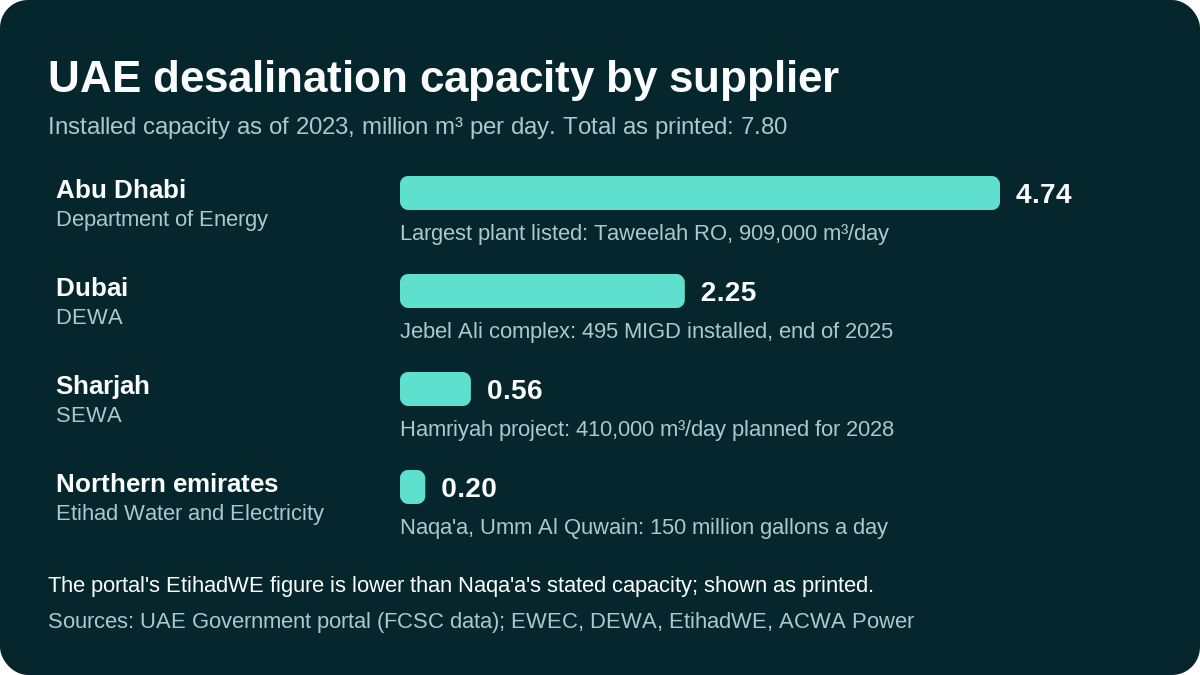
| Entity | Installed desalination capacity, as of 2023 (million m³/day) |
|---|---|
| Department of Energy – Abu Dhabi | 4.74 |
| Dubai Electricity & Water Authority (DEWA) | 2.25 |
| Sharjah Electricity Water & Gas Authority (SEWA) | 0.56 |
| Etihad Water & Electricity (federal level) | 0.20 |
| Total, as printed | 7.80 |
The table is from the UAE government portal, which credits the Federal Competitiveness and Statistics Centre. The same page counts 46 desalination plants in the country as of 2015, 27 of them combined power and water stations. One caution: the portal's 0.20 for EtihadWE is lower than the capacity EtihadWE states for its Naqa'a plant alone, and the page does not say how independent plants are counted. We show the figures as printed.
Thermal vs reverse osmosis plants
Many of the older plants are thermal and combined with power stations: 27 of the 46 plants counted in 2015 produced both electricity and water. The newer plants in the lists above are reverse osmosis.
The shift is visible in the published numbers. In EWEC's system, reverse osmosis produced 6 per cent of the water in 2014 and 45 per cent in 2025: 549 million m³ out of 1,214 million. In Dubai, 68 of 495 MIGD was reverse osmosis in 2025, and DEWA's Sustainability Report 2024 says "all future water production expansions will utilise seawater reverse osmosis (SWRO) technology powered by renewable energy sources".
The membranes in these plants work on the same principle as a kitchen purifier, at a different scale. See what is reverse osmosis.
Why the UAE depends on desalination
Behind searches for "water scarcity in UAE" and "UAE water crisis" is one fact: there is little natural fresh water. The government portal puts total water demand at about 5 billion cubic metres a year and says groundwater accounts for "around 46 per cent of the country's water supply and 93 per cent of the irrigation water used on farms". Drinking water is a different story: "Desalination is a key source of water in the UAE, particularly for drinking and domestic use."
The portal adds that the UAE "aims to preserve groundwater as a key emergency water source".
From plant to tap: what is added and what happens in the network
Fresh from either process, the water is almost mineral-free. The World Health Organization notes that "Desalinated water contains lower than usual concentrations of dissolved solids and essential elements such as calcium and magnesium". Such water is conditioned before it is piped.
We did not find a DEWA document that describes that step. What DEWA publishes is the result, in its table for supplied water (2023 averages, units not printed): TDS 216, total hardness 61.3, pH 8.34, and chlorine dioxide as the disinfectant at a typical 0.44. EtihadWE says its water complies with "drinking water specifications and standards issued by the World Health Organisation (WHO)", with periodic sterilisation of lines and tanks and regular and random testing. The standards themselves are explained in Dubai drinking water standards.
What it means at home: taste, TDS, hardness
- Hardness. Desalinated supply is not hard water. DEWA's typical figure of 61.3 sits at the boundary between soft and moderately hard on the usual scale. White marks on taps can still appear as water evaporates.
- TDS. At 216, Dubai's published figure is in the band WHO's taste panels rated excellent, if the conventional unit applies. See what is TDS in water.
- Taste. Minerals are only part of taste. The disinfectant residual and time spent in a warm tank can affect it too.
Whether you can drink it is a separate question, answered in can you drink tap water in Dubai and, for the other emirates, can you drink tap water in the UAE.
Next step
Plant figures stop at the network. To see what arrives at your own tap, book a free water test. Dr Water Lab measures hardness, TDS, disinfectant residual and pH, checks the tank and inlet, and gives you the results in writing with no obligation. Appointments are taken at least 10 days ahead.
Find out what is in your water
The free test measures hardness, TDS, disinfectant residual and pH at your own taps. We supply, install and maintain water treatment systems in every area of Dubai; message us for prices and service details.