Who regulates what
| Body | Role |
|---|---|
| UAE federal government | Council of Ministers Decision No. 26 of 2013 concerning the UAE system for drinking water control is the federal framework |
| UAE.S GSO 149:2021 | The mandatory technical regulation for unbottled drinking water, named by Dubai Municipality as the standard to meet |
| DEWA | Produces, transmits and distributes mains water, and tests it in its own Central Laboratory |
| Dubai Municipality (Health & Safety Department) | Issues the Technical Guidelines for Quality of Unbottled Drinking Water, which apply to buildings, tankers, tank cleaning companies and private laboratories |
| Building owner or owner's representative | Responsible for the water in the building "until it reaches its users" |
Abu Dhabi is separate, with its own regulator and regulations; see can you drink tap water in Abu Dhabi.
Which standard applies in Dubai
Dubai Municipality's guideline (DM-HSD-GU17-DW2, Version 1, issued 25 September 2024) is explicit: "Unbottled drinking water must meet all the conditions stipulated in the mandatory UAE Standard (Technical Regulation 'Unbottled Drinking Water No.: (UAE.S GSO 149:2021)".
DEWA describes its own benchmark differently. Its Sustainability Report 2024 says the water it produces and distributes "is in compliance with the requirements of the latest potable water guidelines issued by the World Health Organization". Its quality table compares its figures with the WHO guidelines, fourth edition with the first and second addenda, 2022.
So two reference points are in use: the UAE standard, named by the municipality, and the WHO guidelines, named by the utility. The stated aim of the municipality's guideline is "to ensure that the consumer is able to obtain safe and healthy drinking water". That is an aim, not a guarantee for any one tap.
What we could read, and what we could not
Could not read: the limit table of UAE.S GSO 149:2021. The standard is sold, not published free. The Gulf standards store lists it as a priced document, and the Dubai Municipality guideline refers to it without reproducing its tables. We therefore do not quote its limits for TDS, hardness, pH or turbidity, and you should be wary of any page that does without showing the source.
Could read, with heavy caution: the previous edition, GSO 149/2014. A copy of this superseded edition is available in a Russian translation. In that text we saw a pH range of 6.5–8, dissolved solids of 100–1000 ppm, and residual free chlorine of 0.5 ppm after at least 30 minutes' contact at pH below 8.0, with no limit for total hardness or turbidity. This edition has been replaced and we read it in translation. It cannot be used to judge today's water against today's standard.
Could not read: DEWA's newest quality table. A Sustainability Report 2025 exists on DEWA's website but we could not open it. The figures below are from the 2024 report.
Could read: the Dubai Municipality guideline and DEWA's 2024 report. Everything else on this page comes from those.
What Dubai Municipality's guideline sets for buildings
These are the values stated in the guideline itself:
| Subject | What the guideline says |
|---|---|
| Residual free chlorine | "the residual free chlorine concentration in this water is 0.2 - 0.5 ppm", raised in epidemics or special cases as the municipality decides |
| Chlorine dioxide | "The maximum value of Chlorine dioxide in drinking water should not exceed 0.5 mg/l" |
| Cold water temperature | "Cold water storage and distribution should be at or below 20 °C" |
| Tank cleaning | Emptied, cleaned and disinfected at least twice a year |
| Laboratory testing | Every six months against UAE.S GSO 149:2021, by a laboratory accredited by the Emirates International Accreditation Centre |
The tank rules are covered in full on water tanks: cleaning and filtration, and the temperature point on why Dubai tap water is warm in summer.
DEWA water quality report: the published parameters
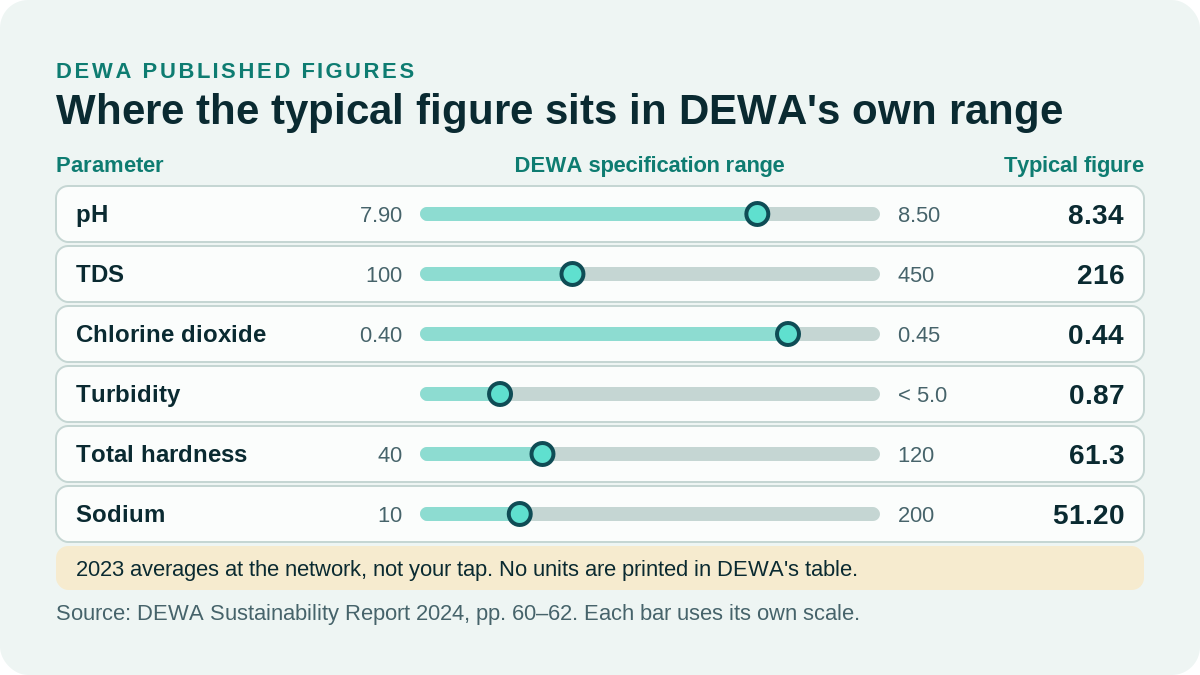
There is no stand-alone public "DEWA water quality report" that we found. The figures are in DEWA's Sustainability Report 2024, pages 60 to 62, in a table for the Jebel Ali stations. The report notes that each typical figure "is the average of individual station averages during the year 2023".
| Parameter | "WHO Guideline Value (Max)" as printed by DEWA | DEWA specification | DEWA typical figure |
|---|---|---|---|
| pH | 6.5 ~ 8.5 | 7.90 – 8.50 | 8.34 |
| TDS | 1000 | 100 – 450 | 216 |
| Chlorine dioxide | – | 0.40 – 0.45 | 0.44 |
| Turbidity | – | < 5.0 | 0.87 |
| Total hardness | 500 | 40 – 120 | 61.3 |
| Sodium | 200 | 10 – 200 | 51.20 |
| Lead | 0.01 | ≤ 0.01 | <0.0020 |
| Nitrate | 50 | ≤ 50 | <0.05 |
| Total coliform bacteria | Absent | Absent | (blank in table) |
| E. coli bacteria | Absent | Absent | (blank in table) |
Read the table with four cautions.
- No units are printed. These parameters are conventionally reported in mg/L and turbidity in NTU. The document does not say so, so we give the numbers as published by DEWA.
- They are 2023 averages, published in the 2024 report.
- They describe the network, not your tap. The supply is measured before it enters any building.
- The "WHO" column needs care for TDS and hardness. DEWA prints 1000 for TDS and 500 for total hardness under "WHO Guideline Value (Max)". WHO's own guidelines say "No health-based guideline value for TDS has been proposed" and "No health-based guideline value is proposed for hardness in drinking-water". Those two numbers come from WHO's remarks on taste and acceptability. They are not WHO health limits. WHO likewise does not propose a health-based guideline value for pH.
DEWA's Central Laboratory is accredited to ISO/IEC 17025:2017 by the Emirates International Accreditation Centre, according to a DEWA release of 18 August 2023.
A note on disinfectant
The municipality's guideline speaks of residual free chlorine at 0.2 to 0.5 ppm. DEWA's table lists chlorine dioxide, typical 0.44, and has no free chlorine row. These are two different disinfectants, and the guideline sets a value for each. When you read about "chlorine" in Dubai water, the accurate phrase is disinfectant residual, with DEWA reporting chlorine dioxide. Chlorine dioxide leaves chlorite and chlorate behind, and building operators may also dose chlorine or chlorine dioxide in tanks, so what reaches a given tap is not published and has to be measured.
The difference between the standard and your tap
A standard tells you what water must be. A utility's report tells you what the water was, on average, at the network. Neither tells you what is in your glass today, because the building's tank and pipes come in between and are the owner's job to maintain.
That gap is what a test at the tap covers. Our home test reads hardness, TDS, disinfectant residual (a standard chlorine test kit also responds to chlorine dioxide and cannot tell the two apart) and pH. It is not a laboratory analysis and does not test for bacteria or metals; the six-monthly accredited laboratory test required of building owners does that. If you live in a managed building, you can ask to see that report.
Next step
Standards describe the supply. To see what reaches your own tap, book a free water test. We measure hardness, TDS, disinfectant residual and pH, check the tank and inlet, and give you the results in writing with no obligation. Appointments are taken at least 10 days ahead.
Find out what is in your water
The free test measures hardness, TDS, disinfectant residual and pH at your own taps. We supply, install and maintain water treatment systems in every area of Dubai; message us for prices and service details.