What the regulator says
The rules are in the Abu Dhabi Department of Energy's Water Quality Regulations 2021 (Fifth Edition), effective from 1 January 2021. Its foreword states the purpose:
"The Regulations are intended to provide for the supply of wholesome drinking water to Consumers and reflect the current guidance by the World Health Organization"
"Wholesome" is the legal test. Under the regulations, water is wholesome if it contains nothing "detrimental to public health" and complies with the prescribed values set out in the regulations' schedules. WHO guidelines are named "as the primary reference", and the regulator may also consider Australian, New Zealand, Gulf, UAE federal and US standards.
Note the wording, as we do for Dubai. The regulation says "wholesome". We did not find the literal phrase "safe to drink" on an official Abu Dhabi regulator or distribution company page. The distribution company's own water quality page would not open when we tried it.
The phrase does appear in a news report. Gulf News, on 14 January 2020, quoted the managing director of Abu Dhabi Distribution Company (ADDC) as saying: "It is safe for residents to drink Abu Dhabi's tap water." The same report said samples are collected from quality zones and analysed daily, with an annual third-party audit, and that customers are responsible for cleaning their internal distribution systems and tanks. Treat that as a news report, not an official publication.
The limits Abu Dhabi sets
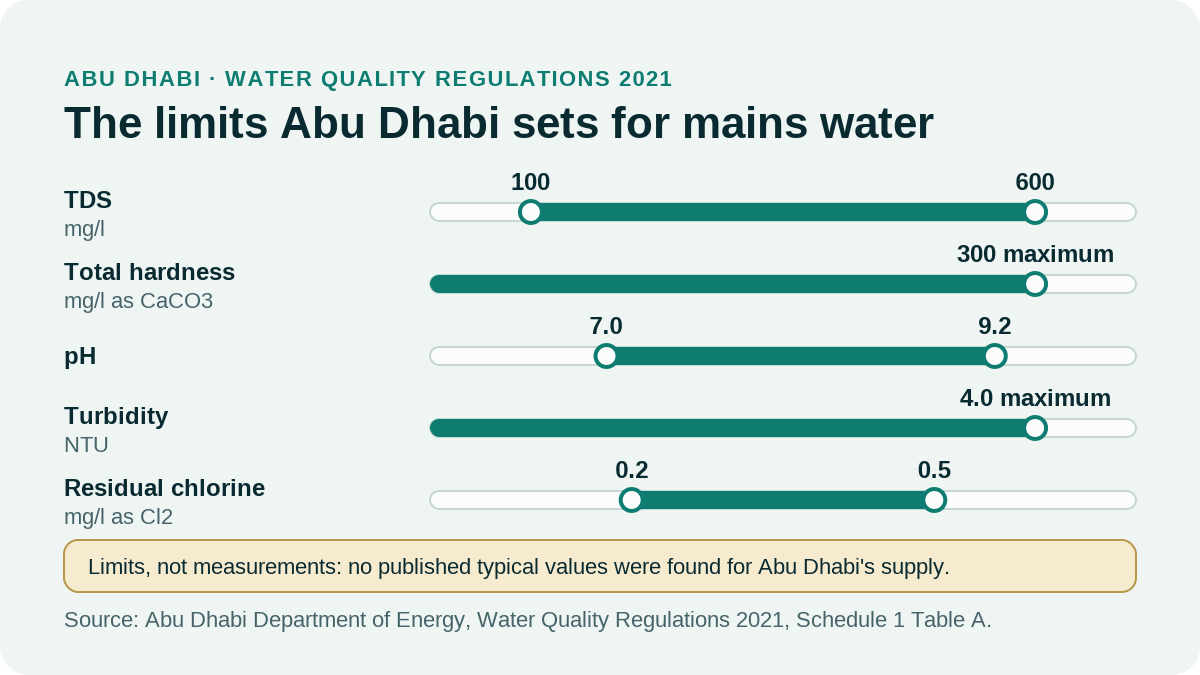
Unlike Dubai's standard, Abu Dhabi's limits are free to read. These are from Schedule 1, Table A of the 2021 regulations.
| Parameter | Abu Dhabi prescribed value |
|---|---|
| TDS | 100 (minimum) – 600 (maximum) mg/l |
| Total hardness | 300 mg/l as CaCO3 (maximum) |
| Calcium hardness | 200 mg/l as CaCO3 |
| pH | 7.0 (minimum) – 9.2 (maximum) |
| Turbidity | 4.0 NTU maximum |
| Residual chlorine | 0.2 (minimum) – 0.5 (maximum) mg/l as Cl2 |
| Chlorine dioxide | 0.1 (minimum) – 0.4 (maximum) mg/l as ClO2 |
| Colour | 15.0 mg/l Pt/Co |
| Taste and odour | "Unobjectionable" |
Two notes from the regulations themselves. On turbidity: "Turbidity should be kept below 1 NTU by Licensees to support effective disinfection." On chlorine: the residual may rise to 1.00 mg/l or above for bacteriological control.
These are limits, the outer edges of what a supplier is allowed to deliver. They are not measurements. We did not find a published table of typical measured values for Abu Dhabi's supply, of the kind DEWA publishes for Dubai, so we do not quote a typical TDS or hardness for Abu Dhabi tap water.
Water hardness in Abu Dhabi
The only official figure we can give is the limit: total hardness may be up to 300 mg/l as calcium carbonate. On the scale used by the US Geological Survey, water above 180 mg/L is "very hard", so the limit would permit hard water. That does not mean the water supplied is hard. A limit says what is allowed, not what is delivered, and we found no published typical value.
If you see scale on taps and shower glass in Abu Dhabi, the reasoning on our page about whether Dubai water is hard applies: heating and evaporation leave minerals behind even from fairly soft water, and only a reading at the tap tells you where you stand.
How Abu Dhabi compares with Dubai
The two emirates have separate utilities and separate rulebooks.
| Dubai | Abu Dhabi | |
|---|---|---|
| Who sets the rules | Dubai Municipality, applying the UAE standard UAE.S GSO 149:2021 | Abu Dhabi Department of Energy, Water Quality Regulations 2021 |
| Official wording | DEWA: water "in compliance with" the latest WHO guidelines | Regulator: "wholesome drinking water" reflecting WHO guidance |
| TDS | DEWA's own specification 100 – 450; typical 216 (2023 average, units not printed) | Limit 100 – 600 mg/l; typical value not found |
| Total hardness | DEWA's own specification 40 – 120; typical 61.3 (2023 average, units not printed) | Limit 300 mg/l as CaCO3; typical value not found |
| Limits free to read | No. The standard is a paid document | Yes |
Do not read this table as one emirate having better water than the other. The Dubai column is a utility's specification and averages; the Abu Dhabi column is a regulator's limits. They are different kinds of document. More on the Dubai side is in Dubai drinking water standards explained and can you drink tap water in Dubai.
Your building's tank still decides the last step
The regulations refer to a separate "Code of Practice for the Inspection and Cleaning of Customer Water Storage Tanks", to be read alongside them. We have not read that code, so we do not quote cleaning intervals for Abu Dhabi. The principle is the one the 2020 news report describes: the supplier is responsible for the water it delivers, and the customer is responsible for the tank and pipes inside the property.
If you rent, ask your landlord or building management when the tank was last cleaned and whether there is a certificate. If you own a villa, check when it was last done. For the reasoning, and for Dubai's rules as a comparison, see water tanks: cleaning and filtration.
If you want to filter tap water in Abu Dhabi
The choices are the same as anywhere:
- An activated carbon filter is certified for free chlorine taste and smell. It does not remove dissolved salts.
- An under-sink reverse osmosis purifier lowers dissolved solids at one kitchen tap. It does not treat the rest of the home.
- A softener removes hardness for the whole house. It does not lower TDS.
- None of these replaces a clean tank.
Which, if any, is worth having depends on what is measured at your tap. Drinking water filters explains the options.
To be confirmed
Next step
Limits on paper do not tell you what is at your tap. Book a free water test. We measure hardness, TDS, disinfectant residual and pH, check the tank and inlet, and give you the results in writing with no obligation. Appointments are taken at least 10 days ahead.
Find out what is in your water
The free test measures hardness, TDS, disinfectant residual and pH at your own taps. We supply, install and maintain water treatment systems in every area of Dubai; message us for prices and service details.