Decision one: filter or purifier
A carbon filter reduces free chlorine and improves taste and smell. It is certified for free chlorine; for chlorine dioxide, the disinfectant DEWA reports for Dubai, we have found no tested figure. It leaves dissolved salts and minerals where they are, so the TDS reading does not change. It needs no power and sends no water to drain.
A reverse osmosis purifier does what the carbon filter does and also reduces dissolved salts. It needs a drain connection and more space, and it has more parts to maintain.
A simple rule: if your only complaint is a disinfectant taste, a carbon filter is the first thing to try, with that caveat. If you want lower TDS, or the test shows something carbon does not treat, you are looking at a purifier. See water purifiers for Dubai homes for the purification methods, and what is TDS in water for how to read the number.
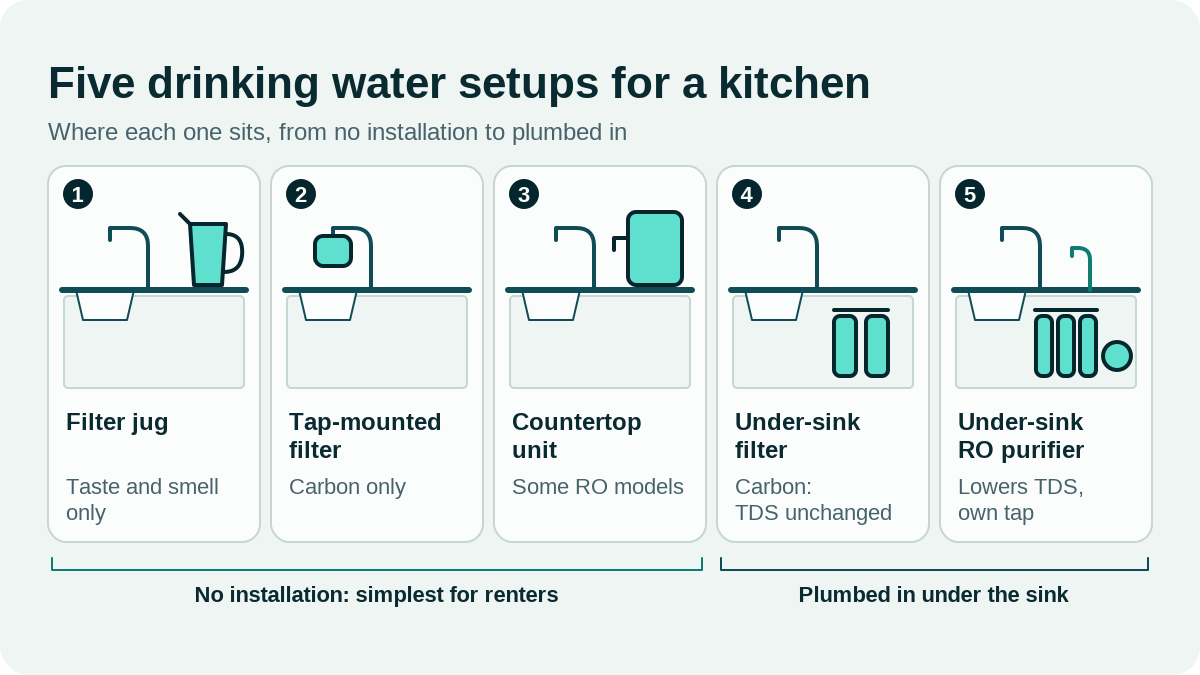
Decision two: where the drinking water filter sits
| Setup | How it works | Good for | Limits |
|---|---|---|---|
| Filter jug | Water drips through a small carbon cartridge | Trying filtered water with no installation | Small volume, frequent cartridge changes, taste and smell only |
| Tap-mounted filter | Screws onto the kitchen tap spout | Renters who want filtered water on demand | Does not fit every tap, small cartridge, carbon only |
| Countertop unit | Sits beside the sink, filled by hand or fed from the tap | Renters who want more capacity, including some RO models | Takes worktop space |
| Under-sink filter | Carbon cartridges in the cabinet, fed from the cold line | Households that use a lot of filtered water and are happy with their TDS | Needs a connection to the cold feed |
| Under-sink RO purifier | Pre-filters, RO membrane and remineralisation in the cabinet, with its own tap | Lower TDS, the widest range of reduction, no worktop clutter | Needs a drain, a tap hole, and sometimes a socket |
Dr Water Lab fits the last of these: an under-sink reverse osmosis purifier with a remineralisation stage and its own tap. We do not sell jugs or tap-mounted filters. They are listed here because for some homes they are the sensible answer, and you should hear that before you spend more.
Tap (faucet-mounted) filter
A tap filter, also sold as a faucet filter, is the second row of the table: a small carbon cartridge in a housing that attaches to the spout of the kitchen tap. The CDC groups it with under-sink units as a point-of-use filter, one that delivers filtered water to a single tap, and suggests this kind of filter when you only need to treat the water you drink and cook with.
Its strengths are the ones renters care about. It needs no plumbing work, and it leaves with you when you move. Its limits follow from its size. The cartridge is small, so it needs changing often. It does not fit every tap. It is a carbon filter, so it works on taste and smell and is certified for free chlorine only, and it does not lower TDS.
A tap filter is enough when taste is the only complaint, the tap accepts one and the household is small. It is not the answer if you want lower TDS or use a lot of filtered water. Our page on tap water filters covers which taps they fit and how they compare with an under-sink system.
How to choose
Do you rent or own? Owners can plumb in whatever fits. Tenants should prefer equipment that leaves no trace, or get the landlord's approval before an under-sink installation. The page on water filters for apartments and renters goes through this.
How much do you drink and cook with? A jug suits one or two people. A family that fills bottles, cooks daily and makes tea and coffee all day will find a jug slow.
What does the test show? TDS, disinfectant residual and the condition of the tank decide whether carbon alone is enough.
How much space is there? Under-sink RO needs room for the filter set and, in many models, a small storage tank. Measure the cabinet and note where the waste pipe and bin sit.
Who will maintain it? A filter that is not serviced stops being useful. Pick the setup you will actually keep up with.
What a tap water filter does not do
- It treats one tap. Showers, the washing machine and the other basins are untouched.
- Carbon does not remove dissolved salts or soften water.
- No kitchen filter fixes a dirty tank. If the test or the visual check points to the tank, that is dealt with at the tank. See water tanks: cleaning and filtration.
- A filter is not a substitute for medical advice. If someone in the home has a weakened immune system, ask their doctor what water they should drink.
What the home needs for an under-sink system
Cabinet space, a cold feed with an isolation valve, a drain connection, a position for the extra tap, and possibly a socket. In a rented home, the tap hole and the drain connection need the landlord's approval. The detail is on the page for under-sink drinking water systems.
How Dr Water Lab sizes it after the test
The free water test covers hardness, TDS, disinfectant residual and pH at the taps, plus a visual check of the tank and inlet. From that, and from the number of people in the home, we work out whether RO is justified, what pre-filtration is needed and what capacity suits you. If a simple carbon filter would do the job, the written results will say so.
Maintenance
Jug and tap-mounted cartridges are small and need changing often. Under-sink cartridges last longer because they are larger. An RO purifier has several parts on different schedules: pre-filters, membrane, and the remineralisation cartridge. Follow the manufacturer's intervals. The CDC also advises washing your hands after changing a filter, since used cartridges hold what they have removed.
What it costs
Our systems start from AED 1,000 and go up to AED 20,000, depending on what your home needs. A written quote follows the test and lists the unit, installation and consumables separately. To compare the running cost with buying bottles, use the bottled water vs home purifier calculator.
Find out which side of the filter-or-purifier line your tap falls on: book a free water test.
Find out what is in your water
The free test measures hardness, TDS, disinfectant residual and pH at your own taps. We supply, install and maintain water treatment systems in every area of Dubai; message us for prices and service details.