Water purifier or water filter: the difference
The two words overlap in everyday use. A working distinction:
- A filter improves water mainly by trapping particles and adsorbing free chlorine, taste and odour. Sediment cartridges and activated carbon are filters.
- A purifier adds a stage that deals with what a simple filter leaves behind: dissolved salts, or microorganisms, or both.
The US Centers for Disease Control and Prevention notes that most common home filters, such as jug and fridge filters, are not designed to remove germs, and that carbon filters mainly improve taste and smell rather than safety. That is the gap a purifier is meant to close.
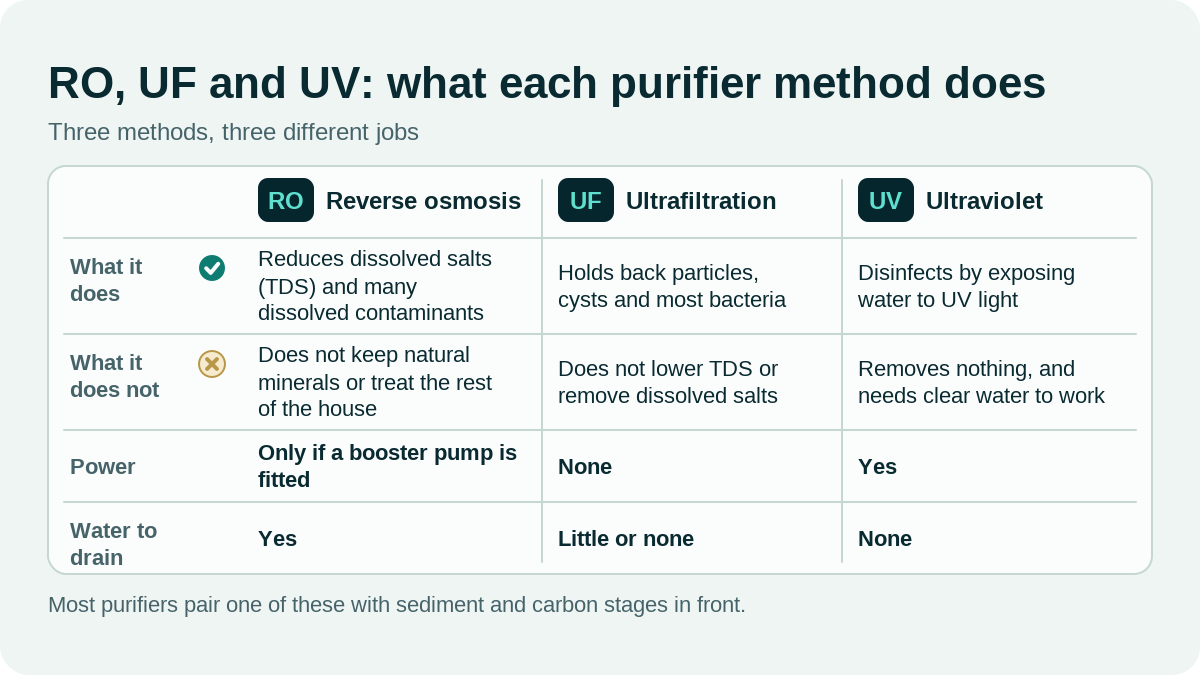
The three purification methods
| Method | What it does | What it does not do | Power | Water to drain |
|---|---|---|---|---|
| Reverse osmosis (RO) | Pushes water through a semi-permeable membrane, reducing dissolved salts (TDS) and many dissolved contaminants | Does not keep natural minerals, and does not treat the rest of the house | Only if a booster pump is fitted | Yes |
| Ultrafiltration (UF) | A fine membrane that holds back particles, cysts and most bacteria | Does not lower TDS or remove dissolved salts | None | Little or none |
| Ultraviolet (UV) | Disinfects by exposing water to UV light | Removes nothing: no particles, chlorine or salts, and it needs clear water to work | Yes | None |
Most purifiers pair one of these with sediment and carbon stages in front. The carbon stage does the work on free chlorine and taste. The membrane or lamp does the rest. For how each works, see what is reverse osmosis and UV water filters.
Which water purifier suits a Dubai home
Three readings from your tap answer most of the question.
TDS. If you want lower TDS in your drinking water, reverse osmosis is the only home method that delivers it. If your TDS is already at a level you are happy with, RO may be more than you need. DEWA's published typical TDS for the water it supplies is 216, against its own specification of 100–450. That is a 2023 average at the network, as published (conventionally mg/L), not a reading at your tap. WHO proposes no health-based guideline value for TDS and describes water below about 600 mg/l as generally good in taste. Our guide to what TDS means explains how to read the number.
Disinfectant taste. Activated carbon, which every purifier above includes, is certified for free chlorine taste and smell. For chlorine dioxide, the disinfectant DEWA reports, we have found no tested figure.
Tank and pipework. Water that sits in a building tank can pick up sediment. A purifier treats the water at your kitchen tap. It does not clean the tank, and a neglected tank shortens the life of every cartridge after it.
What Dr Water Lab fits
For kitchen drinking water, Dr Water Lab fits an under-sink reverse osmosis purifier with a remineralisation stage and its own tap. RO takes out most dissolved minerals along with the salts, and many people find the result tastes flat. The remineralisation stage puts a small amount of mineral back for taste.
If the test shows that a carbon filter would meet your needs, you will be told so. The page on drinking water filters compares the simpler options, and RO water purifiers covers the RO system in detail.
What your home needs
- Cabinet space under or beside the kitchen sink.
- A cold water feed with a working isolation valve.
- A drain connection for the RO reject water.
- A tap position on the sink or worktop for the purifier's own tap.
- A socket inside or near the cabinet if your water pressure calls for a booster pump.
- Landlord approval in a rented home, for the tap hole and the drain connection.
How the system is chosen after the water test
The free test measures hardness, TDS, disinfectant residual and pH at your taps and includes a visual check of the tank and inlet. Three things come out of it for a purifier: whether RO is justified, what pre-filtration the membrane needs, and whether your pressure is enough to run it without a pump. Household size sets the capacity. Equipment is sourced after the test, for your home.
Certification: what to ask any seller
The main performance standards for home units are NSF/ANSI 42 for taste and odour, NSF/ANSI 53 for health-related reduction claims such as cysts, and NSF/ANSI 58 for reverse osmosis systems. Ask which standard a unit is certified to and for which substances. To be confirmed.
Maintenance
A purifier is only as good as its last service. Pre-filters are changed most often, the membrane less often, and the remineralisation cartridge on its own schedule. UV lamps are replaced on a fixed interval even if they still light. The CDC advises changing filters on the manufacturer's schedule, both to keep them working and to prevent germs growing inside them. Your quote lists every consumable and its interval.
What it costs
Our systems start from AED 1,000 and go up to AED 20,000, depending on what your home needs. You receive a written quote after the test, with the equipment, installation and expected maintenance set out separately. For how purifier pricing works in general, see water purifier prices in UAE.
Start with the numbers for your own tap: book a free water test.
Find out what is in your water
The free test measures hardness, TDS, disinfectant residual and pH at your own taps. We supply, install and maintain water treatment systems in every area of Dubai; message us for prices and service details.