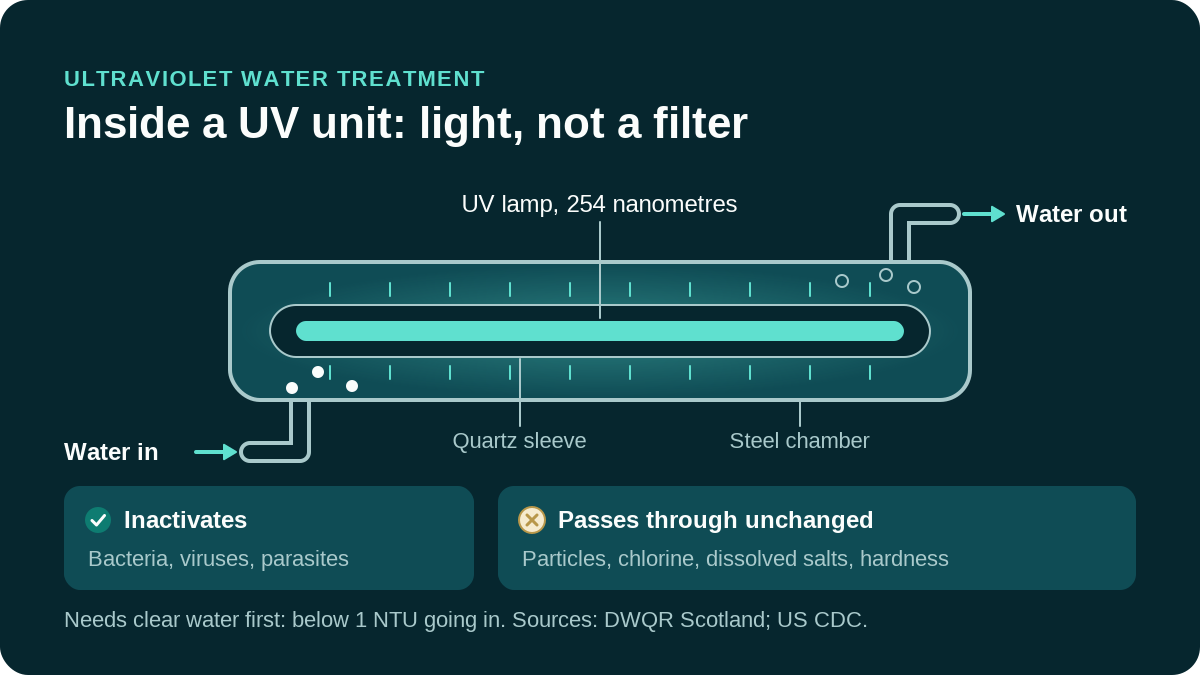
How an ultraviolet water filtration system works
Water flows through a steel chamber. In the middle sits a lamp inside a clear quartz sleeve. As the water passes, it is exposed to ultraviolet light.
Scotland's Drinking Water Quality Regulator (DWQR) explains that UV inactivates microbes by penetrating their cells and disrupting vital functions, including their DNA. The most effective wavelength for this is 254 nanometres, and conventional low-pressure mercury lamps emit most of their energy at that wavelength. A microbe whose DNA is damaged cannot reproduce, so it cannot cause an infection.
Two things decide whether the dose is enough: how strong the light is, and how long the water spends in the chamber. Push water through faster than the unit is rated for and each microbe gets less exposure. This is why UV units have a maximum flow rate, and why the right size matters.
Nothing is added to the water. There is no taste, no smell and no chemical by-product.
What UV does, and what it does not do
The CDC lists UV treatment with pre-filtration as effective against parasites, bacteria and viruses. It also states that UV does not remove chemicals.
| UV does | UV does not |
|---|---|
| Inactivate bacteria | Remove sediment, rust or cloudiness |
| Inactivate viruses | Remove chlorine, taste or odour |
| Inactivate parasites such as Giardia and Cryptosporidium | Lower TDS or remove dissolved salts |
| Work without chemicals | Remove hardness or prevent limescale |
| Remove lead, other metals or pesticides | |
| Keep water disinfected after it leaves the chamber |
A disinfectant residual stays in the water and keeps protecting it through the pipes. UV does not. DWQR notes that UV leaves no lasting disinfectant, so water can be recontaminated afterwards in tanks or pipework. A UV unit should sit as close to the point of use as possible, with nothing after it that could reintroduce microbes.
An inactivated microbe is also still physically in the water. It is harmless, but it has not been "filtered out".
Why UV needs clear water first
UV light has to reach the microbe. Anything that blocks or absorbs the light reduces the dose.
DWQR lists the main things that interfere:
- Turbidity. Particles shade microbes. DWQR advises that water entering a UV unit should be below 1 NTU.
- Colour, iron and manganese. These absorb UV and lower the share of light that gets through.
- Hardness. Scale forms on the warm quartz sleeve and blocks the light from the inside out.
For this reason a UV unit is never fitted on its own. Sediment and carbon cartridges go ahead of it, and the CDC notes that UV systems with pre-filtration are more effective than those without. In hard water areas, scale on the sleeve is the main maintenance issue. DEWA's typical total hardness for the water it supplies is 61.3 (2023 average at the network; no unit printed, conventionally mg/L as calcium carbonate), at the soft / moderately hard boundary on the US Geological Survey scale. Tap readings can differ.
Where a UV unit sits in a home system
UV is the last treatment stage. Three common positions:
- Inside an under-sink purifier. A small lamp after the membrane and carbon stages, just before the tap. This is the "RO + UV" or "UV + UF" combination sold in many purifiers.
- After a storage tank. Larger units treat water as it leaves a tank on the way to the house, where the tank is the hygiene concern.
- Whole-house, after sediment and carbon. Common on private wells. Less common on a disinfected mains supply.
See how a water filter system works for the full order of stages.
Maintenance and lifespan
UV units are simple, but they are not fit-and-forget.
Lamp replacement. A UV lamp loses output as it ages while still appearing to glow normally. DWQR notes that lamps typically last about 10 to 12 months of continuous use, by which point output has fallen to roughly 70 per cent of new. Lamps are replaced on hours of use and the manufacturer's guidance, not when they go dark.
Sleeve cleaning. The quartz sleeve needs regular cleaning to remove scale and film. DWQR suggests monthly as a sensible starting interval where there is no automatic cleaning, adjusted according to what you find. The harder the water, the more often it is needed.
Power. No power, no treatment. Conventional lamps also need a warm-up period before they reach full output. Units with an alarm or a shut-off valve handle this better than units without.
Pre-filters. Overdue cartridges let cloudy water reach the lamp and undercut the whole unit.
To be confirmed
Certification: Class A and Class B
The standard for household UV equipment is NSF/ANSI 55, "Ultraviolet Microbiological Water Treatment Systems". It has two classes, and the difference matters:
- Class A units are validated for full disinfection of microbiologically unsafe water, including Cryptosporidium.
- Class B units are for supplementary treatment of water that is already treated and considered safe.
A product described only as "UV" with no class or certification tells you very little about the dose it delivers.
When you need a UV water filter, and when you do not
UV earns its place when microbes are the problem to solve:
- Water from a private well, borehole or rainwater tank
- A storage tank you cannot keep reliably clean
- Someone in the home with a weakened immune system, where a doctor has advised extra precautions. The CDC recommends such households talk to their healthcare provider before choosing a system.
UV is usually not needed when:
- You are on a disinfected mains supply and your tank is clean and maintained
- You already have reverse osmosis at the kitchen tap. The CDC lists RO as removing parasites, bacteria and viruses, so UV after RO is a second barrier, not the main one
- Your complaint is taste, chlorine smell, limescale or high TDS. UV changes none of these
For most Dubai homes on mains water, tank hygiene is the more useful place to start. See water tanks: cleaning and filtration and can you drink tap water in Dubai? Dubai Municipality's 2024 guideline says all water tanks should be emptied, cleaned and disinfected at least twice a year.
Common misconceptions
"A UV filter purifies water." It disinfects. Every chemical, salt and particle that went in comes out.
"The lamp is glowing, so it is working." Visible glow says nothing about UV output. An old lamp can look fine and under-dose.
"UV makes RO unnecessary." They do different jobs. See the RO vs UV comparison in our guide to water purification systems, or read what reverse osmosis is.
Next step
Not sure whether microbes, chlorine or hardness is the issue in your home? Dr Water Lab tests hardness, TDS, disinfectant residual and pH at your taps and checks your tank and inlet, free of charge. Book a water test.
Find out what is in your water
The free test measures hardness, TDS, disinfectant residual and pH at your own taps. We supply, install and maintain water treatment systems in every area of Dubai; message us for prices and service details.