What a tap filter is
Three products are sold under this name.
- Faucet-mounted filter. A small housing that screws onto the end of the spout in place of the aerator. University of Nebraska–Lincoln Extension notes that these "can have bypass valves that allow selective filtering, which prolongs the life of the carbon".
- Inline filter. A cartridge fitted in the pipe that feeds the tap. The same guide says an inline device "is typically installed beneath the kitchen sink in the cold water supply line". Where hot and cold share one spout, only the cold water can be considered treated.
- Tap with a built-in filter. A tap sold with its own cartridge, either in the tap body or under the sink feeding a separate channel in the spout.
What a tap filter can and cannot reduce
Tap filters work with activated carbon. What a particular model does depends on what it is certified for, so read the claim on the box against the standard.
| A tap filter can | A tap filter cannot |
|---|---|
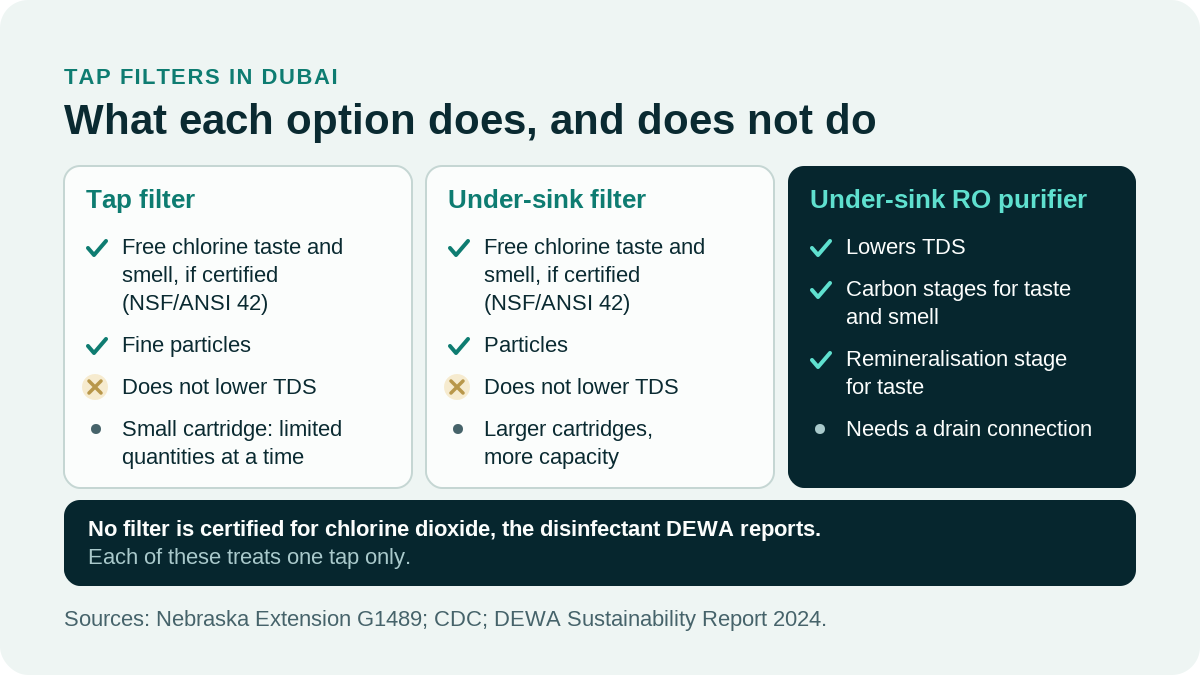
| Reduce free chlorine taste and smell, if certified to NSF/ANSI 42 | Lower TDS. Carbon does not remove dissolved salts |
| Reduce specific contaminants such as lead, only if the model is certified for them under NSF/ANSI 53 | Soften water. Carbon does not remove calcium and magnesium |
| Catch fine particles, depending on its pore size | Disinfect. Carbon filters do not remove bacteria and viruses |
| Carry a certified claim for chlorine dioxide, chlorite or chlorate. No NSF/ANSI standard has one |
The Nebraska guide says faucet-mounted and pour-through devices "will treat only limited quantities of water at a time and are not as effective as other devices".
Chlorine filter for tap: what that means in Dubai
Sellers describe these products as a "chlorine filter for tap". The certification behind that phrase is for free chlorine. DEWA's published disinfectant figure is for chlorine dioxide: typical 0.44 against a specification of 0.40 to 0.45, in the water it supplies to the network (2023 averages, no units printed). No filter of any size is certified for chlorine dioxide, and we have found no household-scale test. We do not claim that a tap filter reduces the disinfectant in Dubai's water. The detail is in how to remove chlorine from tap water.
Will it fit my tap?
Check three things before you buy.
- The spout end. A faucet-mounted filter replaces the aerator, the small screen at the end of the spout. The US Environmental Protection Agency notes that "Some aerators cannot be removed".
- Pull-out and spray-head mixers. A faucet-mounted unit hangs from a fixed spout. If your mixer has a pull-out or pull-down spray head, check the filter maker's fitting list and thread sizes first, or choose an inline or under-sink filter.
- Water temperature. The EPA's filter guidance says: "Never run hot water through your faucet filter" because it can damage the filter. In Dubai the cold tap can run warm in summer, so check the maximum water temperature printed for the cartridge.
Kitchen tap filter or bathroom tap filter?
A kitchen tap filter treats the water you drink and cook with, which is where a tap filter earns its place. A bathroom tap filter is the same idea on a basin tap, with the same limits. Check its rated capacity.
Tap filter vs under-sink filter vs RO
A tap filter is a small carbon cartridge on the spout or in the pipe to it. An under-sink filter has larger sediment and carbon cartridges in the cabinet, so more capacity for the same job. Neither lowers TDS. An under-sink reverse osmosis purifier adds a membrane, which does, and needs a drain connection as well as the cold line.
The under-sink options are described in under-sink drinking water systems and compared with other drinking water filters.
Cartridge life and running cost
A tap filter's running cost is its cartridges. Each has a rated capacity in litres or gallons, and that rating, not the calendar, decides its life.
You cannot see when carbon is spent. The EPA's advice is to use the indicator if the filter has one and otherwise to "track the days (or gallons used)" and set a reminder. Before you compare water filter tap prices, multiply the cartridge price by the number of changes a year for your household.
Who a tap filter suits
A tap filter suits renters and apartment residents who want better-tasting water from one tap, with nothing to drill and nothing left behind when they move.
Dr Water Lab starts with a free water test at your taps. For drinking water we fit under-sink reverse osmosis purifiers with a remineralisation stage, and in apartments we work only at the point of use, as set out in water filters for apartments and renters. Our systems start from AED 1,000 and go up to AED 20,000, depending on what your home needs. If the readings show that a simple filter at the tap would cover what you want, we will tell you so.
Next step
Before you buy any filter, find out what is in the water at your tap. Book a free water test. We measure hardness, TDS, disinfectant residual and pH, make a visual check of the tank and inlet, and give you the results in writing with no obligation. Appointments are taken at least 10 days ahead.
Find out what is in your water
The free test measures hardness, TDS, disinfectant residual and pH at your own taps. We supply, install and maintain water treatment systems in every area of Dubai; message us for prices and service details.