Why chlorine is in tap water
The US Centers for Disease Control and Prevention explains that water utilities add a disinfectant to kill germs that can enter water at its source or along the pipes, and that the disinfectant is usually chlorine or chloramine. A small amount is left in the water deliberately so it stays protected on its way to you.
The World Health Organization notes that chlorine is present in most disinfected drinking water at 0.2 to 1 mg per litre, sets a guideline value of 5 mg per litre for free chlorine, and notes that most people can taste chlorine below that level, some at as little as 0.3 mg per litre. Those are worldwide figures, not measurements of Dubai water.
People remove it at home for taste and smell, not because the regulated level is unsafe.
Is tap water chlorinated in Dubai?
Dubai's mains water is disinfected, but DEWA's published figure is for chlorine dioxide, not free chlorine: typical 0.44, specification 0.40 to 0.45, in the water it supplies to the network (2023 averages; no units printed, conventionally mg/L). Dubai Municipality's 2024 guideline cites residual free chlorine of 0.2 to 0.5 ppm at the point of delivery and a chlorine dioxide maximum of 0.5 mg/l. Neither is a reading at your tap. Chlorine dioxide leaves chlorite and chlorate behind, and building operators may also dose chlorine or chlorine dioxide in tanks, so what reaches a given tap is not published. The WHO puts the taste and odour threshold of chlorine dioxide at about 0.2 to 0.4 mg/L, so some people may notice a disinfectant taste or smell.
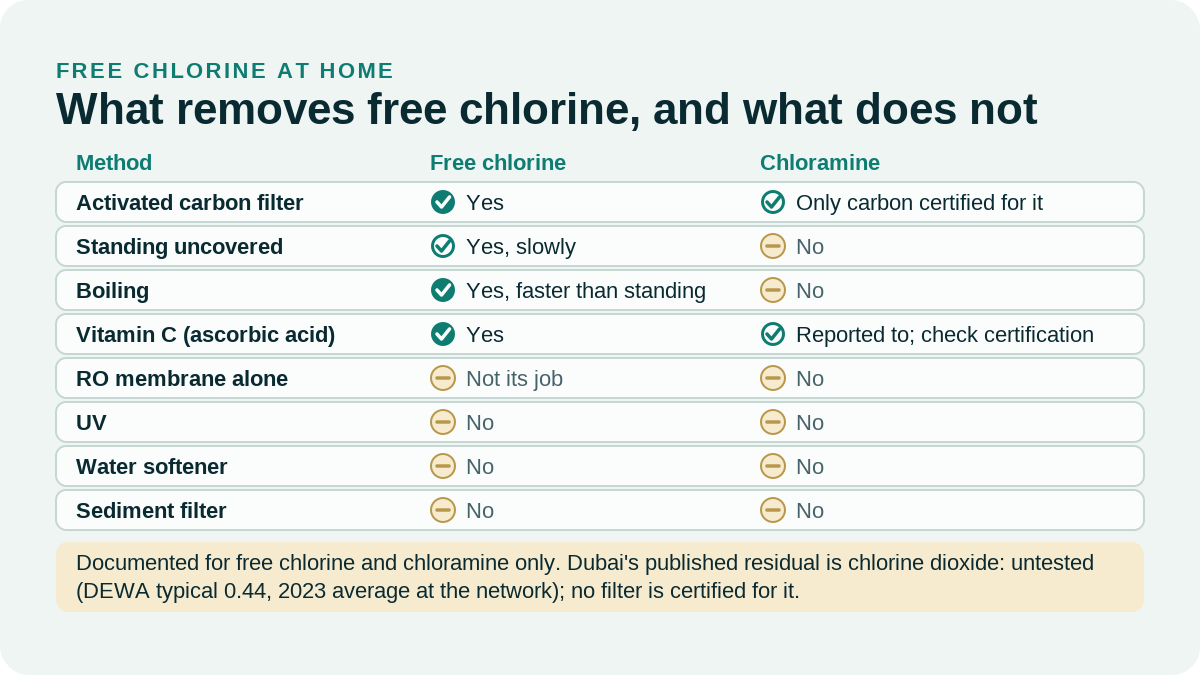
The methods below are documented for free chlorine and chloramine. For chlorine dioxide, chlorite and chlorate there is no NSF/ANSI certification claim, and we have found no test at household or shower scale. Reverse osmosis is named as a possibility for the two ions, but that is unproven and uncertified. Ask any seller for test data that names chlorine dioxide.
The level at your tap depends on the route: water held in a building tank can lose disinfectant before it reaches you, which is why we measure the disinfectant residual at the tap. A standard chlorine test kit also responds to chlorine dioxide and cannot tell the two apart, so the reading is an indication, not a breakdown.
What works, and what does not
| Method | Free chlorine | Chloramine | Limits |
|---|---|---|---|
| Activated carbon filter | Yes | Only with carbon made and certified for it | Cartridge must be changed on time; needs enough contact time |
| Standing uncovered | Yes, slowly | No | Takes a long time; open water can pick up dust and germs |
| Boiling | Yes, faster than standing | No | Uses energy; only practical for small amounts |
| Vitamin C (ascorbic acid) | Yes | Reported to; check the product's certification | Used mostly in shower filters; media is used up quickly |
| Reverse osmosis membrane alone | Not its job | No | RO systems rely on their carbon stages for chlorine |
| UV | No | No | UV removes nothing; it disinfects |
| Water softener | No | No | A softener removes hardness only |
| Sediment filter | No | No | Removes particles only |
Activated carbon
Chlorine reacts with the carbon surface as water passes through and is converted to chloride, which has no chlorine taste or smell.
What to look for:
- Certification for the claim. The NSF/ANSI 42 standard for aesthetic effects is the one under which chlorine reduction is certified.
- Contact time. A small cartridge at a high flow has less time to work than a large one.
- A change schedule. Carbon has a limited capacity. A cartridge left in too long stops removing chlorine and can harbour bacteria.
Carbon does not remove dissolved salts or lower TDS. See activated carbon filters.
Standing
Free chlorine is volatile and leaves water that stands open to the air. The CDC notes that chlorine can be removed by letting water sit out for a few days, and that chloramine cannot be removed this way.
It is slow, it depends on the surface area and temperature, and water that has lost its disinfectant and sits uncovered is no longer protected. If you use this method for drinking water, use a clean container, keep it in the fridge and do not store it for long.
Boiling
Boiling drives free chlorine out faster than standing does. Source to be confirmed Boiling does not remove chloramine, and it does not remove dissolved salts.
Chloramine behaves differently
Chloramine is formed when ammonia is added to chlorine. It lasts longer in the pipes, which also makes it harder to remove at home. The US Environmental Protection Agency states that:
- boiling does not remove monochloramine
- letting water sit at room temperature does not remove it
- reverse osmosis filters do not remove it
- some home treatment systems and filters may remove it, and products often carry certification describing how well
In practice that means a carbon filter specifically certified for chloramine reduction, usually one using catalytic carbon, with more contact time than a chlorine-only filter needs.
Fish and amphibians should not be kept in water containing chlorine or chloramine, according to the CDC.
Shower versus drinking water
Drinking water is cold, the flow is low, and you can give carbon plenty of contact time. An under-sink drinking water system with a carbon stage handles free chlorine well.
Shower water is hot and fast. A shower filter has seconds to work, in a small housing. Carbon is generally less effective in hot, fast water, which is why shower filters often use other media such as KDF or vitamin C, alone or with carbon. See shower filter types compared.
If you notice a disinfectant smell, a shower filter is a low-cost, removable thing to try, but its effect on Dubai's chlorine dioxide residual is untested. It does not soften water, it does not lower TDS, and it is not a treatment for any skin or hair condition. See shower filters in Dubai.
Whole house. In a villa, a carbon vessel at the inlet reduces free chlorine at every tap and shower at once. Dubai Municipality requires that residual disinfectant remain sufficient to prevent re-contamination, so where the filter sits relative to the tank is decided at the survey. See whole-house water filtration for villas.
One caution: once the disinfectant is removed, the water has no residual protection, so do not store it for long, and keep filters and any tank after them clean.
Next step
Find out what disinfectant residual is at your own taps before choosing a filter. Book a free water test. We measure disinfectant residual, hardness, TDS and pH, check the tank and inlet, and give you the results in writing with no obligation. Appointments are taken at least 10 days ahead.
Find out what is in your water
The free test measures hardness, TDS, disinfectant residual and pH at your own taps. We supply, install and maintain water treatment systems in every area of Dubai; message us for prices and service details.