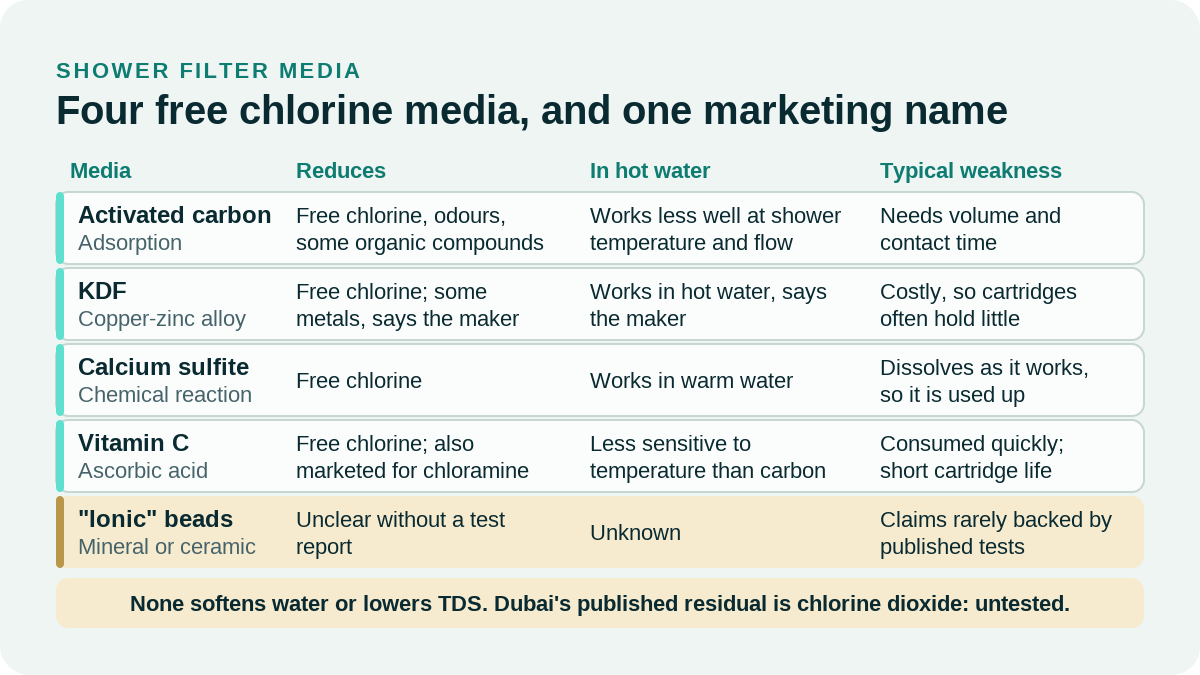
The shower filter types in one table
| Media | How it works | Reduces | Does not do | Hot water | Typical weakness |
|---|---|---|---|---|---|
| Activated carbon | Adsorption: free chlorine and organic compounds stick to a porous surface | Free chlorine, odours, some organic compounds | Soften water, lower TDS | Works less well at shower temperature and flow | Loses efficiency when hot; needs volume and contact time |
| KDF (copper-zinc alloy) | Redox reaction turns free chlorine into chloride | Free chlorine; some dissolved metals, according to the manufacturer | Soften water, lower TDS; limited effect on combined chlorine | Works in hot water, according to the manufacturer | Heavy and costly, so cartridges often contain little of it |
| Calcium sulfite | Chemical reaction with free chlorine | Free chlorine | Soften water, lower TDS | Works in warm water | Dissolves as it works, so it is used up |
| Vitamin C (ascorbic acid) | Chemical reaction neutralises free chlorine | Free chlorine, and it is also marketed for chloramine | Soften water, lower TDS, catch sediment | Not sensitive to temperature in the same way as carbon | Consumed quickly; short cartridge life |
| "Ionic", mineral or ceramic beads | Varies; often no stated mechanism | Unclear without a test report | Soften water, lower TDS | Unknown | Claims are rarely backed by published tests |
| Sediment pad or mesh | Physical straining | Sand, rust, grit | Reduce chlorine or hardness | Unaffected | Clogs, which slows the flow |
Activated carbon
Carbon is the standard free chlorine media in drinking water filters. It has a very large internal surface, and free chlorine and many taste and odour compounds hold on to it. Our page on activated carbon filters explains the process.
In a shower the conditions are against it. The water is hot and moving fast, and the cartridge is small. A patent for shower filter media puts it this way: carbon's efficiency in shower water "is limited by the higher flow rate and high temperatures". This is why carbon in a shower filter is nearly always one layer among several, not the only one.
KDF shower filter media
KDF is a granular alloy of copper and zinc. When chlorinated water passes over it, an exchange of electrons converts free chlorine into chloride, which is harmless at these levels. The manufacturer states that the media removes chlorine and soluble heavy metals "even in hot water", and positions it as a partner for carbon, treating the water before it reaches the carbon bed. The media itself is certified to NSF/ANSI 42, a drinking water standard. That is a certification of the ingredient, not of any shower filter built with it.
KDF acts on free chlorine. The patent mentioned above states that it "only affects the free chlorine and not the combined chlorine", meaning chloramine. And the granules are heavy and relatively expensive, so some low-cost filters contain a token amount.
A KDF shower filter suits homes where free chlorine is the target. In Dubai that needs checking. DEWA's published quality table lists chlorine dioxide as the disinfectant in the water it supplies (typical 0.44, a 2023 average at the network, as published), with no free chlorine or chloramine figure. Dubai Municipality's guideline speaks of a free chlorine residual of 0.2–0.5 ppm at the point of delivery. No NSF/ANSI certification covers chlorine dioxide, and we have found no tested figure for it for any of these media at shower flow and temperature. Ask for test data that names chlorine dioxide.
Calcium sulfite
Calcium sulfite reacts directly with free chlorine and does so in warm water. The catch is that it is consumed. The same patent describes powdered calcium sulfite as highly soluble and reports a bench test in which the powder had fully dissolved early in the test. Makers now use hardened beads that dissolve more slowly.
It suits hot showers, usually with KDF. Ask for a tested capacity.
Vitamin C filter shower heads
A vitamin C filter shower head holds a block or gel of ascorbic acid, often in a clear handle. Ascorbic acid reacts with free chlorine and neutralises it. The reaction is fast, and it is the reason these filters are also marketed for chloramine, which carbon and KDF handle less well.
The limits: the vitamin C is used up with every shower, so the cartridge may need changing more often than other types. It does nothing for sediment. And claims that vitamin C in the water feeds your skin or hair are marketing, not measured benefit. We have not found an independent standard that certifies vitamin C shower filters: Source to be confirmed.
Ionic shower filters
"Ionic shower filter" is not a technical category. The name is used for handheld heads filled with small mineral, ceramic or tourmaline beads, sometimes combined with a plate of tiny holes that raises spray pressure. The claims attached to them include negative ions, changed pH, "energised" water and softening.
What can be said fairly:
- The beads are not ion-exchange resin. They do not soften water.
- The fine-hole spray plate does make the water feel stronger and can reduce water use.
- Some beads may contain calcium sulfite, which does react with chlorine. If so, the seller should be able to show a chlorine test.
- NSF/ANSI 177, the standard for shower filters, lists one reduction claim: free available chlorine. Claims about ions and energy sit outside anything it tests.
Cartridge life and cost by type
Life depends on the amount of media, your water and how many showers the household takes, so we give no unsourced figures. As a pattern:
- Media that are consumed (vitamin C, calcium sulfite) run out sooner.
- KDF lasts longer but can be fouled by sediment.
- Carbon loses capacity gradually and gives no visible sign.
Typical cartridge life and price for the filters we fit: To be confirmed. Cartridge prices are listed in your written quote. For how to tell when a cartridge is spent, see how to install a shower filter and when to change the cartridge.
Which type suits whom
| Your situation | A sensible choice |
|---|---|
| Hot showers, free chlorine in the water | KDF with calcium sulfite, or KDF with carbon |
| Disinfectant smell on Dubai mains water | Any of these is something to try; all are untested for chlorine dioxide |
| Cool or lukewarm showers | Carbon-based multi-layer filter |
| You want a visible cartridge and do not mind frequent changes | Vitamin C |
| Gritty water or an old building tank | Any type with a sediment layer you can rinse or replace |
| Weak pressure | A low-resistance in-line filter; avoid dense multi-stage cartridges |
| Limescale is the real problem | None of these. See do shower filters remove hard water |
For the wider buying criteria, including certification and flow, read our guide to the best shower filter in UAE. For how these media fit into the bigger picture of home treatment, see water purification systems: types and methods.
Next step
Knowing the disinfectant residual and hardness at your tap helps with the choice. A standard chlorine test kit also responds to chlorine dioxide and cannot tell the two apart, so the residual reading is an indication. Book a free water test and we will measure both at your taps and explain what the results mean. Appointments are taken at least 10 days ahead.
Find out what is in your water
The free test measures hardness, TDS, disinfectant residual and pH at your own taps. We supply, install and maintain water treatment systems in every area of Dubai; message us for prices and service details.