What distilled water is
The meaning of distilled water is in the method. University of Nebraska–Lincoln Extension describes it: "Distillers use heat to boil contaminated water and produce steam." Minerals and most other impurities do not turn to vapour, so they stay in the boiling chamber. Then "The steam cools, condenses back to a liquid, and the water flows into a storage container."
The same guide says distillation "can remove nearly all impurities from water", including many organic compounds, heavy metals, chlorine and chloramines. Volatile substances such as some solvents can evaporate with the water and carry over unless the distiller has an extra stage to deal with them.
Distilled vs deionised vs demineralised vs RO water
These four names are often used as if they meant the same thing. The US Food and Drug Administration's bottled water rule treats them as one family, purified water, named by how it was made.
| Name | How it is made | Notes |
|---|---|---|
| Distilled water | Boiled to steam and condensed | The FDA rule allows the name only "if it is produced by distillation" |
| Deionised water | Treated by deionisation, a process that removes dissolved mineral ions | Named by the rule only if "processed by deionization" |
| Reverse osmosis water | Pushed through a membrane that holds back most dissolved solids | Named by the rule only if "processed by reverse osmosis" |
| Demineralised or purified water | Any of the above, or another suitable process | The umbrella terms in the FDA rule |
So is deionised water the same as distilled water? No. Both are low in minerals, but they are made differently, and the results differ. The US Environmental Protection Agency, writing about humidifiers, says water demineralised by deionisation or reverse osmosis "would, on the average, be expected to contain a higher mineral content than distilled waters".
How these compare with mineral and spring water is covered in purified, distilled, mineral and RO water: what is the difference?
Deionised water: how it differs from distilled
Deionised water is made by ion exchange, not by boiling. The US Centers for Disease Control and Prevention defines deionisation as the "removal of ions from water by exchange with other ions associated with fixed charges on a resin bed". Positively charged ions such as calcium and sodium are usually swapped for hydrogen ions, and negatively charged ones for hydroxide ions, which combine to form water.
The method explains the difference. Ion exchange takes out dissolved minerals and salts because they carry an electric charge. Substances without a charge are another matter: a University of Illinois physics Q&A on deionised water notes that "Non-ionic contaminants may persist", and the same page calls distilled water purer. Distillation leaves behind almost everything that does not evaporate, charged or not.
| Distilled water | Deionised water | |
|---|---|---|
| How it is made | Boiled to steam, then condensed | Passed through ion-exchange resin |
| What it takes out | Nearly all impurities, according to the Nebraska guide | Dissolved minerals and salts (charged ions) |
| What can remain | Volatile substances that evaporate with the water | Uncharged substances |
What distilled water is used for
The common thread is equipment that suffers when minerals are left behind as water evaporates or reacts.
- Humidifiers. The EPA explains that minerals in tap water can form scale in the machine and a "white dust" on surfaces, and notes that distilled water "will likely contain lower mineral content than most tap water".
- Lead-acid batteries. One battery maker's maintenance guide puts it in capitals: "ADD WATER, NEVER ACID, TO CELLS (distilled water recommended)."
- CPAP humidifiers. Guidance differs between providers. An NHS England leaflet, for example, tells patients to fill the water tub with boiled water that has gone cold. Follow the manual for your machine and the advice of your clinic.
- Steam irons and garment steamers. Follow the manual, which will say whether tap water is acceptable.
Can you drink distilled water?
We make no health claim in either direction. What the World Health Organization says is this: "Point-of-use reverse osmosis and distilling devices remove virtually all the minerals from the input water", and users "should be made aware of the changes in mineral composition". It also describes the taste: demineralised water "tends to have a flat taste", which is why producers of demineralised bottled water often add some minerals back.
The Nebraska guide says the same about drinking distilled water: distillation removes some oxygen and trace metals that contribute to taste, so people often describe it as flat or bland. If you have a medical reason to choose a particular water, ask your doctor.
Where people buy distilled water in Dubai
When we checked online listings in the UAE in November 2026, we found distilled water sold in two kinds of place: the car-care or household aisle of a hypermarket chain's online shop, in a 5-litre can, and a pharmacy chain's online shop, in a 1-litre bottle. We did not check laboratory suppliers. Stock comes and goes, so search for "distilled water near me" on the day.
Two checks before you buy:
- Read the label for the method. "Distilled" and "deionised" are different products. One listing we saw used both words.
- Read the label for the use. Water sold for batteries and appliances may be marked as not for drinking, as one listing we saw was.
We do not sell distilled water and do not name shops or brands.
Can a home RO system replace distilled water?
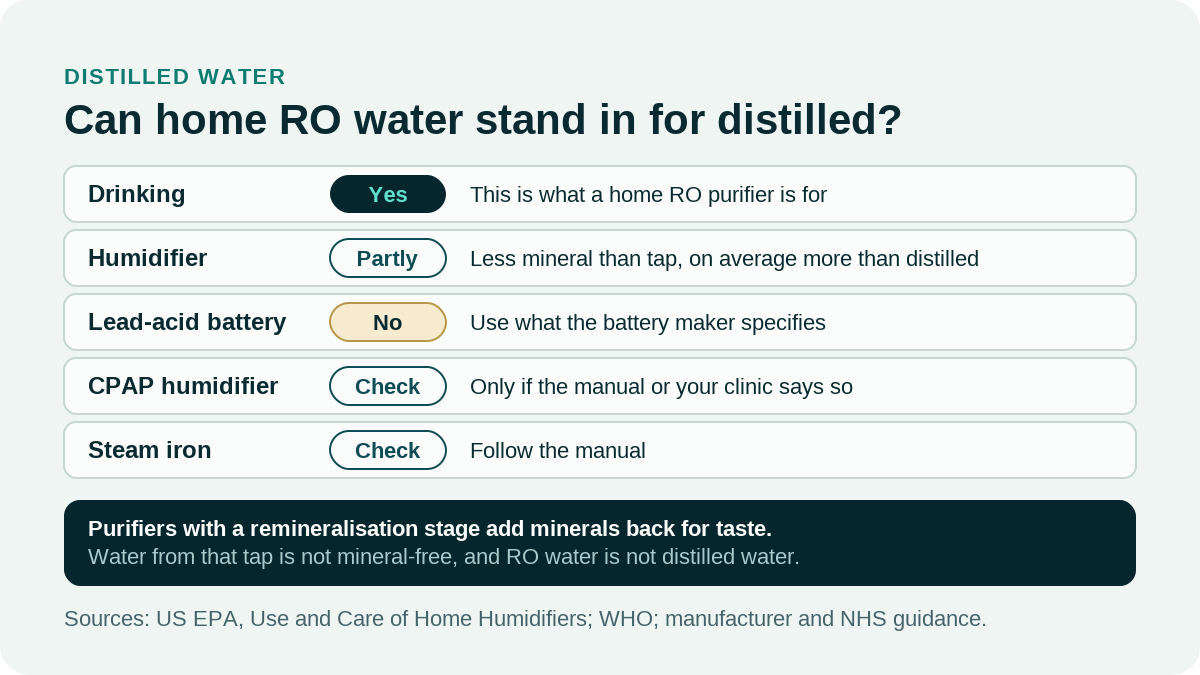
Sometimes, depending on the use. Start with one fact about the purifiers we fit: they include a remineralisation stage, which puts minerals back for taste. Water from that tap is deliberately not mineral-free. If you want low-mineral water from a reverse osmosis system for an appliance, it has to be drawn before the remineralisation stage, and a TDS meter will tell you what you have. See what is reverse osmosis? and how to add minerals back to RO water.
| Use | Can RO water stand in? |
|---|---|
| Drinking | Yes. This is what a home RO purifier is for, and remineralised water tastes less flat |
| Humidifier | Partly. RO water has less mineral than tap water but, on average, more than distilled. Watch for white dust and scale |
| Lead-acid battery | No. Use what the battery maker specifies |
| CPAP humidifier | Only if the manual or your clinic says so |
| Steam iron | Follow the manual |
| Any device marked "distilled water only" | No. RO water is not distilled water |
For comparison, DEWA's published typical TDS for Dubai's mains water is 216 (2023 average at the network, units not printed). A working membrane lowers that sharply but, going by the EPA's remark above, generally not to the level of distilled water. RO water purifiers explains what the systems do.
How to distil water at home, and why it is slow
A countertop distiller is a kettle with a condenser. You fill the boiling chamber, switch it on, and collect the condensed water in a container.
It is slow because every drop has to be boiled off. The Nebraska guide gives the example of "an 1100-watt unit that takes three hours to distill 1 gallon". That is 3.3 kWh for about 3.8 litres, or roughly 0.87 kWh a litre. At DEWA's lowest residential slab of AED 0.23 per kWh, plus the fuel surcharge of AED 0.06 published for November 2026 and 5% VAT, the electricity comes to about AED 0.27 a litre.
Scale collects in the boiler. The minerals left behind build up in the boiling chamber and have to be cleaned out, or the distiller becomes less efficient.
Improvised stovetop methods work on the same principle; we have no figures for them. If you need a few litres a month for an iron or a battery, buying it is simpler. If you want low-mineral drinking water every day, that is a job for reverse osmosis, not distillation.
Next step
If you are buying distilled water to drink because you are unsure about your tap, measure the tap first. Book a free water test. We measure hardness, TDS, disinfectant residual and pH, check the tank and inlet, and give you the results in writing with no obligation. Appointments are taken at least 10 days ahead.
Find out what is in your water
The free test measures hardness, TDS, disinfectant residual and pH at your own taps. We supply, install and maintain water treatment systems in every area of Dubai; message us for prices and service details.