Why tank water gets hot in summer
DEWA's own conservation booklet acknowledges it: "The water gets naturally heated at that time of year." No official source we read says exactly where the heat is gained. A tank and pipes on a roof in the sun are the likely places. The full account is in why Dubai tap water is warm in summer.
Two official texts show what a well-built system is meant to achieve:
- Dubai Municipality's guideline for drinking water in buildings says "Cold water storage and distribution should be at or below 20 °C".
- The Dubai Building Code says tanks installed above ground "shall be constructed from pre-insulated GRP", installed in a conditioned space, and "shall not be exposed to the external Dubai climate".
A tank that stands outdoors on a roof without insulation does not match that description, and that is when people start looking for a water tank cooler.
What a tank chiller is and how it works
A water tank chiller system is a small refrigeration machine, in principle like an air conditioner that cools water instead of air. A pump draws water from the tank, passes it through a heat exchanger where a refrigerant absorbs its heat, and returns it cooler. The machine then releases that heat to the outside air.
Two things follow from that design:
- It cools the tank, not the pipes. Water that leaves a cool tank and then sits in a hot pipe warms up again. The first water out of the tap can still be hot.
- It fights the sun all day. An unshaded, uninsulated tank gains heat continuously, and the chiller has to remove it continuously.
Sizing basics: tank volume and tonnage
Chiller capacity is quoted in tons of refrigeration or in kilowatts. One ton of refrigeration is 12,000 Btu per hour, which the US National Institute of Standards and Technology gives as 3,516.853 watts: about 3.5 kW of heat removed.
The load is set by how much water you have and how far you want to cool it. The US Geological Survey gives the physics: "Water has to absorb 4,184 Joules of heat (1 kilocalorie) for the temperature of one kilogram of water to increase 1°C." Cooling works the same way in reverse.
A worked example:
- A 1,000 litre tank holds about 1,000 kg of water.
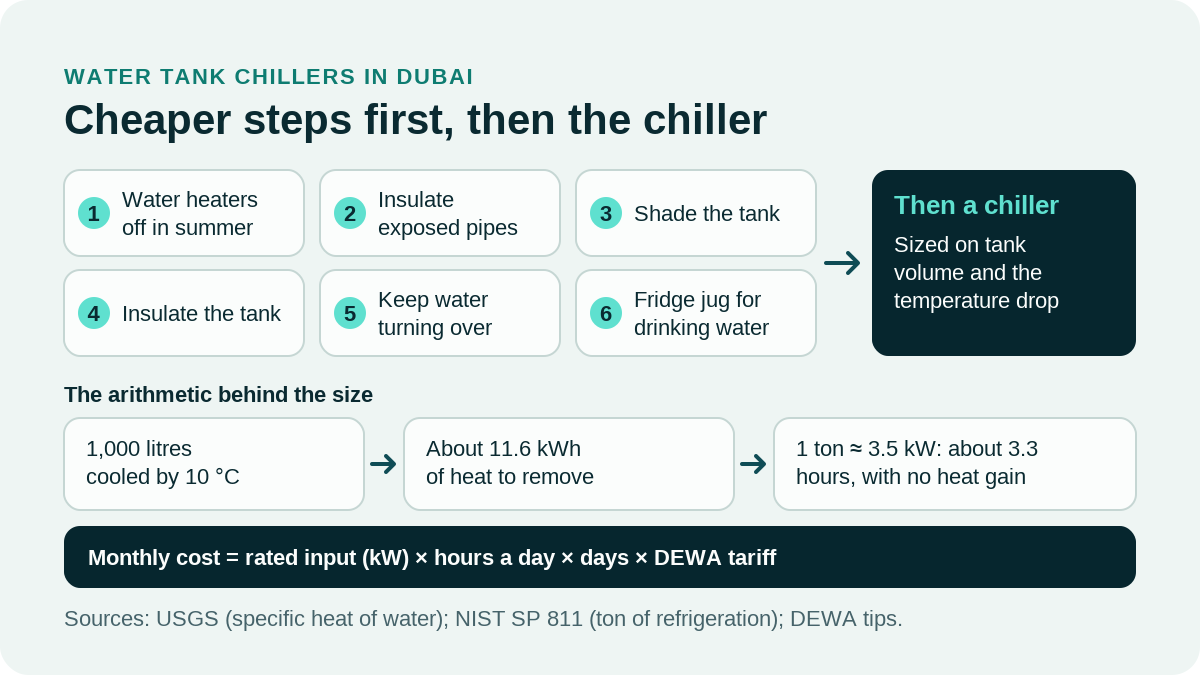
- Cooling it by 10 °C means removing 1,000 × 10 × 4,184 joules, which is about 41.8 megajoules or 11.6 kWh of heat.
- A one-ton chiller removes about 3.5 kWh of heat an hour, so it would need about 3.3 hours to do that once, if the tank gained no heat in the meantime.
A real tank does gain heat in the meantime, and it is refilled with warm water as you use it. Those two loads, heat gain through the tank walls and the daily volume of new water, are what an installer has to estimate for your home. Ask any supplier to show the calculation behind the size they propose: tank volume, daily water use, the temperature drop they are designing for, and what they assumed about shade and insulation.
Running cost on a DEWA bill
The heat removed is not the electricity used. A chiller normally uses less electricity than the heat it moves, and how much less is its efficiency rating. The US Department of Energy's purchasing guidance rates air-cooled chillers by Energy Efficiency Ratio (EER), in Btu per watt. We do not quote a typical efficiency, because it varies by model and operating conditions.
The reliable way to estimate cost is from the data sheet:
Monthly cost = rated power input (kW) × hours run per day × days × tariff
The tariff for a home is DEWA's slab rate, AED 0.23 to AED 0.38 per kWh depending on your total monthly consumption, plus the fuel surcharge (AED 0.06 per kWh was published for November 2026) and 5% VAT.
To show the arithmetic only: a machine drawing 1 kW for 8 hours a day uses 8 kWh a day, or 240 kWh over 30 days. That is about AED 73 a month in the lowest slab and about AED 111 in the highest. The 1 kW and the 8 hours are round numbers, not a typical chiller. Our DEWA bill calculator shows the slabs.
Cheaper steps first
These cost less than a chiller and reduce the load on one if you fit it later.
- Switch off water heaters in summer. DEWA's own tip: "Close your water heaters in the summer."
- Insulate exposed pipes. DEWA advises it, and Dubai Municipality's guideline names uninsulated pipes as poor temperature control.
- Shade the tank. A shade structure or enclosure keeps direct sun off it. Anything fitted must leave the tank cover intact, fixed and accessible for cleaning.
- Insulate the tank, or replace an old one. The Building Code's standard for above-ground tanks is pre-insulated GRP. A lighter-coloured surface also absorbs less sun than a dark one, though we have no measurements to put a number on it.
- Keep water turning over. A tank far larger than the household needs holds water for longer in the heat. The municipality's guideline lists oversized tanks that cause stagnation among the conditions for microbial growth.
- Chill drinking water in the fridge. For taste, a covered jug in the fridge does what a chiller does for a fraction of the energy.
If you rent, steps 2 to 5 are for the landlord or building management.
Does chilled water change water quality or filtration?
Quality. Temperature matters for stored water. The World Health Organization notes that "High water temperature enhances the growth of microorganisms" and that Legionella can proliferate "at temperatures above 25 °C". Cooler stored water is closer to what the Dubai guideline asks for. A chiller is not a treatment, though. It removes nothing from the water and does not disinfect, and it adds a pump, a heat exchanger and pipework that have to be kept clean with the rest of the system. The tank still has to be emptied, cleaned and disinfected at least twice a year, as set out in water tanks: cleaning and filtration.
Filtration. A filter does not cool water, and a chiller does not filter it. One link between them is temperature limits. Filter housings and membranes have them. One manufacturer's technical sheet for a standard plastic filter housing gives a maximum of 51.7 °C. Cooler water keeps equipment further from limits like that; check the figure for your own system.
Dr Water Lab's own work is water testing and filtration: whole-house water filtration for villas at the inlet, and drinking water purifiers at the sink. This page is a neutral guide, and we do not recommend or rank chiller suppliers.
Next step
If warm water has made you wonder about the tank, find out what is at the tap. Book a free water test. We measure hardness, TDS, disinfectant residual and pH, make a visual check of the tank and inlet, and give you the results in writing with no obligation. Appointments are taken at least 10 days ahead.
Find out what is in your water
The free test measures hardness, TDS, disinfectant residual and pH at your own taps. We supply, install and maintain water treatment systems in every area of Dubai; message us for prices and service details.