This page is the practical guide. For what TDS means, WHO's taste bands and Dubai's published figure, see what is TDS in water.
What a TDS meter actually measures
A TDS meter does not weigh anything. It measures electrical conductivity and converts it. The World Health Organization's background document on TDS describes the method: conductivity is measured with a probe "that detects the presence of ions in water", and the readings "are converted into TDS values by means of a factor that varies with the type of water".
That factor is the weak point. The US Environmental Protection Agency's monitoring guidance says TDS in mg/L can be calculated by multiplying conductivity by "a factor between 0.55 and 0.9, which is empirically determined". A pocket meter has one factor built in. It cannot know which minerals are in your glass, so two waters with the same true TDS can give slightly different readings.
Temperature matters too. The EPA guidance notes that "the warmer the water, the higher the conductivity", which is why conductivity is reported at 25 degrees Celsius. Most meters correct for temperature automatically. Check that yours does, because Dubai tap water runs warm in summer.
So what is a TDS ppm meter showing you? An estimate, in parts per million. For household water, 1 ppm and 1 mg/L are treated as the same thing.
How to use a TDS meter, step by step
- Read the manual once. Find out how deep the probe should sit, whether the meter corrects for temperature and how the maker says to calibrate it. If a calibration solution is specified, use that one.
- Rinse a clean glass with the water you are about to test. Soap residue and dried minerals change the reading.
- Run the cold tap for a short while, then fill the glass. Water that has sat in a tap or flexible hose overnight is not typical of your supply.
- Rinse the probe in the sample, then dip it to the marked depth. Do not submerge the whole meter unless the maker says it is waterproof.
- Stir gently and tap the probe against the glass to release air bubbles. Bubbles on the electrodes can distort the reading.
- Wait until the number stops moving, then press hold if the meter has it.
- Write down the number, the tap, the date and the water temperature. One reading means little. A record means a lot.
- Shake the probe dry and replace the cap. Clean the electrodes only as the maker describes.
A TDS meter chart: how to read your number
There is no official health limit for TDS to chart against. WHO's guidelines say "No health-based guideline value for TDS has been proposed". What WHO reports is how taste panels rated water:
| Meter reading (ppm, treated as mg/litre) | Taste-panel rating reported by WHO |
|---|---|
| Less than 300 | Excellent |
| 300 to 600 | Good |
| 600 to 900 | Fair |
| 900 to 1200 | Poor |
| Greater than 1200 | Unacceptable |
These are taste bands, not safety bands. The same WHO document adds that water with extremely low TDS "may also be unacceptable because of its flat, insipid taste".
For a local reference point, DEWA publishes a typical TDS of 216 for the water it supplies, against its own specification of 100 – 450. That is water at the network, before your building's tank and pipes. If it reads far above it, or jumps between months, look at the tank and ask the building for its records.
Checking an RO system with a TDS meter
This is the job a TDS meter does best. A reverse osmosis membrane holds back dissolved salts, so a working system shows a clear drop.
- Measure the cold kitchen tap. Call it the feed reading.
- Run the purifier tap briefly, then measure the purified water.
- Work out the reduction: (feed − purified) ÷ feed × 100.
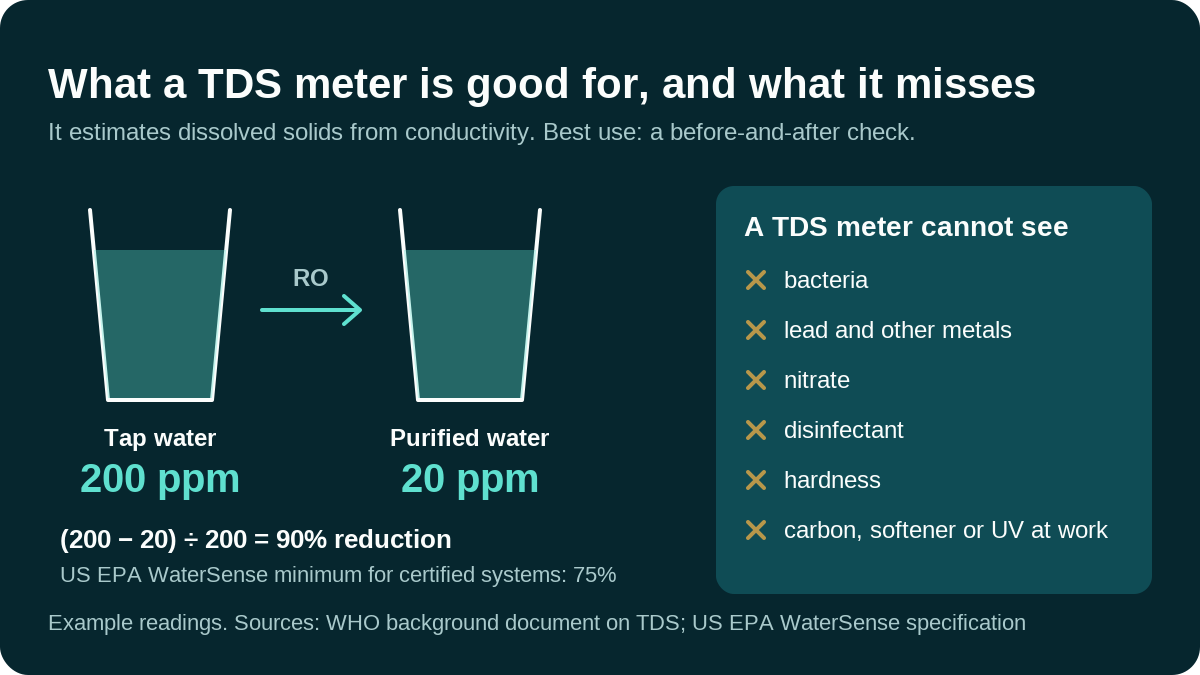
An example: a feed of 200 ppm and purified water of 20 ppm is a 90 per cent reduction. As a benchmark, the US EPA's WaterSense specification requires certified point-of-use systems to "reduce the influent challenge level of TDS by at least 75 percent".
Three things to know when you use a reverse osmosis TDS meter check:
- Take both readings every time. Your tap reading moves, so the purified reading alone can mislead you.
- Watch the trend. A reduction that shrinks over the months means the membrane or filters need attention.
- A remineralisation stage raises the final number on purpose. The under-sink RO water purifiers we fit add minerals back after the membrane, because WHO notes that these devices "remove virtually all the minerals from the input water" and very low TDS water tastes flat. The reading at the purifier tap will be higher than the reading straight after the membrane. See how to add minerals back to RO water.
What a TDS meter cannot detect
A TDS meter adds everything dissolved into one number. It cannot tell you:
- Whether bacteria are present. Bacteria do not change conductivity.
- Whether lead, other metals or nitrate are present at levels that matter. These are measured in thousandths of a milligram or a few milligrams per litre, far too little to move the reading.
- How much disinfectant is in the water.
- How hard the water is. Hardness is the calcium and magnesium part only. Water can read high because of sodium and still be soft.
- Whether a carbon filter, sediment filter, softener or UV lamp is working. Carbon does not remove dissolved salts. A softener swaps calcium and magnesium for sodium. A sediment filter and a UV lamp do not change dissolved solids. The reading before and after these devices is about the same, and that does not mean they are broken.
TDS meter vs pH meter vs test strips
| Tool | What it measures | What it is good for | Limit |
|---|---|---|---|
| TDS meter | Conductivity, shown as estimated TDS | Before-and-after checks on reverse osmosis; spotting a change | One number for all dissolved minerals |
| pH meter | How acidic or alkaline the water is | Checking alkaline or remineralising stages | Needs regular calibration; says nothing about minerals or safety |
| Combined TDS and pH meter | Both of the above | Convenience | Same limits as each alone |
| Test strips | Colour bands for items such as hardness, pH and chlorine | A rough first look | Read by eye; coarse steps |
None of these tools tests for bacteria or metals. That takes an accredited laboratory. See lab test, home test kit or home visit.
Next step
A TDS reading means more beside hardness, disinfectant residual and pH from the same tap. Book a free water test. Dr Water Lab measures all four at your taps, checks the tank and inlet, and gives you the results in writing with no obligation. Appointments are taken at least 10 days ahead.
Find out what is in your water
The free test measures hardness, TDS, disinfectant residual and pH at your own taps. We supply, install and maintain water treatment systems in every area of Dubai; message us for prices and service details.