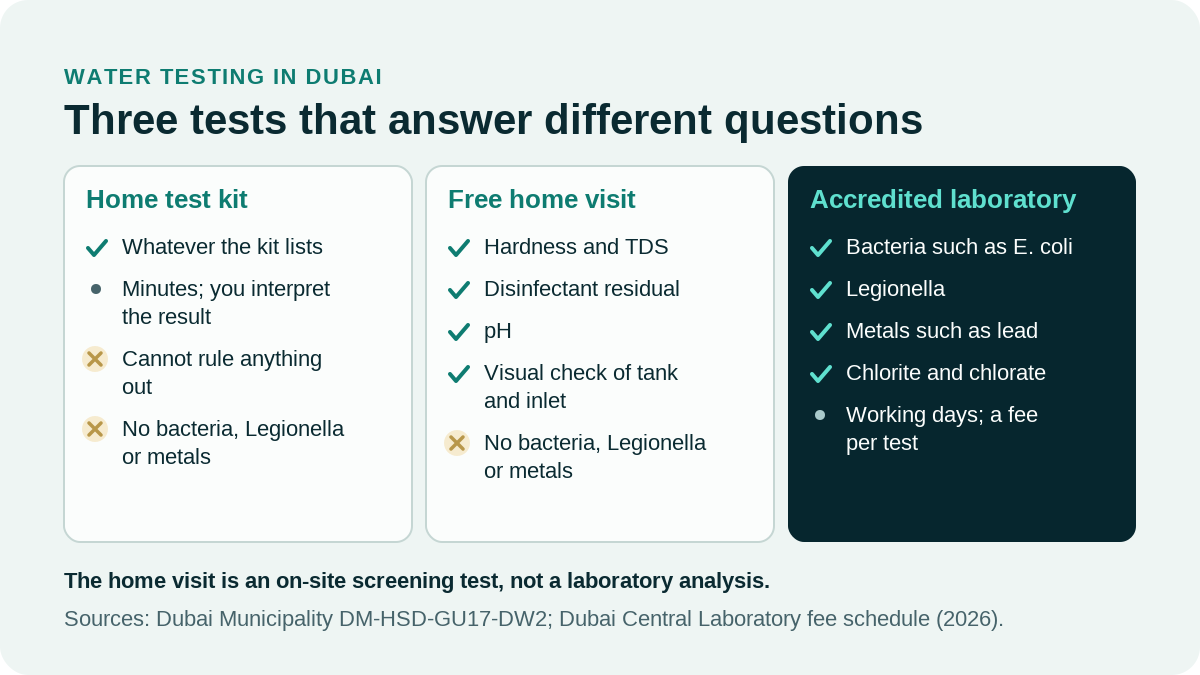
Three ways to test water at home
| Home test kit or strips | Dr Water Lab free home visit | Accredited laboratory | |
|---|---|---|---|
| Measures | Whatever the kit lists; each kit differs | Hardness, TDS, disinfectant residual, pH; visual check of tank and inlet | Bacteria, Legionella, metals, individual chemicals, plus the basics |
| Cost level | The price of the kit | Free | A fee per test |
| Time | Minutes | Readings on the spot; appointments at least 10 days ahead | Working days |
What a test strip or home kit can tell you
A home water test kit is a set of strips or reagents that change colour, sometimes with a small meter. It is quick, and for a few simple readings it is a reasonable first look.
Its limits are worth knowing. A 2025 study in the Journal of Water and Health evaluated off-the-shelf home drinking water test kits for iron, copper, manganese and fluoride. The authors found "highly repeatable but variable performance", noted that the kits are unregulated and lack performance data, and concluded that whether a result can be relied on "depends on which parameter is being measured in which water with which kit and for which purpose".
Three practical points:
- A chlorine strip does not tell you which disinfectant you have. DEWA's published figure is for chlorine dioxide. A standard chlorine test also responds to chlorine dioxide and cannot tell the two apart, so call the reading a disinfectant residual.
- A TDS meter measures dissolved minerals, not safety. It cannot see bacteria or metals. See what is TDS?
- A kit cannot rule something out. A blank strip means the kit did not detect it, which is not the same as absent.
What only an accredited laboratory can test
Bacteria, Legionella, lead and other metals, and individual chemicals need a laboratory. These are measured at very low levels with culture methods and instruments that no strip can match, and for bacteria the way the sample is taken matters as much as the analysis.
Dubai Municipality's guideline for drinking water in buildings requires building owners to use "a laboratory accredited by the Emirates International Accreditation Center" for the routine tests on their water. If you search for a water testing lab near me, that accreditation is the first thing to ask a laboratory for, along with whether the specific tests you want are within its accredited scope.
The government laboratory is Dubai Central Laboratory, a department of Dubai Municipality. In July 2026 the municipality announced that it had adopted artificial intelligence technologies for "the early and accurate detection of bacterial contamination, including Legionella and E. coli", and described its monitoring as covering water storage tanks, taps, swimming pools and non-bottled drinking water.
Legionella testing
Legionella is a bacterium that grows in water systems. The World Health Organization notes that it can proliferate "at temperatures above 25 °C", which is why Dubai Municipality wants cold water kept cold and hot water kept hot in buildings. A Legionella bacteria test is a laboratory test on a properly taken sample. No home kit or home visit, including ours, tests for it. If someone in your home is unwell, speak to a doctor; a water test is not a diagnosis.
How laboratory water testing works in Dubai
Sampling. The US Environmental Protection Agency's fact sheet on home water testing sets out the general practice: "Most testing laboratories or services supply their own sample containers", and samples for coliform bacteria "must be collected using sterile containers and under sterile conditions". It adds that laboratories may sometimes send a trained technician to collect the sample, and suggests asking, since you may get better samples and more reliable results. Dubai Municipality's guideline points to the international standard for microbiological sampling, ISO 19458, and says samples must be protected from contamination, stored properly and analysed as soon as possible.
Turnaround and fees. Dubai Central Laboratory publishes a fee schedule for environmental samples, last updated 25 June 2026, with an application link. It lists a unit price and a test duration in working days for each test. The schedule prints no currency. Some rows that matter for a home:
| Test (as listed) | Unit price | Working days |
|---|---|---|
| Drinking water: pH | 42 | 2 |
| Drinking water: total hardness | 70 | 2 |
| Drinking water: total dissolved solids | 84 | 3 |
| Drinking water: chlorite, chlorate (each) | 70 | 3 |
| Drinking water: lead by ICP-MS | 116 | 5 |
| Water: coliforms and E. coli, Quanti-Tray technique | 61 | 3 |
| Water: Legionella, ISO 11731 | 400 | 14 |
| Water: Legionella by MICA | 314 | 4 |
The schedule also lists a knowledge fee and an innovation fee of 10.00 each. Fees and procedures change, so confirm with the laboratory before you rely on these figures, and ask how a household sample must be collected and delivered. We do not name or rank private laboratories, and we have no sourced figures for their fees.
What our free home visit measures and what it does not
Our visit measures four things at the taps you use: hardness, TDS, disinfectant residual and pH. It includes a visual check of the tank and the water inlet, and you receive the results in writing. The details are on the booking page.
It does not test for bacteria, Legionella, heavy metals or individual chemicals, and it does not certify water as safe or unsafe to drink. It is an on-site screening test, not a laboratory analysis. The disinfectant reading is an indication, not a breakdown: the kit does not separate chlorine from chlorine dioxide and does not measure chlorite or chlorate. For any of those, an accredited laboratory is the right route, and we will say so.
Which test for which worry
| Your question | Start with | Why |
|---|---|---|
| The water tastes or smells odd | Home visit | TDS and disinfectant residual are the readings most related to taste, and the tank is checked at the same visit |
| Scale on taps and kettles | Home visit or a hardness kit | Hardness is the reading that matters. DEWA's published typical figure for the network is 61.3, which is not hard; see is Dubai water hard? |
| I do not trust the tank | Tank cleaning record, then a laboratory | Dubai Municipality requires a laboratory test one week after each cleaning; see water tanks: cleaning and filtration |
| A new baby at home | Laboratory | Only a laboratory can test for bacteria. Ask your paediatrician what water to use |
| Moving into a new or long-empty villa | Laboratory, then home visit | The guideline calls for sampling after major changes to a building's water system |
The standards a laboratory result is compared with are explained in Dubai drinking water standards.
Next step
If your question is about taste, scale or whether treatment is worth it, start with the basics. Book a free water test. We measure hardness, TDS, disinfectant residual and pH at your taps, check the tank and inlet, and give you the results in writing with no obligation. Appointments are taken at least 10 days ahead.
Find out what is in your water
The free test measures hardness, TDS, disinfectant residual and pH at your own taps. We supply, install and maintain water treatment systems in every area of Dubai; message us for prices and service details.