What a candle filter is
The candle is a ceramic tube, closed at one end, with a threaded outlet at the other. Water passes from the outside of the tube to the hollow inside and leaves through the outlet. Anything too large for the pores stays on the outer surface.
The US Centers for Disease Control and Prevention (CDC) describes the principle in one line: "Ceramic filters depend on mechanical processes to remove contaminants." Nothing is added to the water and nothing is dissolved out of it. It is a sieve.
Many candles on sale add an activated carbon core or a silver treatment. Judge those claims by certification, as explained below.
Gravity water filter units and under-sink candles
Candles are used in two ways.
- Gravity units. Two containers sit one on top of the other. You fill the top one, and water drips through the candles into the bottom one, which has a tap. No plumbing and no power are needed, which makes these popular with renters. They are slow, and the lower container is a storage vessel that has to be kept clean.
- Pressure housings. A candle sits inside a housing under the sink or on the counter, fed by mains pressure. Flow is faster, and the water goes straight to a tap without being stored.
CDC lists the drawbacks of household ceramic filtration as "unknown effectiveness against viruses, lack of residual protection that can lead to recontamination", the need to keep the filter and receptacle clean, "and slow flow rates". That summary was written for developing countries, but the points about storage and cleaning apply to any gravity unit.
What ceramic removes and what it does not
How much a candle removes depends on its pore size, and makers do not all rate pores the same way. CDC explains the term to look for: "If a filter has an absolute pore size of 1 micron, for example, each one of the filter's pores is 1 micron or smaller." A "nominal" rating is an average and tells you less.
What a fine ceramic candle can hold back
- Sand, rust flakes and other visible particles, and cloudiness.
- Parasite cysts such as Giardia and Cryptosporidium. CDC says a microfiltration filter, with a pore size of about 0.1 micron, removes these parasites and is somewhat effective against bacteria.
- Bacteria, if the pores are fine enough. CDC's guide to choosing filters lists an absolute pore size of 0.3 micron or smaller for bacteria.
What it does not remove
- Viruses. CDC states that microfiltration does not remove viruses, and it lists only nanofiltration and reverse osmosis for them.
- Chemicals. Microfiltration does not remove chemicals, according to the same CDC page. Dissolved salts, hardness minerals, metals and nitrate pass through with the water, so a TDS reading before and after a plain ceramic candle is about the same.
- Taste and smell, unless the candle has a carbon core.
One point specific to Dubai: DEWA's published disinfectant is chlorine dioxide, and no household filter is certified for reducing it. A carbon core is certified, where it is certified at all, for free chlorine. We make no claim that a candle filter reduces the disinfectant in Dubai's mains water.
How to check a candle's claims
Look for certification by claim, not for general wording such as "removes 99.99%".
- NSF/ANSI 42 covers aesthetic claims such as particulate reduction, chlorine, taste and odour.
- NSF/ANSI 53 covers health claims, including cyst reduction.
- In Dubai, the Municipality's drinking water guideline says filters must carry a certificate of conformity or a recognised quality mark, and that microbial performance should follow the World Health Organization's scheme for evaluating household water treatment. It adds that the filter material should not affect water quality, and gives the example of a ceramic filter that may release arsenic into the water. That is a reason to buy a candle with documents, not an unmarked one.
CDC's general caution applies: most home water filters "are not designed to remove germs from your water". A candle is a microbial barrier only if it is rated and certified as one.
Candle filter cleaning and replacement
The trapped material builds up on the outside of the candle and the flow slows down. That is the signal to clean it.
- Follow the maker's instructions. Cleaning means removing the layer from the outer surface, with clean hands and clean water.
- Clean the lower container and tap of a gravity unit at the same time. Filtered water has no protection against recontamination while it sits there.
- Check the candle for cracks and check the seal at the base each time. CDC notes that a ceramic filter lasts a long time "if the filter remains unbroken". Water that finds a crack or a loose seal bypasses the ceramic altogether.
- Replace the candle on the maker's schedule. A carbon core has a fixed capacity and is spent while the ceramic still looks sound.
CDC's advice for any home filter is that you need to maintain it "to keep it working properly and prevent germs from growing in it". Dubai Municipality's guideline makes the same point about carbon: old carbon filters past their use-by date "can support the growth of microbes". Our guide to water filter cartridges covers replacement in more detail.
Candle filter vs carbon block vs RO for Dubai tap water
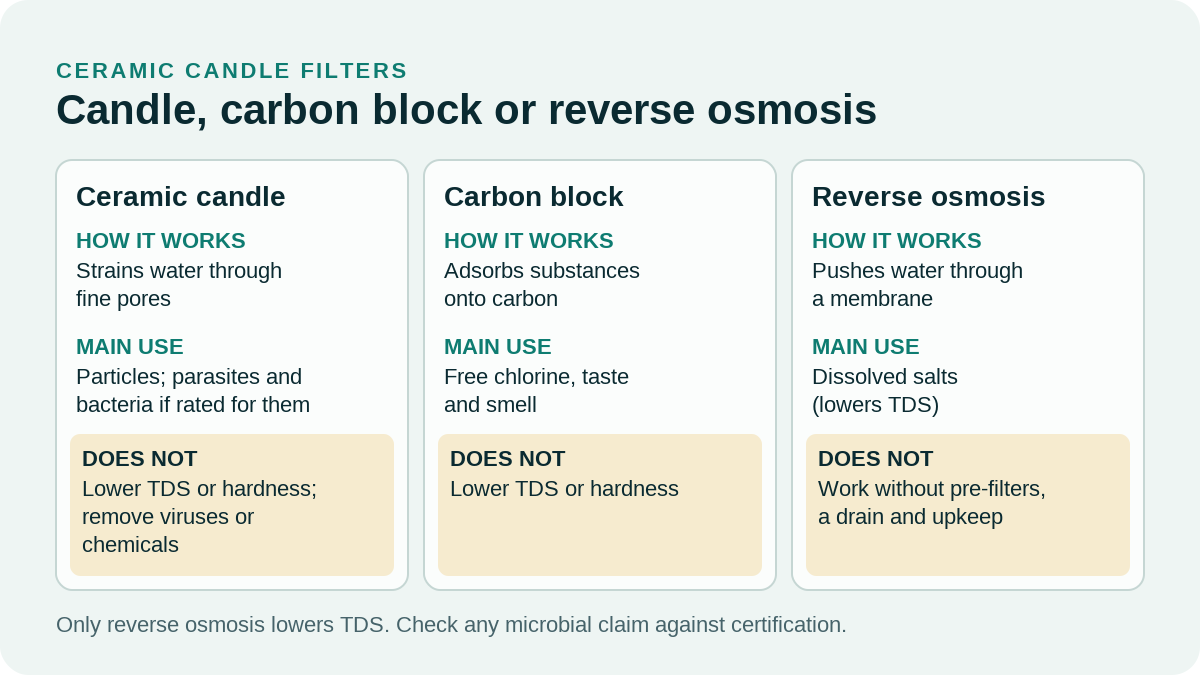
| Ceramic candle | Carbon block | Reverse osmosis | |
|---|---|---|---|
| How it works | Strains water through fine pores | Adsorbs substances onto carbon | Pushes water through a membrane |
| Main use | Particles; parasites and bacteria if rated for them | Free chlorine, taste and smell | Dissolved salts (lowers TDS) |
| Does not | Lower TDS or hardness; remove viruses or chemicals | Lower TDS or hardness | Work without pre-filters, a drain and upkeep |
DEWA publishes a typical TDS of 216 and total hardness of 61.3 for the water it supplies (2023 averages at the network, units not printed). Neither figure calls for treatment by default. If what bothers you is taste, an activated carbon filter is the usual choice. If you see grit or discolouration, look at the building tank first and then at a sediment filter. If you want lower TDS, only reverse osmosis does that.
A candle filter suits someone who wants a simple particle barrier with no plumbing. It is not a substitute for a clean tank. For the wider picture, see water purification systems: types and methods and our page on drinking water filters.
Next step
Before buying any filter, find out what is in the water at your own tap. Book a free water test. We measure hardness, TDS, disinfectant residual and pH at your taps, check the tank and inlet, and give you the results in writing with no obligation. Appointments are taken at least 10 days ahead.
Find out what is in your water
The free test measures hardness, TDS, disinfectant residual and pH at your own taps. We supply, install and maintain water treatment systems in every area of Dubai; message us for prices and service details.