What pH means in water
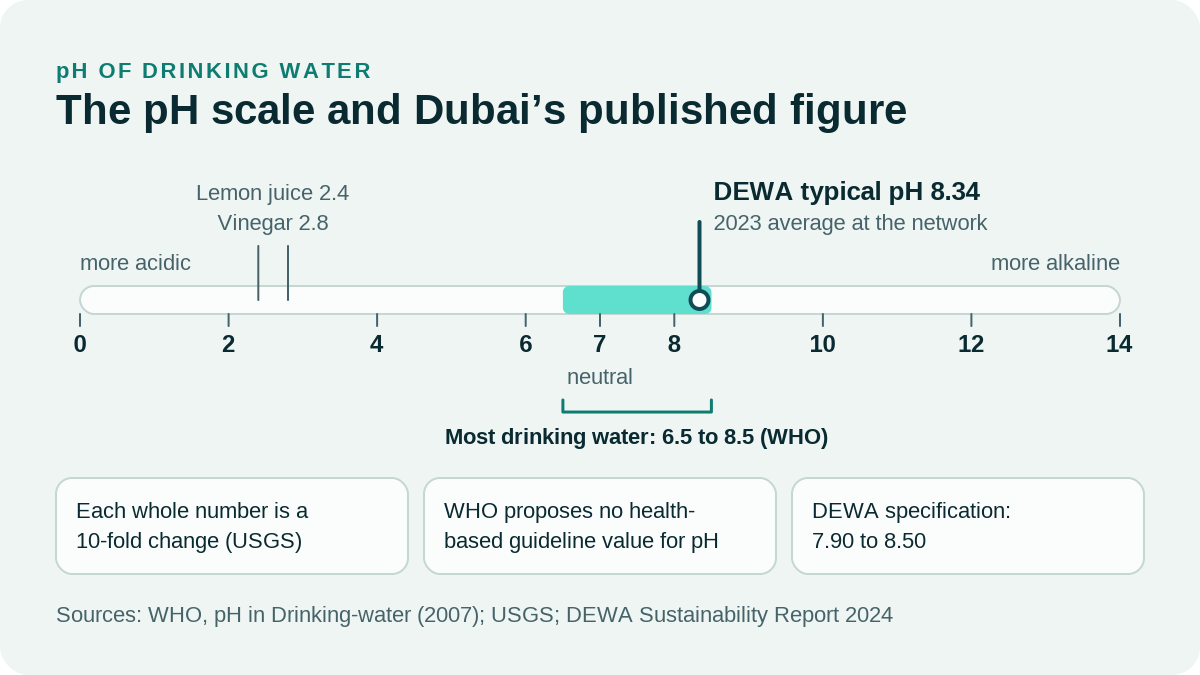
The US Geological Survey (USGS) gives the plain definition: "pH is a measure of how acidic/basic water is. The range goes from 0 to 14, with 7 being neutral." Below 7 is acidic. Above 7 is alkaline, also called basic.
Two things about the scale are easy to miss.
- It is logarithmic. USGS: "Each number represents a 10-fold change in the acidity/basicness of the water." Water at pH 6 is ten times more acidic than water at pH 7, and water at pH 5 is a hundred times more acidic.
- It measures balance, not quantity. pH reflects the relative amount of hydrogen and hydroxyl ions. It does not tell you how much is dissolved in the water. That is what TDS measures, and the two numbers are independent.
WHO explains what sets the pH value of water in practice: the balance between carbon dioxide, bicarbonate and carbonate. More dissolved carbon dioxide lowers pH.
For a sense of scale, WHO notes that lemon juice has a pH of 2.4, vinegar 2.8, and stomach fluid between 1.0 and 3.5. Drinking water sits far from those.
The pH range for drinking water
There is no single legal number that applies everywhere. These are the figures in the documents we read:
| Document | pH figure | What kind of figure |
|---|---|---|
| WHO, pH in Drinking-water | Most drinking water lies within 6.5–8.5; optimum for supply "often in the range 6.5–9.5" | Description and operating guidance; no health-based guideline value |
| US EPA secondary standards | 6.5–8.5 | Non-enforceable, for taste, corrosion and appearance |
| Abu Dhabi Water Quality Regulations 2021 | 7.0 (minimum) – 9.2 (maximum) | Regulatory limit in Abu Dhabi |
| DEWA's own specification | 7.90 – 8.50 | What DEWA holds its supplied water to |
One caution. DEWA's quality table prints "6.5 ~ 8.5" in a column headed "WHO Guideline Value (Max)". WHO's own document says: "It is not considered to be necessary to propose a health-based guideline value for pH." We describe 6.5 to 8.5 as the usual range, not as a WHO limit. Our page on Dubai drinking water standards explains how these documents relate.
Why suppliers care about pH
WHO calls pH "one of the most important operational water quality parameters". The reasons are practical:
- Corrosion. WHO: "in general, the lower the pH, the higher the potential level of corrosion".
- Deposits and taste. At the other end, USGS says high pH "causes a bitter taste" and that pipes and appliances "become encrusted with deposits".
- Disinfection. WHO notes that for effective disinfection with chlorine, the pH should preferably be less than 8.0.
pH of Dubai tap water
DEWA publishes a typical pH of 8.34 for the water it supplies, against its own specification of 7.90 to 8.50. The figure comes from the DEWA Sustainability Report 2024 and is an average of station averages for 2023.
How to read it:
- It is mildly alkaline, inside the 6.5 to 8.5 range, and inside Abu Dhabi's regulatory range as well.
- It describes water at the network, up to your meter. Your tap is downstream of a building tank and pipes, and the reading there can differ.
- A drinking water pH level above 7 is what you would expect from a supplier protecting metal pipes.
Bottled water pH levels
Bottled waters usually print a pH on the label. We found no official table of bottled water pH levels for the UAE, so we do not quote one. When you compare labels:
- The printed pH is the value at bottling. WHO notes that more dissolved carbon dioxide lowers pH, so the reading can drift once a bottle is open to the air.
- For the same reason, sparkling water is more acidic than still water.
- Water sold as alkaline is usually marketed at pH 8, 9 or higher. Dubai's mains supply is already above 8.
pH is one of the less useful numbers on a label. Our guide on how to choose bottled water in the UAE covers sodium and TDS, which tell you more.
Does RO change the pH level of water?
Usually, yes. Reverse osmosis removes most dissolved minerals, including the bicarbonate that holds pH steady. Water that comes out of the membrane can taste flat and may read slightly below neutral.
A remineralisation stage after the membrane puts some calcium and magnesium back, which improves the taste and brings the pH up again. See how to add minerals back to RO water.
How to lower or raise the pH of water
For drinking, there is rarely a reason to. People who want a lower pH for a specific purpose, such as coffee brewing, generally start from reverse osmosis water. People who want a higher pH use a mineral cartridge or an ioniser; our guides on alkaline water at home and on water ionisers and hydrogen water explain what those do. We do not suggest adding acids to drinking water.
How to test pH at home
- Test strips are cheap and quick. They read in coarse steps, so they are good for telling 6 from 8 and poor for telling 8.0 from 8.4.
- A pocket pH meter reads more finely. WHO notes that pH is usually measured electrometrically with a glass electrode, which is what these meters are. They need calibrating with buffer solutions, or the reading drifts.
- Temperature matters. WHO: "Temperature has a significant effect on pH measurement". Compare readings taken at similar temperatures.
A TDS meter does not measure pH. They are different instruments for different properties; see how to use a TDS meter.
Does pH matter for health? What the evidence says
WHO's position is direct. "A direct relationship between human health and the pH of drinking-water is impossible to ascertain", because pH is tied up with other aspects of water quality. Its conclusion: pH "usually has no direct impact on water consumers", and any effect on health "is likely to be indirect", through metals picked up from plumbing or through disinfection that works less well.
On the claims made for high-pH water, a systematic review in BMJ Open (Fenton and Huang, 2016) looked for evidence on alkaline water and cancer. It found "almost no actual research to either support or disprove these ideas", and its authors wrote that "the promotion of alkaline water as health promoting is not supported by evidence".
We make no health claim for any pH. If you have a kidney or respiratory condition, your doctor is the person to ask about what you drink.
Next step
pH is one of four readings we take. Book a free water test. We measure pH, TDS, hardness and disinfectant residual at your taps, check the tank and inlet, and give you the results in writing with no obligation. Appointments are taken at least 10 days ahead.
Find out what is in your water
The free test measures hardness, TDS, disinfectant residual and pH at your own taps. We supply, install and maintain water treatment systems in every area of Dubai; message us for prices and service details.