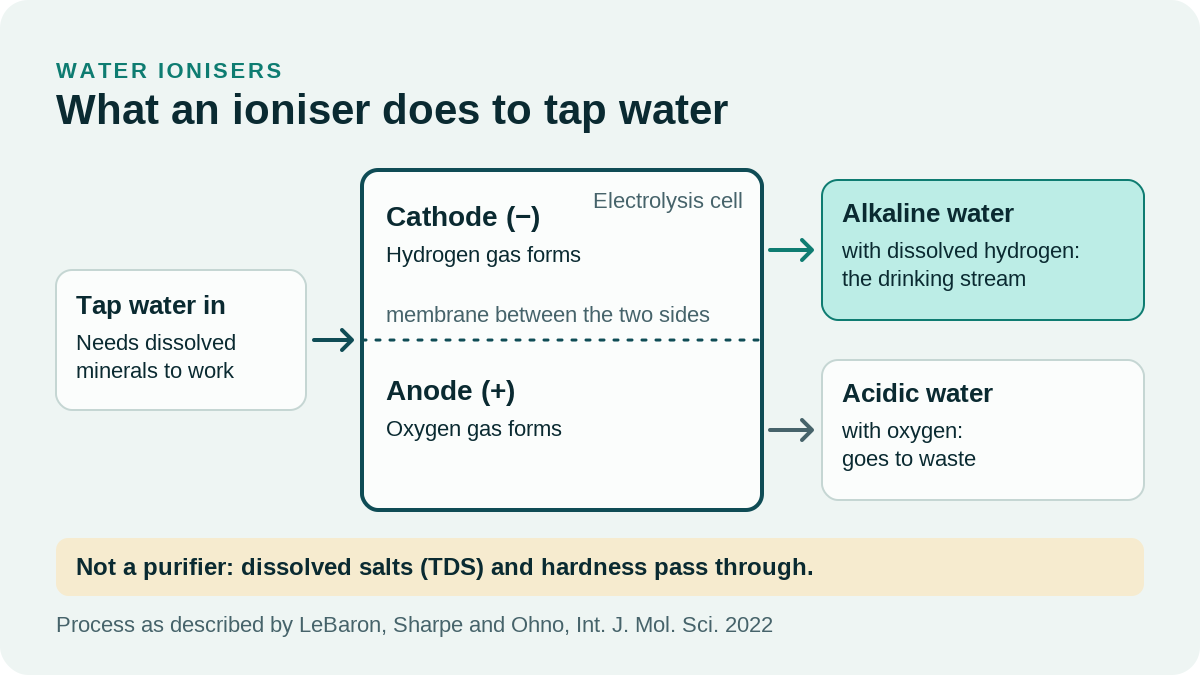
What an ioniser does to water: electrolysis
An ioniser contains an electrolysis cell: two electrodes with a membrane between them. When current flows, water is split at the electrodes. A 2022 review in the International Journal of Molecular Sciences (LeBaron, Sharpe and Ohno) describes the result. Hydrogen gas "is formed at the cathode", oxygen gas "is formed at the anode", and the membrane keeps the two sides apart. The cathode side delivers alkaline water. The anode side delivers "acidic water containing oxygen gas".
The same review gives the technical name for the drinking stream: electrolysed reduced water, "also called 'alkaline ionized water'".
Two practical consequences follow.
- The machine needs minerals in the water to work. Electrolysis depends on dissolved ions to carry current. An ioniser does little with very low-mineral water such as plain reverse osmosis output.
- Output varies. The review notes that the hydrogen level in ionised water "varies significantly", because of "differences in ERW machines, source water, and flow rate".
Ionised, alkaline and hydrogen water: the differences
| Term | What it describes | How it is made |
|---|---|---|
| Alkaline water | Water with a pH above 7 | Naturally by its minerals, by a mineral cartridge, by adding baking soda, or by an ioniser |
| Ionised water | The alkaline stream from an electrolysis machine | A water ioniser (also sold as an alkaline water machine) |
| Hydrogen water | Water with hydrogen gas dissolved in it | Gas dissolved under pressure, tablets, portable generators such as a hydrogen water bottle, or an ioniser |
- Alkaline does not mean ionised. Dubai's mains water is already mildly alkaline: DEWA's typical pH is 8.34 (2023 average at the network). See pH of drinking water.
- Hydrogen water need not be alkaline. Dissolved hydrogen gas is not the same thing as pH. A systematic review of hydrogen-rich water (Dhillon and colleagues, 2024) describes it as made by "dissolving molecular hydrogen gas into water under elevated pressure", and lists the consumer routes as "hydrogen-generating tablets, infusion machines, water generators, and ionizers".
- There is a ceiling on how much hydrogen water can hold. LeBaron and colleagues give the figure at normal temperature and pressure: "Hydrogen can be dissolved in water up to 0.8 mM (1.6 mg/L)." More stays dissolved at lower temperatures or higher pressures. Hydrogen is a gas, so what a bottle or machine produces depends on how it is made and how soon you drink it.
For the simpler ways to raise pH, see alkaline water at home.
Ionized water benefits: what the evidence supports and what it does not
Ionisers and hydrogen products are sold with claims about energy, ageing, recovery and disease. We make no health claim either way. This is what published reviews say.
On alkalinity
- A systematic review in BMJ Open (Fenton and Huang, 2016) searched for evidence on alkaline water and cancer. It found "almost no actual research to either support or disprove these ideas", and the authors concluded that "the promotion of alkaline water as health promoting is not supported by evidence".
- The World Health Organization proposes no health-based guideline value for pH, and says pH "usually has no direct impact on water consumers".
On hydrogen
- The 2024 systematic review by Dhillon and colleagues covered 25 articles on hydrogen-rich water. Its abstract describes preliminary results as encouraging and then states the limit plainly: "further research with larger sample sizes and rigorous methodologies is needed to substantiate these findings." It adds that current research has yet to fully explain how any benefit would come about.
- The same review reports that hydrogen-rich water "is mostly considered safe, with no to minimal side effects".
- LeBaron and colleagues argue that whatever effects have been reported for ionised water come from the dissolved hydrogen, not from the alkalinity. They also caution that from an ioniser "the production of H2, even at the highest setting, may be less than what is used in successful clinical studies".
What that adds up to
The research on hydrogen-rich water is early, and the reviewers themselves call for better trials. The research on alkalinity does not support the health claims. If you have a medical condition, especially one affecting the kidneys, ask your doctor before changing what you drink.
An ioniser is not a purifier: what it leaves in
An alkaline water ionizer machine rearranges what is in the water. It does not take much out.
- Dissolved salts stay. An ioniser does not lower TDS. Only reverse osmosis does that at home.
- Hardness stays. The calcium and magnesium that form scale pass through, and some of that scale forms on the machine's own plates.
- Whatever its built-in filter is not certified for stays. Many ionisers include a carbon or sediment cartridge. Judge it like any other filter, by the claims it is certified for. No filter is certified for reducing chlorine dioxide, the disinfectant DEWA reports, so we make no claim that an ioniser's filter reduces the disinfectant in Dubai's water.
The two technologies also pull in opposite directions. An ioniser needs minerals to work; reverse osmosis removes them. People who want both purified and alkaline water generally purify first and then add minerals back with a remineralisation cartridge, which raises pH without electricity. Our page on water purifiers for Dubai homes sets out the purification options.
Cost and upkeep
We do not sell ionisers or hydrogen generators, so we do not quote prices for them. What we can tell you is what to ask before you buy one.
- What does it cost to run per year? Filter cartridges are a recurring cost on top of the purchase.
- How are the plates cleaned? Scale builds up on electrodes and has to be removed. Ask how, and how often.
- Where does the acidic stream go? A plumbed-in ioniser needs a drain or a second outlet.
- What is the measured output on water like mine? A pH or hydrogen figure on the box is a best case. Ask for readings on water with Dubai's mineral content.
- What is the built-in filter certified for, and by whom?
Be cautious with any seller who promises that the water treats or prevents a condition.
Next step
If what you want is better drinking water, start with what is in it. Book a free water test. We measure pH, TDS, hardness and disinfectant residual at your taps, check the tank and inlet, and give you the results in writing with no obligation. Appointments are taken at least 10 days ahead.
Find out what is in your water
The free test measures hardness, TDS, disinfectant residual and pH at your own taps. We supply, install and maintain water treatment systems in every area of Dubai; message us for prices and service details.