Why there is no single best water in the UAE
"Best" needs a yardstick, and the official ones do not rank water by brand.
- Health. The Codex Alimentarius standard for packaged drinking waters says all packaged water "shall comply with the health-related requirements" of the World Health Organization's drinking-water guidelines. That is a floor every bottle is expected to meet, not a league table.
- Minerals. WHO proposes no health-based guideline value for TDS, hardness or pH. There is no official "ideal" number to chase.
- Taste. Taste is personal. WHO reports that taste panels rated water under 300 mg/litre of TDS as excellent, and also that water with extremely low TDS can taste "flat, insipid".
So the best drinking water in Dubai for you is the one whose numbers fit your taste, your household and your budget. The rest of this page is how to read those numbers.
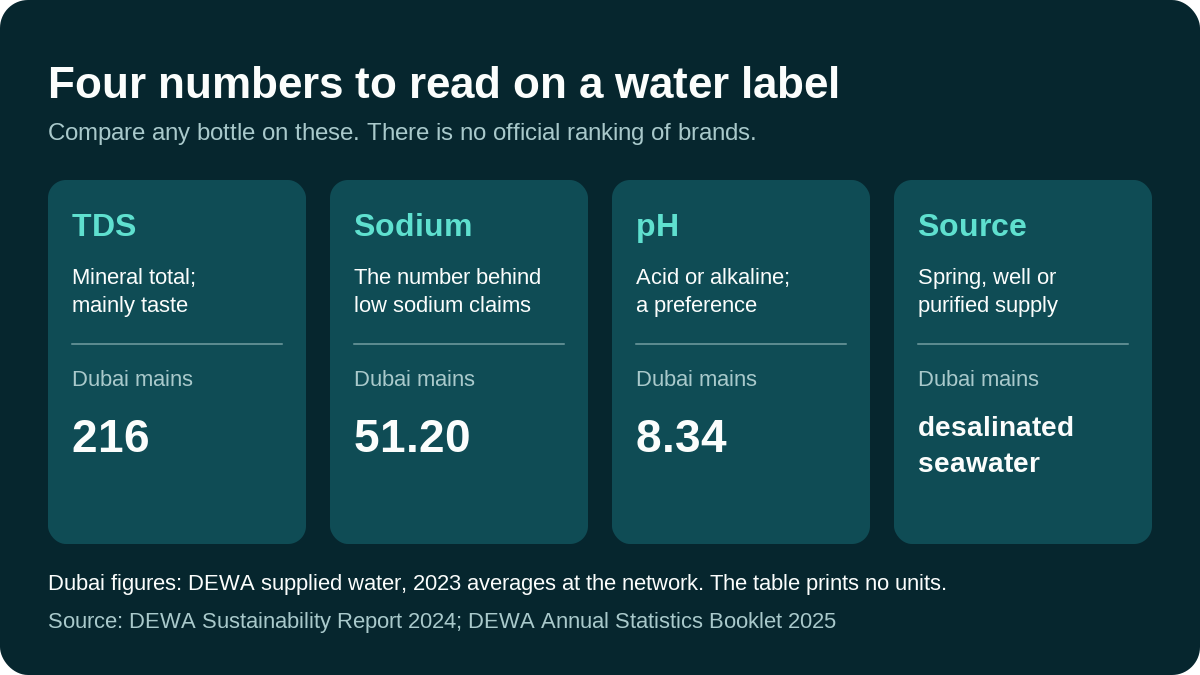
The four numbers on a UAE label: TDS, sodium, pH, source
1. TDS (total dissolved solids). The total of minerals and salts dissolved in the water, in mg/l. It mainly predicts taste: low readings taste light or flat, higher readings taste fuller or slightly salty. It is not a safety score. If TDS is not printed, the composition table still shows which minerals dominate. See what is TDS in water.
2. Sodium. Listed as "Sodium" or "Na" in mg/l. This is the number behind "low sodium" and "zero sodium" claims. As an example of the range, one UAE bottler's published composition table lists 3.5 mg/l for its regular water and less than 1 mg/l for its zero sodium water. Sodium matters most to people on a sodium-restricted diet, who should ask their doctor. See low sodium and zero sodium water.
3. pH. How acidic or alkaline the water is. The same bottler's table lists pH 7.2 for its regular water and 8.2 for its alkaline water. WHO says of pH that "It is not considered to be necessary to propose a health-based guideline value", so treat pH as a taste and preference number. See pH of drinking water.
4. Source. Where the water came from and what was done to it: a named spring or well, or water that has been purified and had minerals added. This decides what the bottle may be called, which is the next section.
Mineral water vs bottled water: what the names mean
The words on the front of the bottle are not interchangeable. The Codex Alimentarius standards, published by the food standards body of FAO and WHO, separate two families.
| Natural mineral water | Bottled or packaged drinking water | |
|---|---|---|
| Where it comes from | "obtained directly from natural or drilled sources from underground water bearing strata" | Waters defined by origin, or "prepared waters", which "may originate from any type of water supply" |
| What may be done to it | Only limited treatments that do not change its essential mineral content | Prepared waters may be treated in ways that change their physical and chemical characteristics |
| Minerals | Its own, from the source, in constant proportions | "may contain minerals, naturally occurring or intentionally added" |
| On the label | The name and location of the source, and the analytical composition | A name set by national rules; origin names only for waters defined by origin |
In plain terms, natural mineral water is bottled close to a protected underground source with its minerals as they are. Bottled drinking water may start from any supply, may be treated, and may have minerals added. Neither is the "better" one. They are different products. The Gulf and UAE standards for both are priced documents that we have not read, which is why we quote Codex here. For the full picture of water types see purified, distilled, mineral and RO water.
Storage: heat, sunlight and 5-gallon bottles
We looked for an official Dubai document that sets a storage temperature for bottled water at home and did not find one, so we give no figure. What we can say:
- Follow the storage instruction printed on the bottle. The bottler sets it for that packaging.
- Ask how the bottles are stored before delivery. The label's storage instruction applies to the seller as well as to you.
- Keep the dispenser clean. Dubai's Food Code requires food businesses to keep them clean: "Drinking water coolers and dispensers shall be regularly cleaned and disinfected so as to keep it free of dirt and microbial contamination." The rule is written for food establishments, and the reason behind it applies in a kitchen at home. A 5-gallon bottle is only as clean as the dispenser it sits on.
We make no health claims about bottles and heat.
How Dubai tap water compares on the same four numbers
DEWA publishes typical figures for the water it supplies (2023 averages, in its Sustainability Report 2024; the table prints no units).
| Number | DEWA's published typical figure | DEWA's own specification |
|---|---|---|
| TDS | 216 | 100 – 450 |
| Sodium | 51.20 | 10 – 200 |
| pH | 8.34 | 7.90 – 8.50 |
| Source | Desalinated seawater: 161,505 million imperial gallons in 2025, against 440 million from groundwater |
Two differences from a bottle label stand out. Sodium is higher than the 3.5 mg/l in the bottled example above, and the figures describe water at the network, not at your tap. Between the meter and the glass the water passes through your building's tank and pipes, which the building owner is responsible for. DEWA states that the water it produces and distributes complies with WHO's drinking-water guidelines.
Bottled, filtered or tap: cost and convenience
- Bottled. Nothing to install. You pay per bottle, store the bottles and, for 5-gallon bottles, keep a dispenser clean. On two bottlers' own shop pages on 22 November 2026, a 5-gallon bottle was listed between AED 9.52 and AED 11.43. See what 5-gallon water costs per year.
- Filtered at home. A cost at the start, then filters. A carbon filter changes taste and smell but not TDS or sodium. Reverse osmosis lowers both, and a remineralisation stage sets the final taste. See drinking water filters.
- Tap. DEWA's residential water tariff starts at AED 7.700 per cubic metre, which is 1,000 litres, before the fuel surcharge and VAT. That is less than one fil per litre (our arithmetic).
To put your own numbers side by side, use the bottled water vs purifier calculator.
Next step
Before you decide between bottles and a filter, find out what your own tap delivers. Book a free water test. Dr Water Lab measures hardness, TDS, disinfectant residual and pH at your taps, checks the tank and inlet, and gives you the results in writing with no obligation. Appointments are taken at least 10 days ahead.
Find out what is in your water
The free test measures hardness, TDS, disinfectant residual and pH at your own taps. We supply, install and maintain water treatment systems in every area of Dubai; message us for prices and service details.