What "low sodium" and "zero sodium" mean on a UAE label
We have to start with a gap. Health and nutrition claims on food labels in the Gulf are covered by a Gulf technical regulation, GSO 2333:2022, "Requirements for Health and Nutrition Claims on Food Products". It is a priced document and we have not read its sodium thresholds, so we do not quote a UAE legal definition here.
What we can quote is the international reference. The Codex Alimentarius Guidelines for Use of Nutrition and Health Claims set these conditions for sodium claims on food:
| Claim | Condition (not more than) | The same figure for water |
|---|---|---|
| Low sodium | 0.12 g per 100 g | 1,200 mg per litre |
| Very low sodium | 0.04 g per 100 g | 400 mg per litre |
| Sodium free | 0.005 g per 100 g | 50 mg per litre |
The right-hand column is our arithmetic, treating 100 g of water as 100 ml. It shows why the claim needs care with water. Under the Codex food conditions almost any drinking water would count as "low sodium". What bottlers in the UAE mean by "zero sodium" is much stricter than that. One UAE bottler's published composition table lists sodium at 3.5 mg/l for its regular water and less than 1 mg/l for its zero sodium water.
So read the number, not the claim.
How much sodium is in Dubai tap water
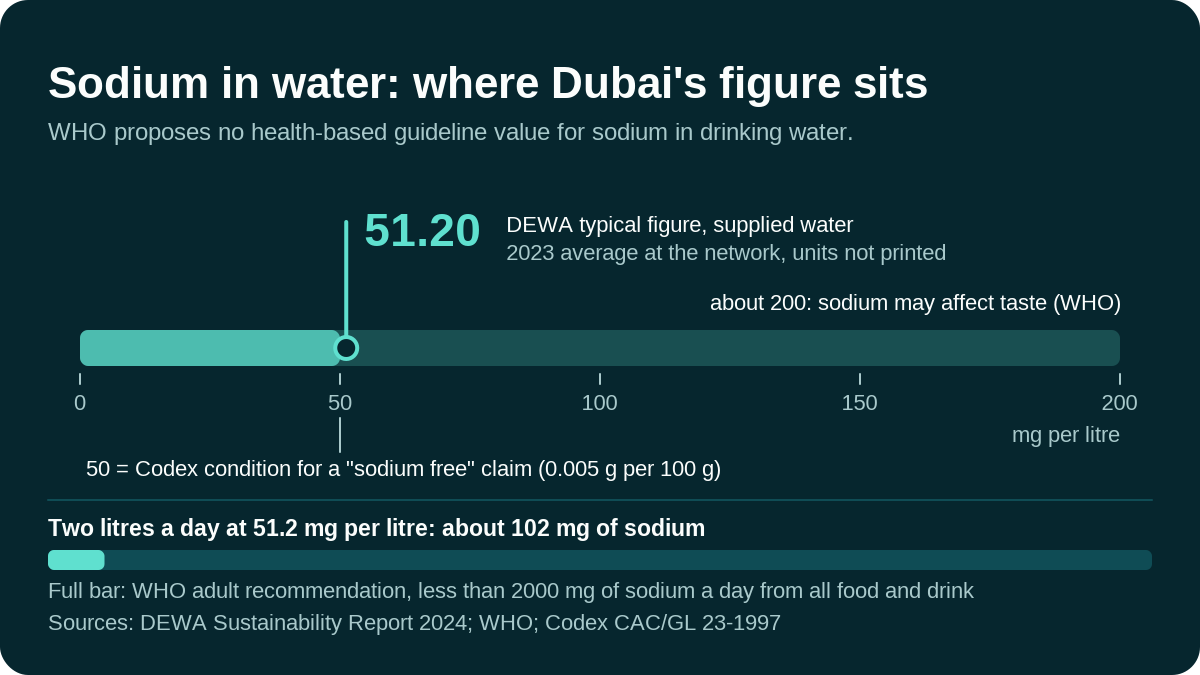
DEWA's quality table for supplied water gives a typical sodium figure of 51.20, against its own specification of 10 – 200. The values are 2023 averages, published in the DEWA Sustainability Report 2024, and the table prints no units; sodium is conventionally reported in mg/L.
Two cautions about that figure:
- It describes water at the network, up to your meter, not at your tap.
- DEWA's table prints 200 in a column headed "WHO Guideline Value (Max)". WHO does not set a health limit for sodium in water. Its background document says: "No health-based guideline value is therefore proposed. However, sodium may affect the taste of drinking-water at levels above about 200 mg/litre." The 200 is a taste remark.
The same WHO document says most water supplies contain less than 20 mg of sodium per litre, so Dubai's figure is above the common range and well under the level WHO links to taste.
How that compares with what you eat in a day
WHO's advice on sodium is about the whole diet: "For adults, WHO recommends less than 2000 mg/day of sodium (equivalent to less than 5 g/day salt), or just under a teaspoon."
Put Dubai's figure next to that. If the conventional unit applies, two litres of water at 51.2 mg per litre carry about 102 mg of sodium. That is about 5 per cent of 2,000 mg (our arithmetic). The same two litres of the 3.5 mg/l bottled water mentioned above carry 7 mg.
WHO's document on sodium in drinking water makes the general point: food is the main source of daily exposure, and "sodium in drinking-water generally makes only a small contribution to total dietary sodium."
Is sodium in water good or bad? We do not make health claims either way. WHO's document concludes that "no firm conclusions can be drawn" on sodium in drinking water and disease. Who should ask a doctor:
- anyone told to follow a sodium-restricted diet. The WHO document notes that "People on a low-sodium diet need to restrict their sodium intake to less than 2 g/day", and for them every source counts.
- parents preparing infant formula. See water for baby formula in Dubai and ask your paediatrician.
Does a filter remove sodium? Carbon vs RO
Sodium is a dissolved salt, so most filters leave it alone.
| Method | Effect on sodium |
|---|---|
| Sediment filter | None. It catches particles. |
| Activated carbon | None. Carbon improves taste and smell but does not remove dissolved salts. |
| UV lamp | None. It disinfects and removes nothing. |
| Water softener | Raises it. See the next section. |
| Reverse osmosis | Lowers it, along with the other dissolved minerals. |
Reverse osmosis is the household method that lowers dissolved salts. WHO notes that point-of-use reverse osmosis devices "remove virtually all the minerals from the input water", and the US EPA's WaterSense specification requires certified systems to reduce TDS by at least 75 per cent. That specification is written for total dissolved solids, not sodium on its own, so ask for the test data of a particular system if sodium is your reason for buying. An RO water purifier with a remineralisation stage puts calcium and magnesium back for taste; ask which minerals the cartridge adds.
A TDS meter reads all dissolved minerals together, not sodium alone; see what is TDS in water.
Softeners add sodium: what to know
An ion-exchange softener removes calcium and magnesium by swapping them for sodium. WHO's document on hardness says softening "also increases the sodium (and chloride) content of the drinking-water".
How much depends on how hard the water was. North Dakota State University's extension guide gives the rule of thumb: about 8 mg of sodium per litre is added for every grain of hardness removed, with one grain per gallon equal to 17 mg/l. DEWA's published typical hardness is 61.3, which is not hard water. Softening all of that would add roughly 29 mg of sodium per litre on top of the 51.20 already there (our arithmetic). WHO notes that domestic softeners "can give levels of over 300 mg/litre, but much lower ones are usually found."
Two practical points:
- A softener is only worth fitting when a test shows hardness worth treating. Dubai's mains figure does not. See water softeners in Dubai.
- Where a softener is fitted, drinking water can be kept separate. The same university guide suggests leaving one kitchen tap unsoftened, and advises people on restricted-sodium diets to consult their physician. Reverse osmosis at the kitchen tap is the other route.
How to read sodium on a bottle
- Find the composition panel. Sodium is listed as "Sodium" or "Na", in mg/l.
- Multiply by what you drink. Milligrams per litre times litres per day gives your daily sodium from that water.
- Read the rest of the panel. On the bottler's table mentioned above, the zero sodium water lists potassium at 75 mg/l against 5 mg/l in the regular water. A change in one mineral often comes with a change in another. If you have been told to limit any mineral, show the panel to your doctor.
- Compare like with like. Use the same unit and the same bottle size. Our guide to choosing bottled water in the UAE covers the other numbers on the label.
To compare the yearly cost of bottles with a purifier, use the bottled water vs purifier calculator.
Next step
If sodium matters in your home, start with what is in your water and what equipment is on the line. Book a free water test. Dr Water Lab measures hardness, TDS, disinfectant residual and pH at your taps and checks the tank and inlet, with written results and no obligation. Our test does not measure sodium on its own; we will tell you when a laboratory test is the right step. Appointments are taken at least 10 days ahead.
Find out what is in your water
The free test measures hardness, TDS, disinfectant residual and pH at your own taps. We supply, install and maintain water treatment systems in every area of Dubai; message us for prices and service details.