How to read this page
We are a water treatment company, not a health service. Everything below is quoted or summarised from named official sources. We did not find a step-by-step guide for parents published by a UAE health authority when we searched in November 2026, so the sources are WHO, the NHS, the US Centers for Disease Control and Prevention (CDC) and the UK Food Standards Agency. Guidance differs a little between countries. Your paediatrician or clinic in the UAE is the right place to settle any difference.
What official guidance says about water for baby formula
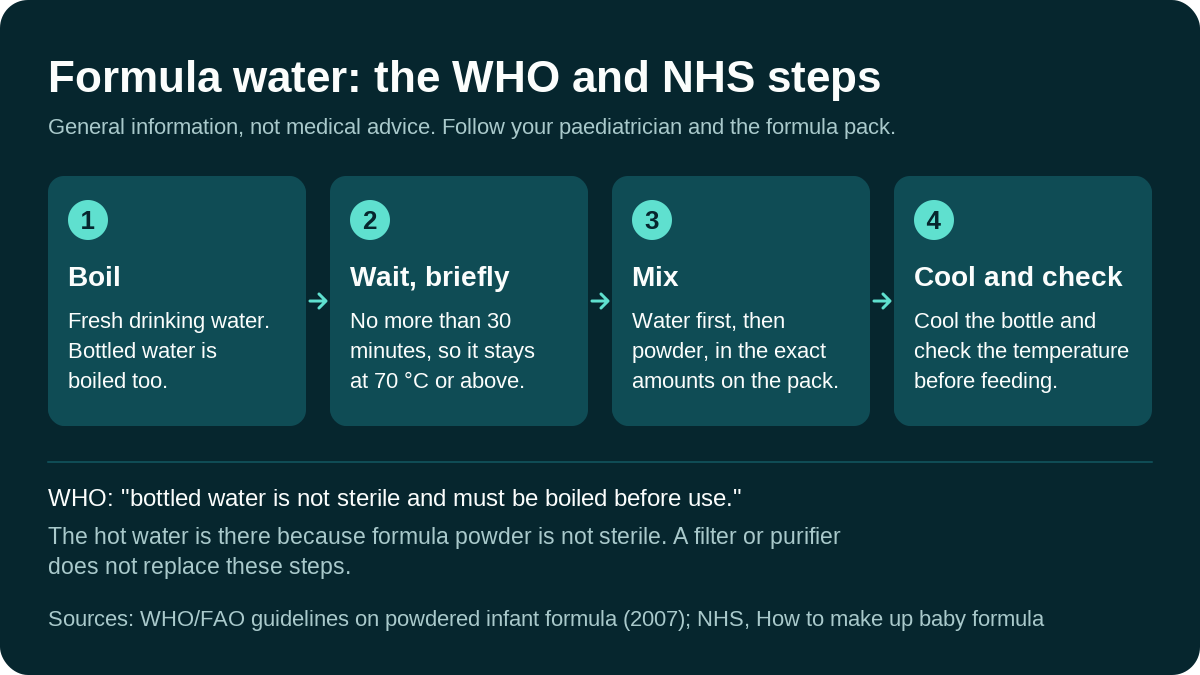
WHO. Its guidelines on powdered infant formula state that the powder "is not a sterile product and may contain harmful bacteria". For preparation at home they say: "Boil a sufficient volume of safe water", then use water "that has been allowed to cool to no less than 70 °C". To stay at that temperature, "the water should be left for no more than 30 minutes after boiling". WHO adds: "bottled water is not sterile and must be boiled before use."
NHS. The steps are the same. Fill the kettle with at least 1 litre of fresh tap water, boil it, then "leave the water to cool for no more than 30 minutes, so that it remains at a temperature of at least 70C". The NHS explains the reason: "Water at 70C or more will kill any harmful bacteria." It also says not to use water that has been boiled before.
CDC. The US guidance is worded differently. CDC says: "Most of the time, it's safe to prepare powdered infant formula by mixing it with tap water", and tells parents to "use water from a safe source". It asks for extra steps for babies younger than 2 months, babies born prematurely and babies with a weakened immune system: "Boil the water and then wait about five minutes before mixing with powdered infant formula."
All three agree on two points. Hot water is used because of the powder, not only because of the water. And the amount of water must be exactly what the pack says: CDC warns that too much or too little water can harm your baby.
Because the water is very hot when mixed, WHO stresses cooling the feed and checking its temperature before feeding, to avoid scalding. The pack and your paediatrician come first.
Tap, bottled or filtered: what changes and what does not
| Water | What the guidance we read says | Still boiled? |
|---|---|---|
| Tap | NHS: "Use freshly boiled drinking water from the tap". CDC: use water from a safe source | Yes, under WHO and NHS guidance |
| Bottled | WHO: not sterile, must be boiled. NHS: may contain too much sodium or sulphate. CDC: safe to use | Yes, under WHO, NHS and Food Standards Agency guidance |
| Filtered | CDC: the water "can be filtered or unfiltered" | No source we read says filtering replaces boiling |
| Artificially softened | NHS: "Do not use artificially softened water" | Not applicable |
Tap water in Dubai. DEWA states that the water it produces and distributes complies with WHO drinking-water guidelines. That statement covers water up to your meter; the building is covered further down.
Bottled water. The NHS says bottled water "is not usually recommended for making up infant formula feeds". That is advice written for the UK. The UK Food Standards Agency, in guidance for travellers, says: "If you are unsure about the tap water, use sealed still bottled water and boil it before using it to prepare the feed."
Filtered water. No official source we read treats a home filter as a substitute for boiling, and we make no claim that any filter makes water suitable for infants. CDC notes that water contaminated with harmful chemicals "cannot be made safe by boiling, disinfecting, or filtering".
Softened water. If your villa has a water softener, note the NHS line above. WHO explains that ion-exchange softening "also increases the sodium (and chloride) content of the drinking-water". Tell your paediatrician that the home has a softener.
Sodium and mineral content: reading a label for infant use
The Food Standards Agency gives figures for the case where natural mineral water is the only option: choose water with sodium below 200 mg/l and sulphate below 250 mg/l, and pick the lowest sodium content available. On a label, look for sodium (Na) and sulphate (SO4) in the mineral analysis.
Waters sold as "baby water" or "low sodium" are still bottled water, so WHO's line on boiling applies. Our page on low sodium water explains what that label means.
Does RO or filtered water still need boiling?
Under the guidance above, yes. The boiling step exists to deliver water at 70 °C or more to a powder that is not sterile. A purifier does not change that. The NHS applies the same test to formula preparation machines: if the water is less than 70C, it says to stop using the machine and follow the step-by-step guide.
Two further points about reverse osmosis water:
- WHO notes that point-of-use reverse osmosis devices "remove virtually all the minerals from the input water". Whether that matters for your baby is a question for your paediatrician, not for us.
- A purifier is not a steriliser.
On alkaline water for baby formula: none of the guidance we read mentions it. Ask your paediatrician before using water with anything added.
Why the building tank matters more than the mains
In most Dubai homes, mains water passes through a storage tank before it reaches the tap. DEWA's published quality figures describe water at the network, up to the meter. After that, Dubai Municipality's guideline makes the building owner responsible, and says "All water tanks should be emptied, cleaned, and disinfected with 50 mg/L of chlorine at least twice a year." A Government of Dubai laboratory factsheet puts it simply: "The quality of the water coming out of the tap depends on how well the water storage tanks are maintained."
Ask your landlord or building management when the tank was last cleaned and whether a laboratory test followed. Our page on cooking, boiling and brushing teeth with Dubai tap water explains what boiling does and does not do, and can you drink tap water in Dubai covers the supply itself.
Next step
If you want to know what is coming out of your own taps, book a free water test. We measure hardness, TDS, disinfectant residual and pH and look at the tank and inlet. It is a screening visit, not a laboratory test for bacteria and not medical advice. Appointments are taken at least 10 days ahead.
Find out what is in your water
The free test measures hardness, TDS, disinfectant residual and pH at your own taps. We supply, install and maintain water treatment systems in every area of Dubai; message us for prices and service details.