Why Dubai homes have a tank at all
The Dubai Building Code (2021 edition) gives the reason in one sentence: potable water storage shall be provided in the building "to protect the building against interruptions to the incoming mains supplies and to enable water supply pressures to be safely maintained". The tank is a buffer.
DEWA's quality figures describe water up to your meter. After it, the tank and pipes are the building's responsibility. For the supply side, see where Dubai's tap water comes from.
The Code describes design requirements. An older villa may have been built to earlier rules, so treat what follows as the current standard to compare your tank against, not a description of every tank in Dubai.
Tank materials compared: GRP, polyethylene and concrete
The Code's basic test applies to every material, steel included: a domestic water tank "shall be manufactured from a material that does not rust or corrode", and the material must not affect the colour, taste or odour of the water or cause any harmful effect to health.
| Material | What the official documents say | Points to check |
|---|---|---|
| GRP (glass-reinforced plastic) | The Code says tanks installed above ground "shall be constructed from pre-insulated GRP". Dubai Central Laboratory runs a certification rule for GRP tanks for drinking water, one-piece and sectional, against BS EN 13280 | For sectional tanks the Code specifies flanges on the outside (base and sides) to simplify cleaning |
| Polyethylene | Dubai Central Laboratory runs a certification rule for one-piece, rotationally moulded, upright cylindrical polyethylene tanks against ASTM D1998. For drinking water only specific material grades are permitted | People often search for a "PVC water tank"; the certification rule we read covers polyethylene. Ask which plastic the tank is made of and for the certificate |
| Concrete | The Code allows raw water tanks to be built of concrete and buried, and says "All concrete tanks shall be lined with a suitable GRP coating or liner" | The lining is what touches the water; its condition matters |
The Code also requires every cold water storage tank to have a laboratory testing certificate stating its suitability for storing drinking water. Whatever the material, ask the seller for that certificate.
What decides the price of a 1000 litre water tank. We do not sell tanks and do not publish tank prices. The price depends on the material, insulation, one-piece or sectional construction, certification, the fittings included and delivery and installation.
What size tank does a villa need?
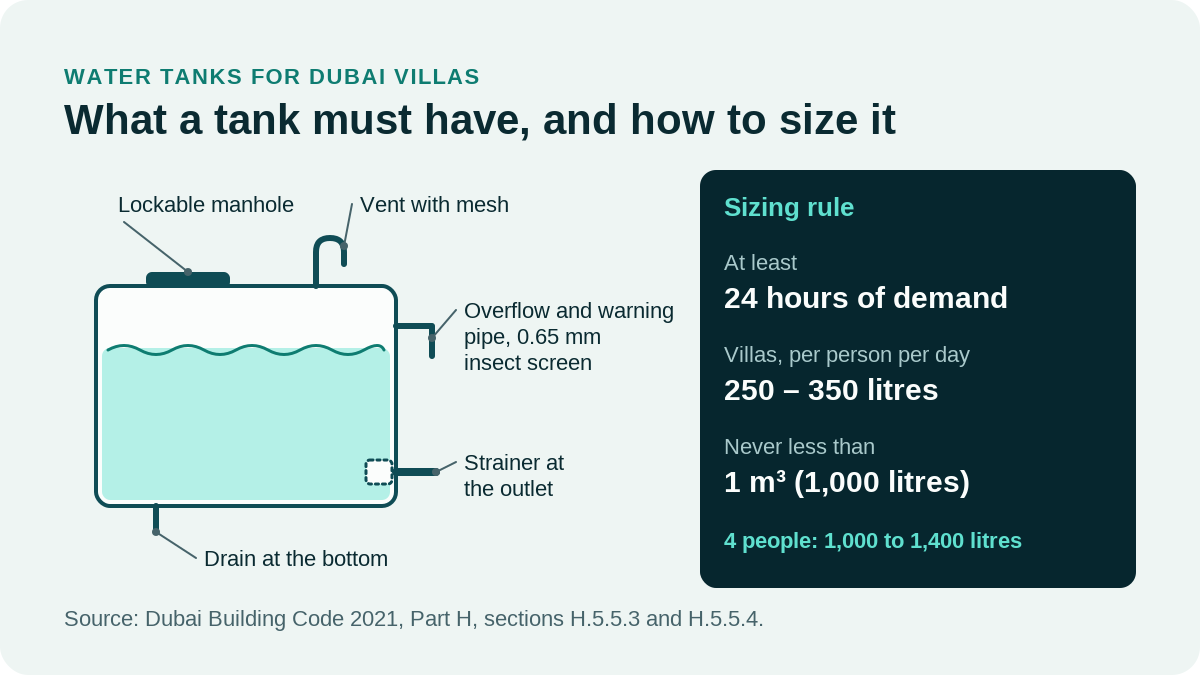
The Building Code sets a floor: tanks "shall be sized based on 24 h demand" from all water connections except firefighting, and "shall be not less than 1 m3", which is 1,000 litres.
For demand, the Code reproduces DEWA's reference consumption rates:
| User category | Litres per person per day |
|---|---|
| Villas | 250 – 350 |
| Residential buildings (flat) | 200 – 300 |
The Code adds that the maximum of each range "should not be used unless justified". These are planning figures for sizing, not measurements of what any household uses.
A simple method. Multiply the number of people by the rate.
- 4 people × 250 to 350 litres = 1,000 to 1,400 litres for one day
So a 1000 litre water tank is the Code's minimum and covers one day for three people at the upper rate or four at the lower rate.
Bigger is not safer. Dubai Municipality's guideline lists "Installing oversized storage tanks that cause stagnation and stratification" among the conditions for microbial growth. Size the tank for the people who live there.
How to calculate water tank capacity in litres. For a rectangular tank, multiply length × width × water depth in metres, then multiply by 1,000. A tank 1.5 m long, 1 m wide and filled to 1 m holds 1,500 litres. For a round tank, multiply 3.14 × radius × radius × water depth in metres, then by 1,000.
Roof tank or ground tank?
The Code notes that it is common in Dubai for buildings to have two storage tanks, one at the incoming main at ground or basement level and one at roof level, and that pressure-boosting pumps have made it possible to omit the roof tank. For location it requires a risk assessment and sets these rules:
- Keep tanks as far as possible from drainage lines, manholes and septic tanks. Drainage pipes must not run above or next to a water tank.
- Above-ground tanks should be in a conditioned space, not exposed to the outdoor climate.
A roof tank standing in the open does not meet that last point. A tank in the sun delivers warm water in summer; see why Dubai tap water is warm in summer and our guide to water tank chillers.
What keeps tank water clean
The Code lists what each tank, or each section of a divided tank, must have. Each item has a job.
| Fitting | Why it is there |
|---|---|
| Lockable manhole, large enough for a person | Access for cleaning; keeps animals, dust and tampering out |
| Vent pipe with a corrosion-resistant mesh | Lets air in and out as the level changes, without insects |
| Overflow pipe, and a warning pipe with a 0.65 mm insect screen | Carries water away if the inlet valve fails, and shows you that it has |
| Drain at the bottom | Lets the tank be emptied completely for cleaning |
The Code also says the tank should be free of sharp corners that collect dirt, and asks for storage to be split into two compartments or two tanks, so one can be cleaned while the other stays in use. Where an overflow or warning pipe cannot be run to a drain, it requires an audible alarm. A water tank level indicator is an optional extra beyond that: it shows how full the tank is, which helps you notice a pump or valve fault early.
Cleaning. Dubai Municipality requires tanks to be emptied, cleaned and disinfected at least twice a year by an approved company, with the lid kept intact and fixed. Who is responsible, what the guideline says and what to ask a cleaning company are covered in water tank cleaning in Dubai.
Where filtration sits: before or after the tank
A filter treats the water that passes through it. It does not clean the tank.
- Before the tank. A sediment filter on the incoming line keeps sand and rust out of the tank, so less settles on the floor between cleanings.
- After the tank. Filtration after the tank and pump treats what the tank adds. This is where our whole-house water filtration for villas is normally discussed, with sediment and carbon stages at the water inlet to the house.
Position matters because of disinfectant. The supply carries a small disinfectant residual that protects stored water, and Dubai Municipality requires that the residual remain sufficient to prevent re-contamination. Carbon ahead of a storage tank can remove that protection where the residual is free chlorine. Where each stage goes is decided at the survey, with the tank in front of us.
Next step
To see what your tank is doing to your water, measure it at the tap. Book a free water test. We measure hardness, TDS, disinfectant residual and pH, make a visual check of the tank and inlet, and give you the results in writing with no obligation. Appointments are taken at least 10 days ahead.
Find out what is in your water
The free test measures hardness, TDS, disinfectant residual and pH at your own taps. We supply, install and maintain water treatment systems in every area of Dubai; message us for prices and service details.