What microplastics are
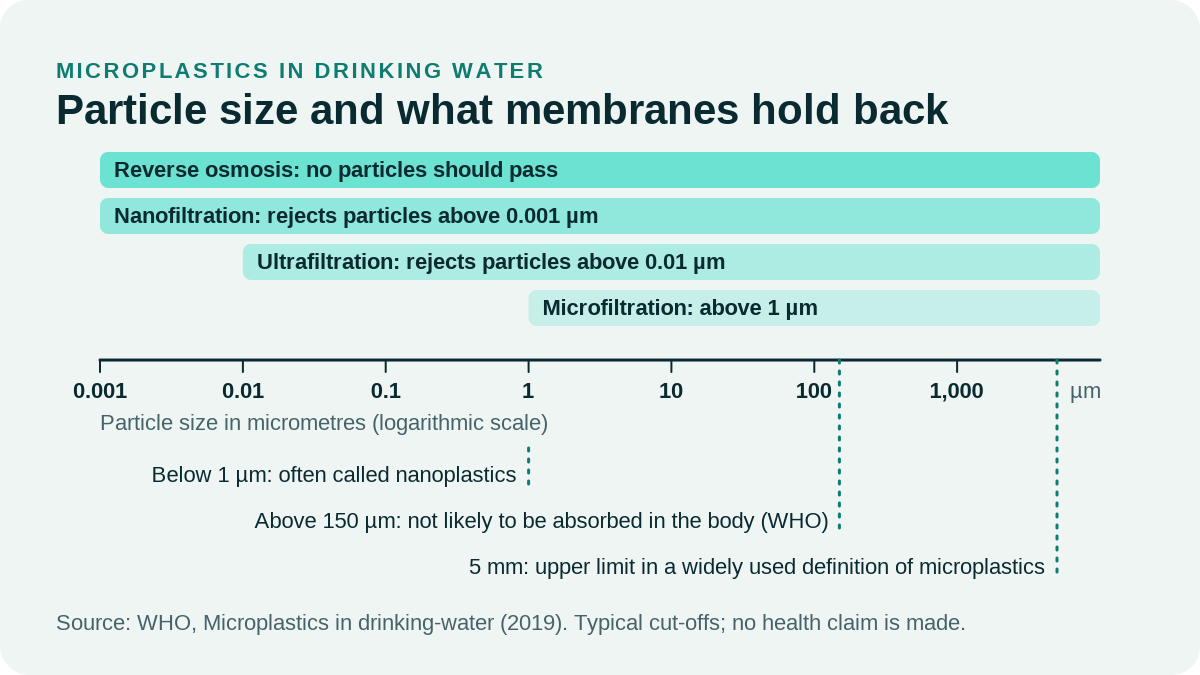
There is no agreed scientific definition. WHO's report says a widely used one "describes microplastics as plastic particles smaller than 5 mm in length", and that particles smaller than 1 micrometre (µm) "are often referred to as nanoplastics". A micrometre is a thousandth of a millimetre.
As a category it is broad: fragments, fibres, film, foam and pellets, in different plastics, sizes and densities. WHO adds that some of the microplastics found in drinking water "may come from treatment and distribution systems for tap water and/or bottling of bottled water".
What studies found in tap and bottled water
WHO states that microplastics have been detected in "drinking-water, both bottled and tap water".
- Few studies, wide range. When WHO wrote its report, only nine studies had analysed drinking water. Counts in individual samples ranged from 0 to 10,000 particles per litre, and mean values from 0.001 to 1,000 particles per litre.
- What was found. Fragments and fibres were the main shapes. The plastics detected most often were polyethylene terephthalate (PET, the usual bottle plastic) and polypropylene.
- Quality of the data. A review commissioned for WHO (Koelmans and colleagues, 2019) assessed fifty studies of microplastics in drinking water and its freshwater sources. Its abstract reports that "only four out of 50 studies received positive scores for all proposed quality criteria".
- Methods decide the count. The smallest particle a study reports depends on its mesh or instrument. A 2024 study in PNAS (Qian and colleagues) used a newer imaging method that detects particles below 100 nanometres. In bottled water from three brands it estimated "about 2.4 ± 1.3 × 10⁵ particles per liter", roughly 240,000, "about 90% of which are nanoplastics".
Because methods and size limits differ so much, the numbers cannot be lined up to say that tap is better than bottled or the reverse.
What WHO says about risk
WHO's 2019 report, "Microplastics in drinking-water", looked at three possible hazards: the particles themselves, chemicals carried by them, and microbes growing on them. Its findings, in its own words:
- Chemicals and microbes. "Based on the limited evidence available, chemicals and microbial pathogens associated with microplastics in drinking-water pose a low concern for human health."
- Particles. On the evidence so far, "firm conclusions on the risk associated with ingestion of microplastic particles through drinking-water cannot yet be determined; however at this point, no data suggests overt health concerns".
- Size. The report says "microplastics greater than 150 µm are not likely to be absorbed in the human body and uptake of smaller particles is expected to be limited". For very small particles including nanoplastics, absorption "may be higher, however the database is extremely limited".
- Monitoring. "Routine monitoring of microplastics in drinking-water is not recommended at this time, as there is no evidence to indicate a human health concern."
WHO also called for better research. In the news release that accompanied the report, its Dr Maria Neira said: "We urgently need to know more about the health impact of microplastics because they are everywhere". A second WHO report in 2022 identified research needs to address the remaining uncertainties, and the authors of the 2024 bottled water study write that the toxicological consequences of real-life exposure "have yet to be determined".
So the honest summary is neither "harmless" nor "harmful". The evidence reviewed by WHO does not show a health concern, and the evidence is limited, most of all for the smallest particles.
How to remove microplastics from water: which filter types hold back particles of that size
A particle is removed by a physical barrier finer than the particle. WHO's report sets out what membranes do:
| Barrier | What WHO's report says |
|---|---|
| Reverse osmosis | A diffusional membrane: "only dissolved substances can diffuse through the membrane; no particles should pass through" |
| Nanofiltration | Typically rejects particles larger than 0.001 µm |
| Ultrafiltration | Typically rejects particles larger than 0.01 µm |
| Microfiltration | Typically rejects particles larger than 1 µm |
WHO notes that these cut-offs "are far below the size of microplastics that have been detected in drinking-water to date", so particles above them should not pass "unless the membranes are damaged".
For home devices, three points from sources we read:
- A laboratory study of point-of-use devices (Cherian and colleagues, 2023) tested three pour-through filters with PVC and PET fragments. The two devices that included a membrane showed, in the abstract's words, "78–86% and 94–100% removal values for PVC and PET fragments, respectively". The device with only granular activated carbon and ion-exchange resin "resulted in a greater number of particles in its effluent when compared to the influent". This is one study of three devices.
- Certification exists. NSF's listings for drinking water treatment units include a "Microplastics Reduction" claim under NSF/ANSI 401. If a product is sold as a microplastic filter, that is the claim to look for.
- Micron ratings. A sediment filter holds back particles larger than its rating, and an absolute rating means more than a nominal one. Carbon granules and softener resin are not particle barriers.
One caution from WHO applies to all treatment: many membranes and ion-exchange resins are themselves made of polymers, and wear "might release low quantities of microplastics into water". That is a reason to change cartridges on schedule; see water filter cartridges.
An under-sink RO water purifier is the household system with the finest barrier. We do not claim a health benefit from removing particles, because WHO's assessment does not support one.
What is not known for Dubai
We found no published measurement of microplastics in Dubai's mains water. DEWA's water quality table, in its Sustainability Report 2024, lists more than forty parameters and microplastics is not among them. There is no local figure to quote.
What is known is the route the water takes. Dubai's supply is desalinated seawater. DEWA's 2025 statistics give its installed capacity as 427 million imperial gallons per day by multi-stage flash distillation and 68 by reverse osmosis. WHO's reasoning about membranes applies to the reverse osmosis share. After the plant, the water travels through the network and your building's tank and pipes, and we found no published particle counts for those stages either. We do not guess in either direction. The standards the supply is held to are explained in Dubai drinking water standards.
To compare bottles with a purifier on cost, use the bottled water vs home purifier calculator.
Next step
A water test does not count microplastics; that needs a specialist laboratory. It does tell you what your tap water carries day to day. Book a free water test. We measure hardness, TDS, disinfectant residual and pH at your taps, check the tank and inlet, and give you the results in writing with no obligation. Appointments are taken at least 10 days ahead.
Find out what is in your water
The free test measures hardness, TDS, disinfectant residual and pH at your own taps. We supply, install and maintain water treatment systems in every area of Dubai; message us for prices and service details.