First, what this page is and is not
Dr Water Lab is a water treatment business. We can tell you what is in your water and what a filter changes. We cannot diagnose or treat a skin condition. Eczema, also called atopic dermatitis, is a medical condition managed under a doctor's guidance. Nothing here is medical advice.
To be confirmed
What the research says
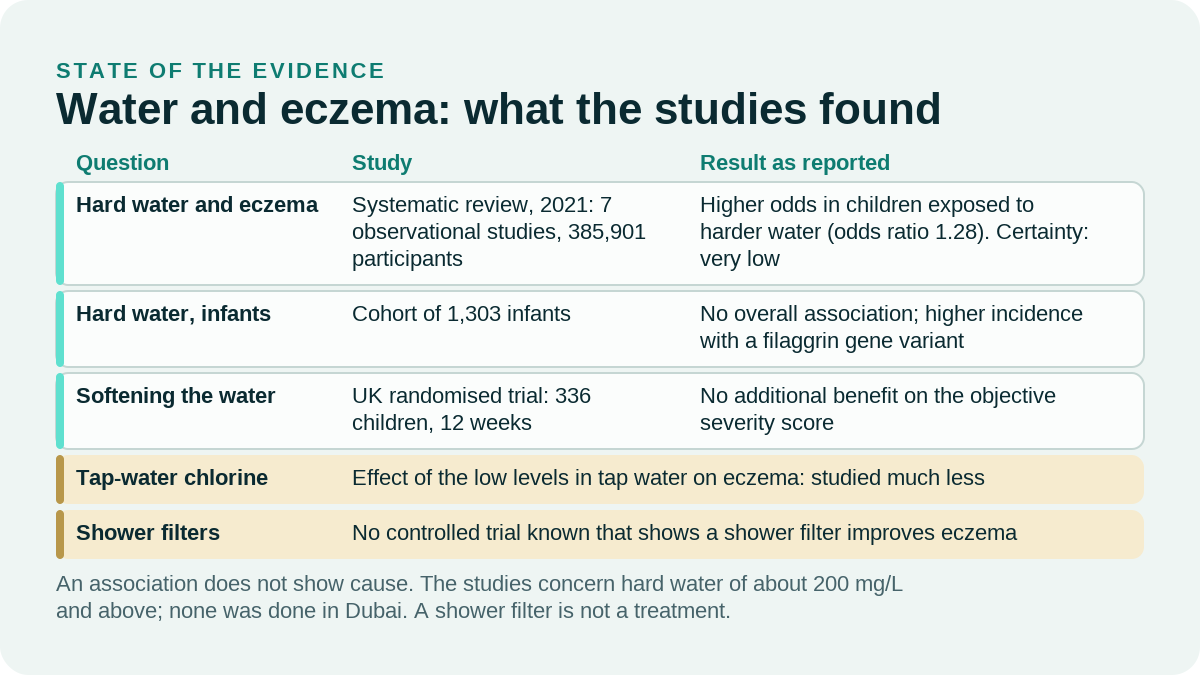
The studies below are peer-reviewed. They concern hard water, of about 200 mg/L and above. None was done in Dubai.
- Hard water and eczema. A 2021 systematic review pooled seven observational studies (385,901 participants) and found higher odds of atopic eczema in children exposed to harder water (odds ratio 1.28), rating the certainty of that evidence very low. An association does not show cause. A cohort of 1,303 infants found no overall association, but a higher incidence in infants with a filaggrin gene variant.
- Softening water. A UK randomised trial of 336 children with moderate or severe eczema in hard-water areas compared an ion-exchange softener plus usual care with usual care alone for 12 weeks, and found no additional benefit on the objective severity score. The 2021 review, pooling two trials, found no evidence that softeners improve objective severity in established eczema. Prevention has only been tested in a feasibility pilot.
- Chlorine. Chlorine is an irritant at high concentrations, as swimmers with sensitive skin know. Whether the low levels in tap water affect eczema has been studied much less. For chlorine dioxide, the US agency ATSDR calls the data on skin exposure extremely limited and located no reports of adverse effects in humans. Source to be confirmed
- Shower filters. We know of no controlled trial showing that a shower filter improves eczema. Source to be confirmed
Put simply: there are plausible reasons why water might matter for sensitive skin, there are many personal accounts, and there is no solid proof that changing the water helps. Anyone who tells you a filter will clear eczema is going beyond what is known.
How chlorine and hard water might affect skin
These are suggested mechanisms, not established causes.
Disinfectant. Chlorine and chlorine dioxide are oxidising disinfectants. We make no claim either way about their effect on skin at tap-water levels.
Hard water. The effects of hard water on skin are mostly indirect. Calcium and magnesium react with soap to form a residue that is harder to rinse away, and people tend to use more soap or shampoo to get a lather. More cleanser and more residue can both irritate sensitive skin. Tap water is often slightly alkaline, while skin is naturally slightly acidic. So can hard water cause dry skin? It may contribute for some people. It has not been shown to cause skin disease.
Water temperature and time. Long, hot showers dry the skin whatever the water contains. In Dubai's summer the cold tap often runs warm, which makes cool showers hard to manage. See why Dubai tap water is warm in summer.
DEWA's published table for the water it supplies lists chlorine dioxide as the disinfectant (typical 0.44, with no free chlorine figure) and a typical total hardness of 61.3. These are 2023 averages at the network, as published, not readings at your tap. Taken as mg/L of calcium carbonate, 61.3 is at the soft / moderately hard boundary on the US Geological Survey scale: not hard, and far below the levels in the eczema studies. The climate matters as well, and many people who search for "eczema Dubai water" are dealing with several changes at once. Our guide for newcomers, new to Dubai: what the water does to hair and skin, covers these.
What a shower filter does and does not change
| Shower filter | |
|---|---|
| Free chlorine | Reduced, while the cartridge is within its life |
| Chlorine dioxide (DEWA's published residual) | Untested; no certification covers it |
| Sediment | Some is caught |
| Hardness (calcium, magnesium) | Unchanged |
| Soap residue caused by hardness | Unchanged |
| Water pH | Not meaningfully changed |
| Bacteria | Not removed; a filter is not a disinfection device |
A shower filter works at one outlet and does not address hardness. The explanation is in do shower filters remove hard water.
One further point for sensitive skin: a cartridge left in place past its life is damp, warm and no longer protected by disinfectant. Change it on schedule. See how to install a shower filter and when to change the cartridge.
When to see a doctor
See a GP or dermatologist, and do not rely on a filter, if:
- a rash is new, spreading or not improving after a couple of weeks
- skin is cracked, weeping, crusted or painful, which can mean infection
- itching disturbs sleep
- a baby or young child is affected
- your usual treatment has stopped working
- you are thinking of stopping a prescribed treatment because you have fitted a filter. Please do not.
If you want to try a shower filter
Trying one is low in risk, as long as expectations are modest and medical care continues.
- Test the water first. If the disinfectant residual at your shower is already very low, a filter has little to act on. We measure it, along with hardness, at no charge; a standard chlorine test kit also responds to chlorine dioxide and cannot tell the two apart.
- Choose on evidence, not on labels. There is no best shower filter for eczema as a product category. Look for certified free chlorine reduction, a sediment layer and a stated capacity, and avoid filters that add fragrance, "vitamin" scents or essential oils to the water, since added ingredients are a possible irritant. The buying criteria are in our guide to the best shower filter in UAE.
- Change one thing at a time. Keep the same cleanser, moisturiser and treatment for four weeks. If you change everything together, you learn nothing.
- Keep a simple record. Note itch and dryness each day.
- Decide honestly. If there is no difference after a month, the filter is not helping your skin, and it is fine to stop.
For villa owners
If you own a villa, treatment at the inlet covers every tap and shower: sediment and carbon filtration, and a softener if the test shows hardness worth treating. It is a bigger step, and the trials found no objective benefit from softening for eczema, so we would not suggest it for that reason. Our shower filters in Dubai page describes the smaller, removable option.
Next step
Knowing your disinfectant residual and hardness tells you whether a filter has anything to work on. Book a free water test. We give you the results in writing, with no obligation. Appointments are taken at least 10 days ahead.
Find out what is in your water
The free test measures hardness, TDS, disinfectant residual and pH at your own taps. We supply, install and maintain water treatment systems in every area of Dubai; message us for prices and service details.