Why this guide to the best water purifier in UAE does not rank brands
Dr Water Lab sources and fits purifiers. We are not a neutral reviewer, so a ranked list from us would be an advert. What we can do honestly is explain how to choose, so you can check any quote, including ours, against the same list.
1. Test the water first
A purifier removes specific things. Until you know which of them are in your water, you cannot tell whether a machine is too little, too much, or aimed at the wrong problem.
The useful numbers at the kitchen tap are:
- TDS (total dissolved solids): the dissolved salts and minerals. See what is TDS in water.
- Disinfectant residual: an indication only, because a standard chlorine test kit also responds to chlorine dioxide and cannot tell the two apart.
- Hardness: calcium and magnesium, the cause of scale.
- pH.
A look at the building's tank and inlet matters too. Water that leaves the mains in good condition can pick up sediment in a tank or old pipework. DEWA's typical figures for the water it supplies to the network (2023 averages; no units printed, conventionally mg/L) are TDS 216, total hardness 61.3 and chlorine dioxide 0.44; it publishes no free chlorine figure. They describe water up to the meter, not at your tap.
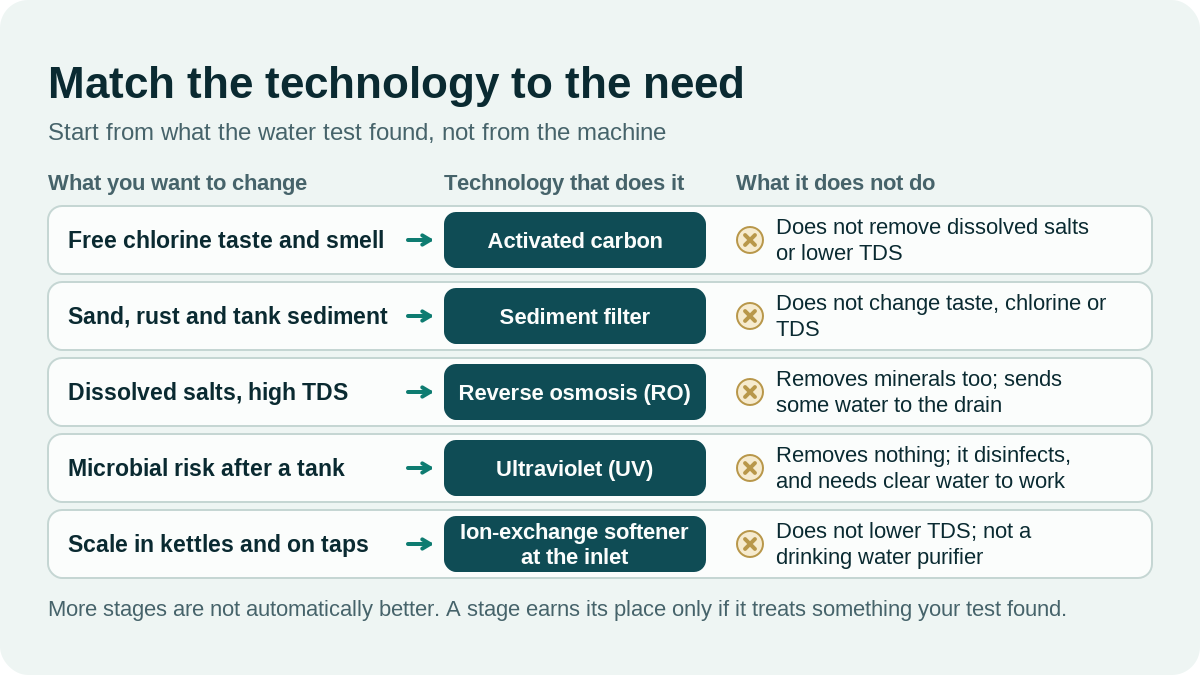
2. Match the technology to the need
| What you want to change | Technology that does it | What it does not do |
|---|---|---|
| Free chlorine taste and smell | Activated carbon | Does not remove dissolved salts or lower TDS; untested for chlorine dioxide |
| Sand, rust and tank sediment | Sediment filter | Does not change taste, chlorine or TDS |
| Dissolved salts, high TDS | Reverse osmosis (RO) | Removes minerals too; sends some water to the drain |
| Microbial risk after a tank | Ultraviolet (UV) | Removes nothing; it disinfects, and needs clear water to work |
| Scale in kettles and on taps | Ion-exchange softener at the inlet | Does not lower TDS; not a drinking water purifier |
Most under-sink purifiers combine several of these in stages. A stage earns its place only if it treats something your test found. See 3-stage, 5-stage and 7-stage filters.
If your TDS is already low and the complaint is taste, a carbon-based filter may be all you need. If you want lower TDS, you need an RO water purifier. RO water can taste flat, which is why many systems add a remineralisation stage; see how to add minerals back to RO water.
3. Look for certification, and read what it covers
Independent certification tells you a claim was tested by someone other than the seller. The NSF/ANSI standards are the ones most often quoted on purifiers:
| Standard | Title | Example claims listed under it |
|---|---|---|
| NSF/ANSI 58 | Reverse Osmosis Drinking Water Treatment Systems | TDS reduction |
| NSF/ANSI 42 | Drinking Water Treatment Units, Aesthetic Effects | Chlorine reduction, chloramine reduction |
| NSF/ANSI 53 | Drinking Water Treatment Units, Health Effects | Lead reduction and other named contaminants |
| NSF/ANSI 55 | Ultraviolet Microbiological Water Treatment Systems | UV disinfection performance |
Three checks keep you from being misled:
- Certified, or "tested to"? "Tested to NSF standards" or "NSF-grade materials" is not certification. Ask for the listing and look the model up in the certifier's public database.
- Whole system, or one part? A certified membrane inside an uncertified housing is a component claim, not a system claim.
- Which claims? Certification covers only the contaminants listed on that model's certificate. A system certified for chlorine taste is not thereby certified for lead.
Certification is voluntary. A purifier without it is not necessarily poor, but you are then relying on the seller's word.
4. Capacity and flow
Two figures matter. Daily output is how much purified water the system can make in a day. Flow at the tap is how fast a glass or a pot fills.
Tank-based RO systems fill a small storage tank slowly and deliver from it quickly, until the tank runs low. Tankless systems make water on demand and need electricity. Count drinking, cooking, tea and coffee, and any pets or baby feeds. Membrane output is usually rated under standard test conditions, so real output at home can differ; ask for the figure under your pressure.
5. Filter cost per year
The purchase price is one payment. Filters are every year. Before you buy, write down:
- each cartridge in the system, and how often the manufacturer says to change it
- the price of each cartridge, bought locally
- whether changes are do-it-yourself or need a technician, and what a visit costs
Add it up for one year, then for five. A cheap machine with costly or hard-to-find cartridges is often the dearer choice. More on this in water purifier prices in UAE.
6. Waste water
RO works by pushing water through a membrane and flushing the rejected salts to the drain. The US Environmental Protection Agency says a typical point-of-use RO system sends five gallons or more to the drain for every gallon it treats, and that systems carrying its WaterSense label must send 2.3 gallons or less. Those are US figures for the general market, but the question to ask is the same anywhere: what is this model's drain-to-product ratio, and is it measured or estimated.
7. Service availability
A purifier is only as good as its last filter change. Ask who will change the cartridges, how quickly a leak or fault is attended, whether parts are held in the UAE, and what the warranty covers in writing.
8. Tenant or owner
- Tenants and apartments: choose equipment that fits under the sink with its own small tap and comes out again when you leave. Nothing should be fitted to shared plumbing. See water filters for apartments and renters.
- Villa owners: you can treat the whole house at the inlet and keep a purifier in the kitchen for drinking.
Best water purifier for home: a short checklist
- Water tested, with results in writing
- Technology matches what the test found
- System-level certification you have looked up yourself
- Daily output and tap flow enough for your household
- Filter cost per year known before purchase
- Drain ratio stated for RO
- Local service, parts and a written warranty
- Removable if you rent
Next step
Find out what your water contains before you compare machines. Book a free water test. We measure hardness, TDS, disinfectant residual and pH at your taps, check the tank and inlet, and give you the results in writing with no obligation. Appointments are taken at least 10 days ahead.
Find out what is in your water
The free test measures hardness, TDS, disinfectant residual and pH at your own taps. We supply, install and maintain water treatment systems in every area of Dubai; message us for prices and service details.