Which hardness setting to choose in Dubai
Capsule and bean-to-cup machines ask for your water hardness so they know how often to prompt you to descale.
Manuals give the setting as a table of hardness ranges, usually in German degrees (°dH) or French degrees (°fH). DEWA publishes hardness as a plain number, conventionally mg/L as calcium carbonate, so it has to be converted.
| Unit | Definition | DEWA's 61.3 converted |
|---|---|---|
| mg/L as calcium carbonate (ppm) | The unit utilities usually publish | 61.3 |
| French degrees (°fH) | 1 °fH = 10 mg/L calcium carbonate | about 6.1 |
| German degrees (°dH) | 1 °dH = 17.848 mg/L calcium carbonate | about 3.4 |
To put 3.4 °dH in context: Germany's law on detergents and cleaning agents classes water up to 8.4 °dH (1.5 millimoles of calcium carbonate per litre) as soft. Dubai's published figure is well inside that band. On the US Geological Survey scale it sits at the boundary between soft and moderately hard; see is Dubai water hard.
Two cautions about the figure itself:
- It is an average of station averages for 2023, for water at the network. DEWA's table prints no units; we treat 61.3 as mg/L as calcium carbonate by convention.
- DEWA's own specification for total hardness is 40 to 120, so the supply can vary within that range. At 120, the conversion gives about 6.7 °dH or 12 °fH, which is still within the soft band above.
So the practical answer: open the manual, find the hardness table, and pick the level whose range includes about 3 to 7 °dH (6 to 12 °fH). Scales differ between makers, so we do not name a level number.
Why your own tap can differ: test strips
Many machines come with a water hardness test strip. It is worth using, for two reasons.
- Your water has been through a tank and pipes. DEWA's figure describes the network, not your kitchen.
- Your villa may have a softener. Softened water reads at or near zero hardness, and the machine should be set to its lowest level.
Follow the instructions printed with the strip: dip it in cold tap water for the stated time, wait as long as it says, and count the fields that have changed colour. A TDS meter cannot stand in for it: TDS counts everything dissolved, and hardness is only the calcium and magnesium part. See what is TDS.
TDS and coffee taste: the best TDS for coffee
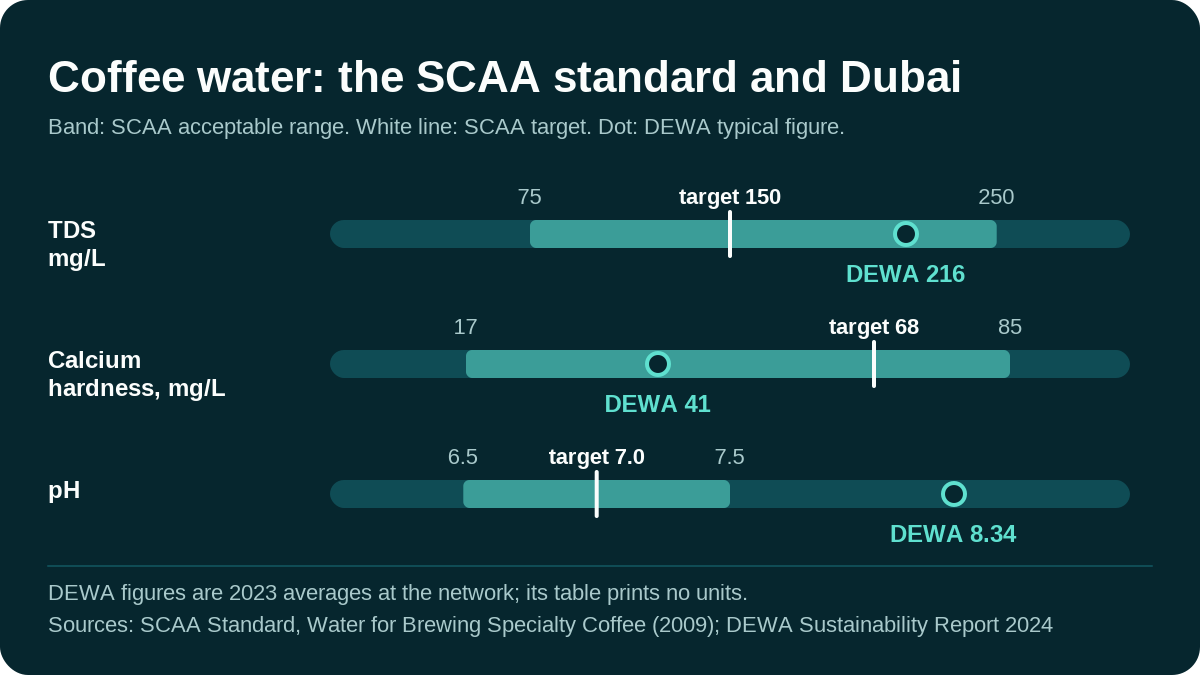
The one published standard we can quote is from the Specialty Coffee Association of America (SCAA), "Water for Brewing Specialty Coffee" (2009):
| Characteristic | SCAA target | SCAA acceptable range | DEWA typical figure, as published |
|---|---|---|---|
| TDS | 150 mg/L | 75 – 250 mg/L | 216 |
| Calcium hardness | 4 grains or 68 mg/L | 1 – 5 grains, or 17 – 85 mg/L | 41 |
| Total alkalinity | 40 mg/L | At or near 40 mg/L | 51.4 (M-alkalinity) |
| pH | 7.0 | 6.5 to 7.5 | 8.34 |
| Sodium | 10 mg/L | At or near 10 mg/L | 51.20 |
| Total chlorine | 0 mg/L | 0 mg/L | Not listed; DEWA reports chlorine dioxide, 0.44 |
| Odour and colour | Clean, fresh, odour free; clear |
The SCAA figures are a taste standard for coffee professionals, not a safety standard, and anything within the range meets it. DEWA's figures are network averages with no units printed. With those limits, the comparison says this:
- TDS and calcium hardness of Dubai's supplied water fall inside the SCAA acceptable ranges. So the best TDS for coffee, by this standard, is a target of 150 mg/L, and Dubai's published 216 is within the accepted 75 to 250.
- pH and sodium are above the SCAA ranges, and alkalinity is somewhat above its target.
- Disinfectant. The standard asks for no chlorine. Dubai's water carries a chlorine dioxide residual. No household filter is certified for reducing chlorine dioxide, so we do not claim that a filter fixes this.
On TDS and calcium hardness, then, Dubai's supplied water is within what this standard accepts as coffee brewing water, and on pH, sodium and disinfectant it is not. If your coffee tastes flat or dull, the water is one thing to look at, after the beans and the grind.
Does RO water work in a coffee machine?
It works, but plain reverse osmosis water is not ideal.
- It is below the SCAA range. The US EPA's WaterSense specification requires certified RO systems to reduce TDS by at least 75 percent. A quarter of 216 is 54, already under the SCAA lower bound of 75, and many systems remove more.
- The World Health Organization (WHO) notes two things about very low-mineral water: it "may also be unacceptable because of its flat, insipid taste", and "it is also often corrosive to water-supply systems".
- It will not scale the machine. That is the appeal.
The middle route is RO water with minerals put back. A remineralisation stage after the membrane raises TDS and hardness a little, which is what the under-sink purifiers we fit include. Measure the result with a TDS meter and the hardness strip and set the machine to what you find. See how to add minerals back to RO water.
On alkaline water for coffee: the SCAA standard targets a neutral pH of 7.0 and an alkalinity near 40 mg/L. Water sold as alkaline moves away from both.
Coffee maker water filters
Some machines take a small filter cartridge in the water tank. They are spent after a set volume, so change them when the maker says, and check the manual for the hardness setting to use while one is fitted. As with any carbon filter, certification covers free chlorine, not chlorine dioxide.
Descaling: how often in Dubai
Follow the machine's prompt. That is what the hardness setting is for. With water near DEWA's published hardness, the prompt comes less often than it would in a hard-water city, but it still comes. Any water with dissolved minerals leaves some deposit where it is heated, which is why a kettle collects scale even when the water is not hard.
WHO puts the level at which scale becomes a general problem much higher: "a hardness above approximately 200 mg/l may cause scale deposition" in pipework and tanks. Dubai's published figure is under a third of that.
Use the descaling product your machine's maker specifies, and rinse as instructed. For kettles, taps and shower glass, see how to remove limescale.
Next step
If you would like the hardness and TDS of your own tap measured properly, book a free water test. We measure hardness, TDS, disinfectant residual and pH at your taps, check the tank and inlet, and give you the results in writing with no obligation. Appointments are taken at least 10 days ahead.
Find out what is in your water
The free test measures hardness, TDS, disinfectant residual and pH at your own taps. We supply, install and maintain water treatment systems in every area of Dubai; message us for prices and service details.