What "sweet water" means in the UAE
"Sweet water" is an everyday name for fresh water. A UAE business directory that has a whole category called "Sweet Water Supply" describes it as "commonly referred to as fresh or potable water". Several of the tanker companies listed there also offer salt water, which is the other half of the trade: salt water for uses that do not need fresh water, sweet water for those that do.
We found no official UAE definition of the term. Dubai Municipality's guideline speaks of "unbottled drinking water". Abu Dhabi's Department of Energy speaks of "drinking and non-drinking water". So "sweet" tells you the water is sold as fresh. It is not a quality grade, and it does not tell you the source.
The contrast with salty water is real in this country. DEWA reports that the groundwater in its own emergency wells has an average TDS of "more than 1,000 mg/L (i.e. 1,500 mg/L precisely)", against a typical 216 for the desalinated water it supplies (2023 average at the network, units not printed). See where Dubai's tap water comes from.
Who uses tanker water
Tanker water fills the gap wherever a pipe does not reach or does not deliver enough:
- homes and farms that are not connected to the mains
- construction sites and temporary camps
- swimming pools, landscaping and events
- buildings during a supply interruption or after a tank has been drained for cleaning
If you live in a villa or apartment with a DEWA water account, you are on mains water and this page is background. If a tanker fills your tank, the rest of it matters to you.
Is tanker sweet water the same as DEWA water?
It can start as the same water. It is not the same service.
What the rules say in Dubai. Dubai Municipality's Technical Guidelines for Quality of Unbottled Drinking Water has a section on tankers. Among its requirements:
- Tanker trucks for drinking water must meet the UAE standard "Vehicles – Requirements in Tankers for Transportation of Drinking Water", UAE.S GSO 2025-2010.
- Vehicles "must be licensed by the competent authority", and the operator needs permits to provide the service.
- "Do not fill tankers from sources other than approved filling stations."
- "Do not use drinking water tankers for any other purpose to prevent cross contamination."
- Drinking water signs must be shown clearly on the tanker in Arabic and English.
- Filling stations keep records for each tanker, including "water source and destination".
- The operator must "Ensure that no water contamination occurs during filling, transportation and unloading."
Abu Dhabi has its own rules. The Department of Energy announced a Tankering Regulation in October 2020 that covers tankers "intended for both drinking and non-drinking water" and bans "interchangeable tankers to avoid any cross-contamination between drinking water, non-drinking water and wastewater."
What differs from mains water.
| Mains water (DEWA) | Tanker sweet water | |
|---|---|---|
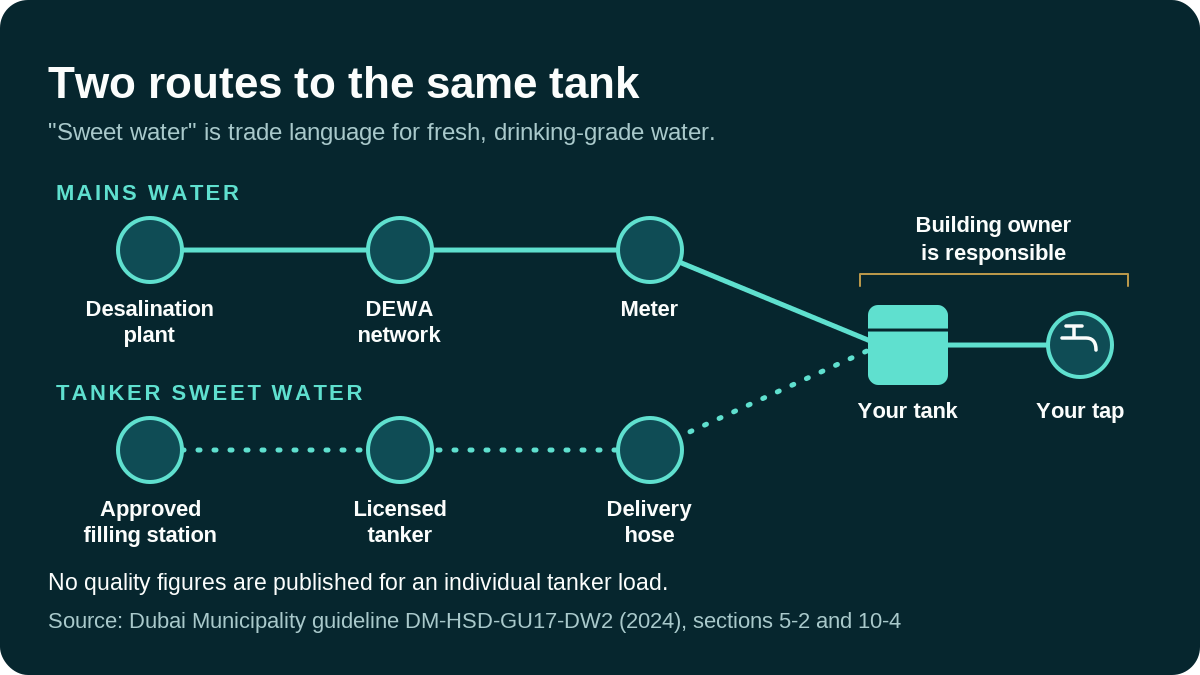
| How it arrives | Sealed network to your meter | Filling station, then a road tanker, then a hose into your tank |
| Who answers for it on the way | DEWA, up to the meter | The licensed tanker operator and filling station |
| Published quality figures | Yes, yearly network averages | None for an individual load |
| What you can check | Your bill and DEWA's reports | The tanker's drinking water sign, permit and filling-station receipt |
| From the tank onward | Building owner | Building owner |
We make no claim about the quality of any tanker company's water. The point is narrower: with mains water there is a published figure to compare your tap against, and with tanker water there is not. A delivery adds two steps, a vehicle and a hose connection, where cleanliness depends on the operator on the day.
Storing tanker water: tank hygiene
Tanker water always passes through your tank, and the tank rules are the same whoever fills it. Dubai Municipality's guideline makes the building owner responsible for water quality in the building "until it reaches its users", and requires that "All water tanks should be emptied, cleaned, and disinfected with 50 mg/L of chlorine at least twice a year."
Three points matter more with tanker supply:
- The filling point. The hatch or inlet is opened at every delivery. Keep the cover intact and fixed, and keep the area around it clean. The guideline also asks consumers to "Provide suitable water connections".
- Tank size. Buying in bulk tempts people to store a lot. The guideline lists "Installing oversized storage tanks that cause stagnation and stratification" among the things that support microbial growth. Size deliveries to what you use.
The cleaning rules, who may clean a tank and how to check it are in water tanks: cleaning and filtration.
Filtering tanker water: why a test comes first
With mains water you can start from DEWA's published figures. With tanker water there is no starting point, so measure before you buy anything.
- TDS. A reading near the mains figure suggests desalinated water. A reading several times higher suggests a saltier source, and only reverse osmosis lowers dissolved salts. A handheld meter is enough for this first check; see how to use a TDS meter.
- Hardness. DEWA's supplied water is not hard, at a typical 61.3. Water from another source may be. A softener is only worth fitting when a test shows hardness worth treating. See is Dubai water hard.
- Sediment. A delivery can stir up whatever has settled in the tank. A sediment stage at the inlet is the usual first step of whole-house filtration.
- Bacteria and metals. No home meter measures these. If you drink tanker-supplied water, an accredited laboratory test is the right check. Dubai Municipality's guideline requires buildings to have drinking water laboratory-tested every six months.
A filter does not make an unknown supply acceptable by itself. The order is: know the source, keep the tank clean, test, then treat what the test finds.
Next step
If your tank is filled by tanker, or you have just moved into a home and do not know its water history, start with measurements. Book a free water test. Dr Water Lab measures hardness, TDS, disinfectant residual and pH at your taps, checks the tank and inlet, and gives you the results in writing with no obligation. Our test does not cover bacteria or metals; we will tell you when a laboratory test is the right step. Appointments are taken at least 10 days ahead.
Find out what is in your water
The free test measures hardness, TDS, disinfectant residual and pH at your own taps. We supply, install and maintain water treatment systems in every area of Dubai; message us for prices and service details.